

Streamline to improve efficiency.
In recent days, the sports sector has also witnessed significant changes in its organizational structure, moving towards a lean, efficient, and powerful approach to ensure effectiveness, efficiency, and performance.

Following the Ministry of Culture, Sports and Tourism's Decision on the Regulations on the functions, tasks, powers, and organizational structure of the Vietnam Sports Department effective March 11, 2025, the Vietnam Sports Department now has only one High-Performance Sports Division. Previously, the Vietnam Sports Department had two units managing and advising on high-performance sports: High-Performance Sports Division 1 and High-Performance Sports Division 2. In fact, before 2014, the sports sector only had one High-Performance Sports Department. In 2014, this was further divided into two departments: High-Performance Sports Department 1 (later transformed into High-Performance Sports Division 1) and High-Performance Sports Department 2 (later transformed into High-Performance Sports Division 2). Those within the sector were already familiar with the previous organizational structure, so they readily accepted the recent changes.
According to insiders, regardless of the organizational structure, the role of advising the leaders of the Vietnam Sports Department must remain effective, thereby clarifying the direction for high-performance sports nationwide. Most importantly, the effectiveness of this must be demonstrated in the future. Meanwhile, from March 11, 2025, a series of former National Sports Training Centers will also be renamed with clearer functions and responsibilities. Specifically, the Hanoi National Sports Training Center has been renamed the National High-Level Athlete Training Center. The Ho Chi Minh City National Sports Training Center has been renamed the National Sports Training Center. The Da Nang National Sports Training Center has been renamed the National Youth Athlete Training Center. All these changes bring expectations of positive changes in the future as everyone's roles and responsibilities become clearer.
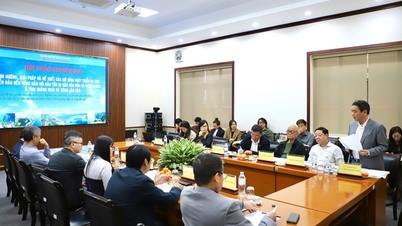
This also provides a basis for hoping for a breakthrough and a strong rise of Vietnamese sports in the Olympic and ASIAD arenas – an issue that has been discussed for a long time and seems to have no solution yet. It is no coincidence that in the past nearly three years, the sports sector has organized many seminars related to developing performance at the Olympic and ASIAD Games. Also on March 28th, the Vietnam Sports Department will organize a seminar to gather feedback on the program for developing key sports in preparation for the Olympic and ASIAD Games from 2026-2046. At this seminar, the application of science and technology to training and competition will be discussed extensively, considered a breakthrough point for Vietnamese sports.
Resources are required.
Hoang Quoc Vinh, Head of the High-Performance Sports Department (Vietnam Sports Administration), once shared that the performance of Vietnamese athletes in upcoming Olympic Games and Asian Games is always a difficult problem for Vietnamese sports. Professionals and managers truly do not want to see inconsistent and fluctuating results at the Olympics and Asian Games. Looking back at the achievements of the two most recent Asian Games, Vietnamese athletes won 7 gold medals, including 4 in 2018 and 3 in 2023. However, in the Olympic arena, the performance of Vietnamese sports is not truly stable. At the 2016 Olympics, Vietnam won 1 gold and 1 silver medal in shooting, ranking 48th overall. But in the two most recent Olympics (Tokyo 2020 Olympics and Paris 2024 Olympics), the Vietnamese sports delegation came away empty-handed, not winning any medals.
Therefore, the Strategy for the Development of Vietnamese Sports and Physical Education until 2030, with a vision to 2045, issued by the Government, addresses the core issues and goals of Vietnamese sports in the coming years, including ensuring progress at these Games. Accordingly, by 2030, Vietnamese sports will consistently maintain a position in the top 3 at the SEA Games and in the top 20 at the Asian Games and ASIAD (winning 5 to 7 gold medals); and win medals at the Olympic and Paralympic Games. The orientation towards 2045 is for high-performance sports to consistently maintain a position in the top 2 at the SEA Games, in the top 15 at the ASIAD (winning at least 10 gold medals), and in the top 50 at the Olympic Games (winning at least 1 gold medal).
Currently, in commemoration of Vietnam Sports Day, the sports sector has developed a plan to implement the Strategy for the Development of Vietnamese Sports and Physical Education until 2030, with a vision to 2045. This plan identifies 17 sports that will receive priority investment, including swimming, athletics, shooting, gymnastics, weightlifting, fencing, boxing, taekwondo, cycling, badminton, archery, judo, wrestling, rowing (Olympic group) and wushu, sepak takraw, and karate (ASIAD group).
After determining the number of sports, the most important task remains finding resources to invest in athletes in these key sports. This ensures athletes receive superior nutrition and medical care, as well as greater access to the benefits of science and technology in training and competition. Head of the High-Performance Sports Department, Hoang Quoc Vinh, shared that the workshop on March 28th was an opportunity to clarify the application of science and technology, especially artificial intelligence, in athlete training. Most importantly, resources from state funding and social contributions are needed to turn the goals for the upcoming Olympics and ASIAD into reality. Only then will the valuable contributions from these workshops not be wasted, and the workshops not be organized merely for the sake of appearances.
Only then can we hope that the 80th anniversary of Vietnam Sports Day next year will yield positive and concrete results, starting with streamlining and clarifying the functions of the sports sector from today.
The most important task in 2025
The Ministry of Culture, Sports and Tourism has set a task to be completed by 2025: to develop and submit for approval the Program for the Development of Key Sports in preparation for participation in the Olympic Games and ASIAD Games for the period 2026-2046. This is also a step in implementing the Strategy for the Development of Sports and Physical Education in Vietnam until 2030, with a vision to 2045. ( Minh Khue )
Source: https://cand.com.vn/the-thao/tim-loi-vuon-minh-o-olympic-asiad-i763179/
























![[Photo] A vibrant celebration of generations of Nhan Dan Newspaper staff](https://vphoto.vietnam.vn/thumb/1200x675/vietnam/resource/IMAGE/2026/03/11/1773228432744_cb-75-nam-7-7034-jpg.webp)





















































Comment (0)