

 |
| The pair of snake mascots for Hue City in the spring of the Year of the Snake 2025. Photo: Bao Phuoc |
According to legends passed down in Phu Bai village (Huong Thuy town), Ong Dai and Ong Cut were twin brothers whose mother was a human, whose father was a snake god, and who were the grandsons of the wind god. The story goes that a girl in the village had reached marriageable age but was still unmarried. One day, she suddenly found herself pregnant without knowing why. Soon after, while washing her face by the pond, a pair of small snakes crawled from her body, and her belly immediately deflated.
However, according to village custom, she was still to be punished for the crime of having an illegitimate child. Before she was to be brought before the court for trial, a celestial being appeared in her dream and declared: “You were originally from heaven, but you accidentally swallowed two eggs of the Serpent God, the offspring of the Wind God, and were banished to earth to give birth. Now that your time is up, you may return to heaven. Tomorrow, find three yards of red silk and tie them around your waist so the gods will recognize you and take you back.”
Following the dream's prophecy, on her way to the village square, she asked for three yards of red silk and vanished before everyone's eyes. After she left, her father on earth was very sad. One day, while he was dozing off, two children came, claiming to be his grandchildren, and asked to stay with him. Opening his eyes, he saw a pair of small snakes intertwined. Startled by the memory of the past, he cared for the snakes as if they were his grandchildren, taking them with him wherever he went.
While clearing the rice paddies to prepare for planting, he accidentally severed the tail of one of the snakes. From then on, the Long Snake and the Short Snake were distinguished. Because they were descendants of the Wind God, the two snakes often used their magic to change the direction of the wind, helping the villagers travel on the waterways and bringing the necessary rain for the crops. When the old man became weak and passed away, the snakes disappeared. The villagers faced crop failure and famine. Remembering the old story, they collectively revered the two snakes as Mr. Long and Mr. Short and erected their altars in the village temple.
From the above legend, it can be seen that, in the folk consciousness of the Hue region, the Snake God (Ông Dài - Ông Cụt) is a nature deity associated with water (born on the edge of a pond, capable of changing wind direction and creating rain), not only assisting in travel on waterways, but also protecting crops. Sharing this role, Ông Dài - Ông Cụt is also revered and worshipped by the villagers of Bác Vọng Đông at the Hai Ông Lớn temple.
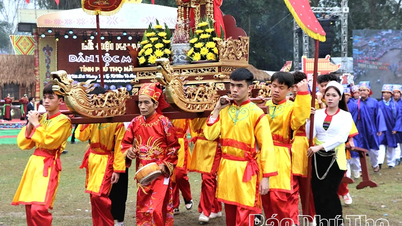
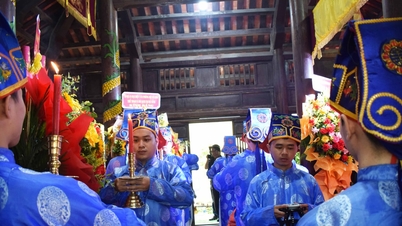
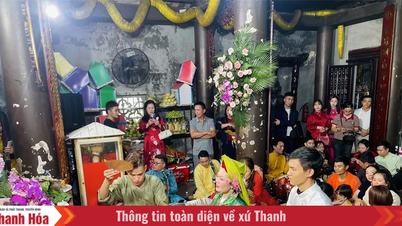
Unlike Ông Dài and Ông Cụt of Phù Bài village, the two Ông Lớn of Bác Vọng Đông village have more unusual personalities. Perhaps this reflects the unpredictability and unpredictability of nature, which makes people both fearful and pleading, especially in a situation where everyone has to "look to the sky, look to the earth, look to the clouds, look to the rain, look to the sun, look to the day, look to the night." From the rituals of Bác Vọng Đông village, it can be seen that the worship of Ông Dài and Ông Cụt is not limited to the village level, but has even been "upgraded" by the State with regulations on offerings, ceremonial music, and especially the presence of local and even central government officials at these ceremonies.
Although snake worship sites in Hue are not as common as those dedicated to tigers, whales, or horses, this is one of the primitive beliefs of the Vietnamese people and shares many similarities with the beliefs of the Muong people, an ethnic group with a common origin with the ancient Vietnamese. The character Khu in Muong mythology, depicted as a large underwater snake, is often compared to Ong Cut and is also associated with agricultural rituals. In particular, the worship of Ong Dai - Ong Cut remains quite prevalent in villages in the Red River Delta, such as: Chan Lac village (Bac Ninh province) worships Ong Dai - Ong Cut in the form of a snake statue in the inner sanctuary of Choa temple; Dai Tu, Cat Dong, and Kim Bai villages (Hanoi) worship Ong Dai - Ong Cut under the names Thien Quan and Ngu Loi; and Van Xa village (Ha Nam province) worships Ong Dai - Ong Cut under the names Cau Mang huynh and Cau Mang de…
Source: https://huengaynay.vn/van-hoa-nghe-thuat/thong-tin-van-hoa/tin-nguong-tho-ran-vung-hue-150497.html

![[Photo] Prime Minister Pham Minh Chinh receives the Chinese Ambassador to Vietnam](https://vphoto.vietnam.vn/thumb/1200x675/vietnam/resource/IMAGE/2026/04/05/1775397481797_ndo_br_dsc-5512-jpg.webp)






























































Comment (0)