

According to the draft amendments to several articles of the 2024 Land Law, prepared by the Ministry of Agriculture and Environment , one of the notable contents is the proposal to issue land use right certificates (red books) for land purchased with handwritten agreements between 2014 and 2024 to resolve legal issues and protect the rights of the people.
In reality, for more than a decade, despite increasingly stringent legal regulations on land use rights transfer, a large number of transactions have continued to be conducted using handwritten documents, without notarization or certification, or lacking the necessary legal conditions.
As a result, many land buyers are unable to obtain land ownership certificates, face difficulties when mortgaging for loans, transferring ownership, or constantly face the risk of disputes.
Therefore, if formalized in a controlled manner, the new proposal is expected to bring these backlog transactions into the official management system, contributing to the transparency of the real estate market.
Ms. Ngoc, a real estate broker in Lam Dong province, said that in many localities in the Central Highlands region, the practice of buying and selling land using handwritten documents is still quite common, especially for agricultural land. Many ethnic minority households are hesitant to contact administrative agencies or are unfamiliar with legal procedures, so they often conduct simple transactions using handwritten documents. "The seller just writes the transfer document, and the buyer then has to go and get the land title certificate themselves," Ms. Ngoc said.
In many cases, land has been bought and sold multiple times using handwritten agreements, but the legal procedures have yet to be completed.

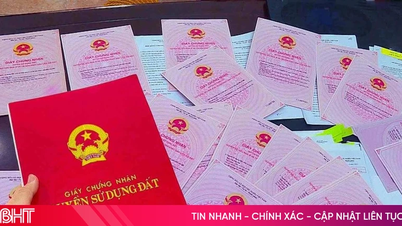
Many large plots of land in the provinces do not yet have land titles (illustrative image).
From a legal perspective, lawyer Tran Duc Phuong of the Ho Chi Minh City Bar Association believes that it is necessary to accurately understand the nature of these transactions to avoid confusion in the application of the law.
According to lawyer Phuong, the common term "land with handwritten documents" is merely a colloquial expression and does not fully reflect the legal concept in current regulations.
He argued that the correct phrase should be "according to legal regulations," because each land use case will have different recognition conditions.
Analyzing the regulations of the Land Law over different periods, lawyer Phuong stated that there are currently three main groups of cases related to land registration and issuance of land use right certificates.
The first case involves land users who possess one of the documents stipulated in the Land Laws of various periods, such as the Land Law of 2003, 2013, or 2024. These cases qualify for initial land registration and the issuance of a land certificate.
The second case involves a transferee receiving the land from a person with valid documents as prescribed. According to Clause 5, Article 137 of the 2024 Land Law, the transferee can still be granted a land certificate if they have documents proving the purchase and transfer.
This is the type of transaction that people commonly refer to as "handwritten agreements," meaning contracts that are not notarized or authenticated. However, the transaction must be documented in writing; verbal agreements are not accepted.
The third case involves land users who do not possess any documents as required by the Land Law, including previous users. Nevertheless, the law still allows for initial land registration and consideration for the issuance of a land use certificate if the conditions of stable use are met for each period.
According to lawyer Phuong, many people currently misunderstand that simply buying and selling with handwritten documents is sufficient to transfer ownership and update changes on the certificate of ownership. "This is an inaccurate understanding and can lead to further disputes," he said.
Because even in cases of land use rights transfers where a land title certificate has been issued but not notarized or authenticated, all procedures must still be followed according to current legal regulations.
However, lawyer Phuong argues that if the amended Land Law extends the time limit for recognizing land registration in cases without documents, it should not be limited to July 1, 2014.
According to him, consideration should be given to extending the deadline to a more recent date, such as January 1, 2026, to definitively resolve the large volume of existing transactions, instead of waiting many more years for subsequent amendments to the law.
Disputes are inevitable.
Some argue that legalizing handwritten transactions will inevitably raise concerns about the risk of violations or disputes. However, according to lawyer Tran Duc Phuong, land disputes are unavoidable in practice, and such concerns should not be used to restrict people's right to register and obtain land certificates.
More importantly, bringing existing transactions into a management framework will help unlock land resources that have been "frozen" for many years due to a lack of legal eligibility.
When land use rights are fully recognized, people will find it easier to conduct transactions, borrow capital, and invest in production, while also contributing to a more transparent and stable real estate market.
Source: https://nld.com.vn/tin-vui-cho-nguoi-mua-dat-giay-tay-truoc-2024-196260507170006846.htm





























































































Comment (0)