Taking advantage of loopholes in the process of worker bees creating new queens, beekeepers have intervened to make worker bees produce royal jelly for human purposes.
Ms. Tran Thi Phuong Hang, who has been involved in beekeeping for over 40 years at Chi Toan bee farm (Ea Kao commune), shared: "In a colony of tens of thousands of bees, experienced beekeepers can distinguish the queen bee, the male bees, and the worker bees at a glance. Each colony has only one queen bee, and the rest are her offspring."
All worker bees are female, and as larvae, they all have the chance to become queen bees. But the worker bees decide which one will be the queen! Even knowing that the colony only needs one queen, they still create several queen cells and feed these larvae entirely with royal jelly. The larvae fed with royal jelly will develop into queen bees, while the others fed with pollen and honey will become worker bees.
|
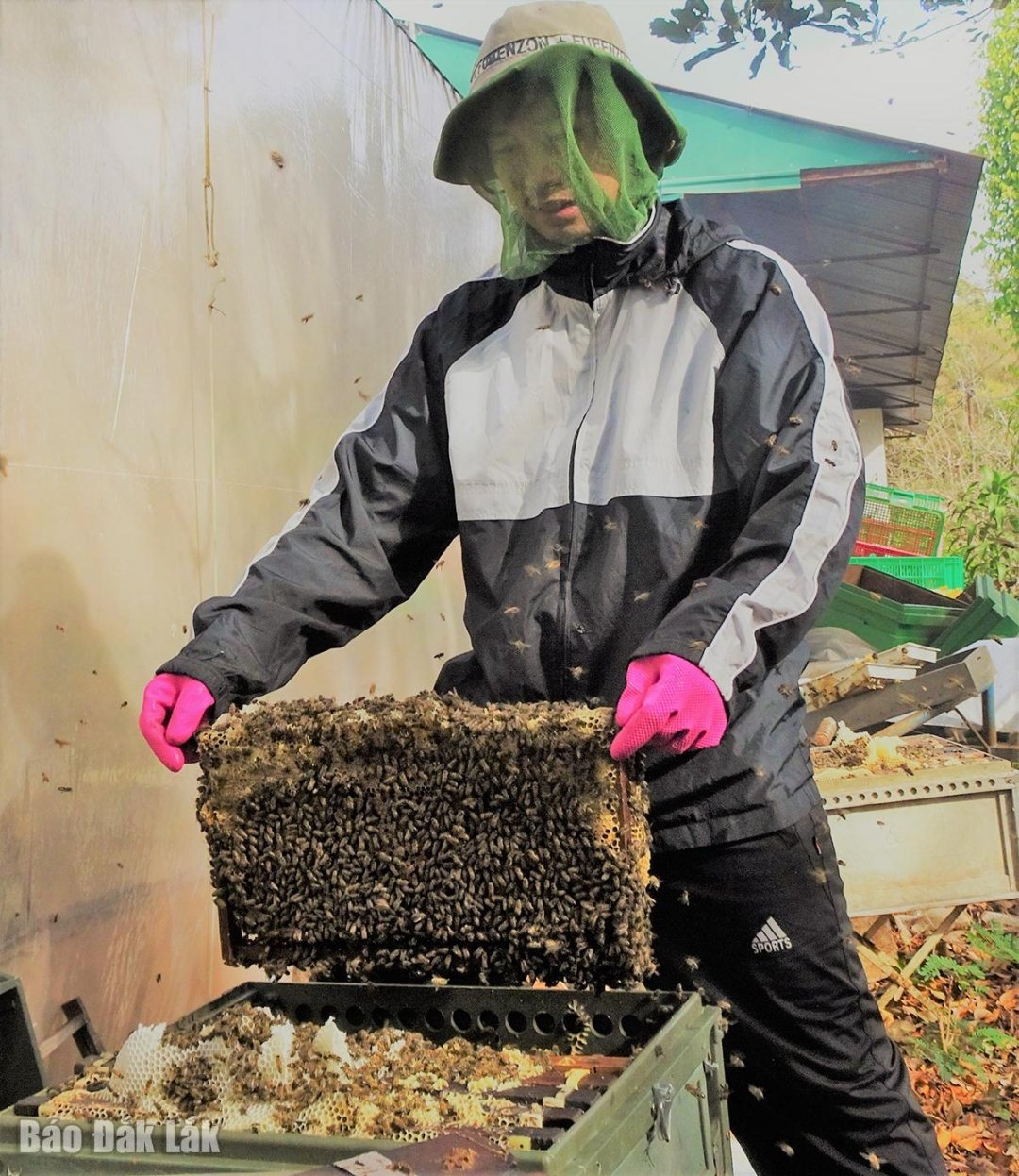
A honeycomb full of ripe honey. |
Understanding the characteristic of worker bees when creating a new queen cell—that they often create more than one—beekeepers trick the colony by hiding the queen and replacing her with many artificial queen cells to harvest royal jelly. In each hive, one or two wooden frames are placed, each holding approximately 200 queen cells (made of plastic, about the size of a little finger), depending on the strength of the colony. Beekeepers then transfer about two-day-old bee larvae into these queen cells. The worker bees then secrete royal jelly to feed these larvae. “The larvae that worker bees feed with royal jelly will become queen bees. Those that are not fed royal jelly will become ordinary bees. After 4 days, beekeepers will move the queen larvae out to collect the royal jelly from those tiny queen cells. A colony at its peak can yield about 100 grams of royal jelly. And a queen bee fed with this miraculous milk can live for 4-7 years, while the lifespan of a worker bee is only about 6 months,” Ms. Hang said. For that reason, royal jelly is considered very good for health: it has anti-aging, anti-inflammatory effects, boosts vitality, nourishes the health of both mothers and babies, and beautifies the skin…
To obtain high-quality royal jelly, bees must be raised in areas with abundant flowering plants where they collect pollen and produce royal jelly. The best sources of royal jelly are typically found in tea and coffee-growing regions such as Dak Lak and Bao Loc (Lam Dong)...
|
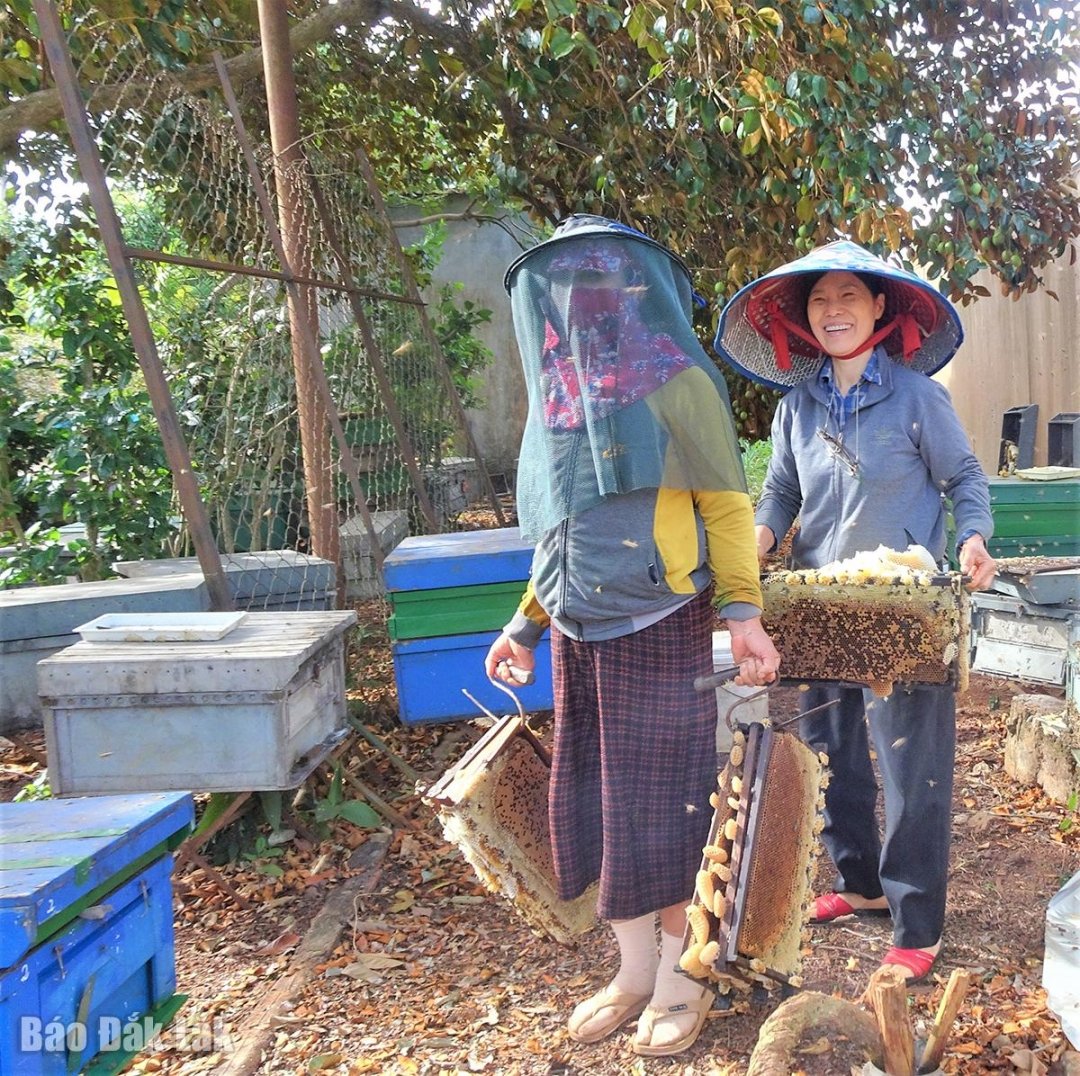
Put the ripe honeycombs into the honey-spinning machine. |
Except for the queen bee, all other female bee larvae will develop into worker bees, and all of them are inhibited and incapable of reproduction.
From birth, worker bees possess the virtues of diligence, dedication, and tireless labor throughout their lives. Nectar is brought back to the hive in liquid form and passed on to the "home" bees. These bees continuously inhale and exhale drops of nectar hundreds of times, allowing enzymes in their salivary glands to transform the natural nectar into honey, concentrating the nectar before it is placed in the honey cells. When the honey is "ripe," the bees seal each honey cell with a layer of white wax. This sealed honey is called mature honey. It can be stored for many years while retaining its nutritional content and exquisite flavor.
Honey from coffee blossoms, refined by bees, is one of the precious natural specialties of the Central Highlands.
Many consumers, seeing coffee blossom honey sold on the market for only about 200,000 to over 500,000 VND/liter, assume that it is of poor quality. Many people, driven by the desire to "hunt" for wild honey at exorbitant prices, unknowingly fall into the trap of fake honey.
With over 40 years of beekeeping experience, Mrs. Hang's family – owners of the Chi Toan bee farm – always adhere to the principle: They let the bees fan the honeycombs day and night until they naturally seal the honey cells. Only when 90% of the honeycombs are completely sealed with white wax do they begin harvesting the mature honey, which may have a viscosity of only 17-18 degrees. Because the honey is mature, dried, and inspected by the bees themselves, the coffee flower honey, with its distinctive aroma, remains unmistakable no matter how long it's stored. Ms. Hang affirmed: "Coffee flower honey is truly the most special kind of honey, unlike anything found elsewhere. Coffee flowers are very fragrant, and the honey harvested is infused with their scent, filling the entire farm with its aroma. The honey is thick and viscous, with a beautiful yellow or amber color and a characteristic mild sour taste. To obtain high-quality coffee flower honey, beekeepers must avoid areas with many rubber, cashew, and avocado trees… because although honey is also produced by bees, honey from these trees is thinner, quickly loses its color, becomes dark, and crystallizes after a short time. Many types of honey from wildflowers that bees collect also tend to foam, so we must be aware of this and avoid them."
|
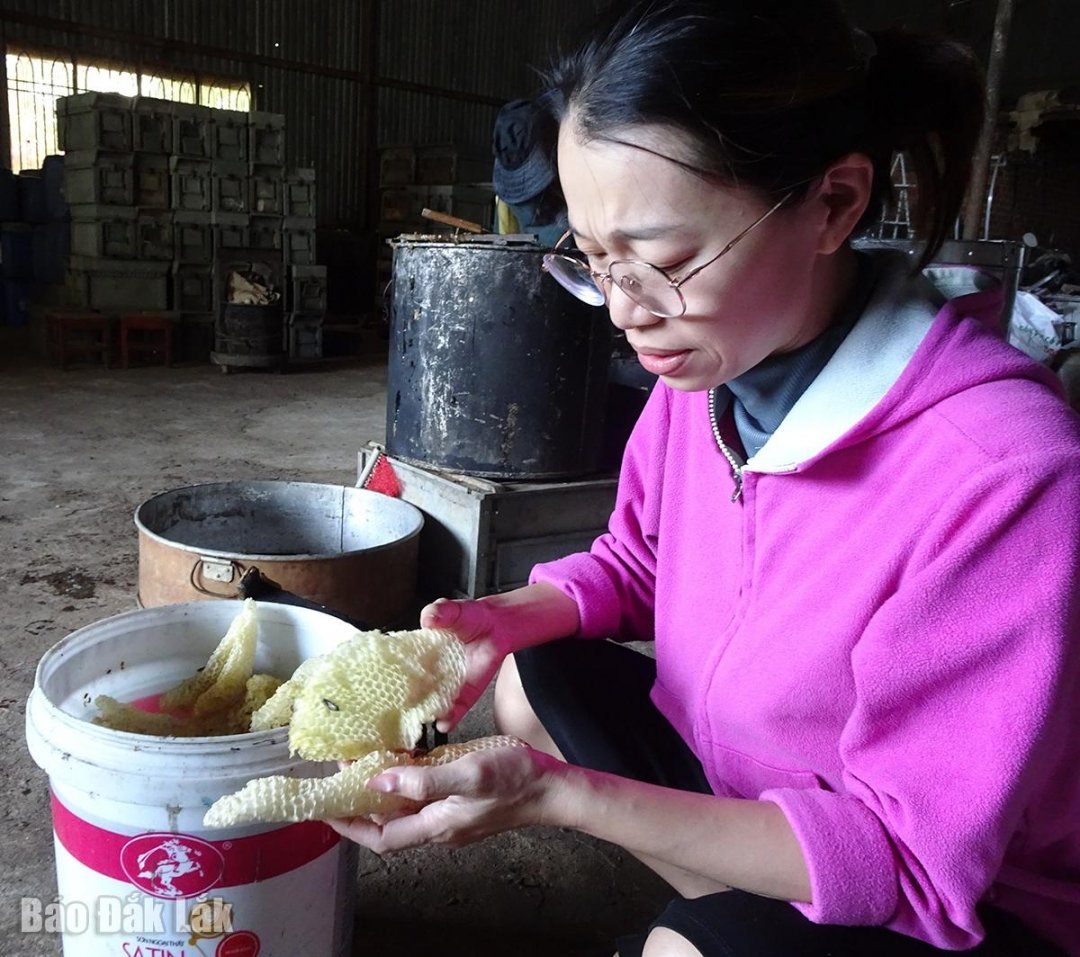
Pure beeswax is collected for export. |
Over the years, through beekeeping and honey production, from manual extraction to wholesale and retail sales, Mrs. Hang's family also sells entire honeycombs to meet customer demand. In particular, to cater to VIPs and high-end restaurants and hotels that use honey in buffets, the family has created a type of honeycomb honey. These are mature, high-quality honeycombs that the bees seal and preserve. Each small, neat, square piece of honeycomb weighs between 0.2 and 0.5 liters and is usually produced during the peak coffee flowering season to ensure beautiful honeycombs with the distinctive flavor of coffee blossoms.
Foreign tourists are very fond of this compact honeycomb honey with its fragrant coffee blossom aroma. They often eat it with bread or as a dessert. What's special is that they also eat the beeswax because beeswax is also produced by the bees from pollen and nectar, so it contains all the same nutrients and minerals as honey.
Having been beekeepers for over 40 years, Mrs. Hang's family now produces many exquisite bee products such as honey, pollen, royal jelly, beeswax, propolis, and several products made from honey, including honey and turmeric tablets (black, yellow, white, and scorpion turmeric). Mrs. Hang shared: "Beekeeping requires patience and a love for these tiny bees, who dedicate their lives to producing honey for the world. Bees are both pets and teachers in life, keeping our whole family connected to this profession…"
Source: https://baodaklak.vn/xa-hoi/202509/tinh-tuy-mat-ong-0931540/


![[Photo] General Secretary and President To Lam works with the Party Committee of the Ministry of Health on the work of Vietnamese traditional medicine.](https://vphoto.vietnam.vn/thumb/1200x675/vietnam/resource/IMAGE/2026/05/20/1779294323718_a1-bnd-2978-3319-jpg.webp)
![[Image] "Journey of Hope" promotes the organ and tissue donation movement in Vietnam.](https://vphoto.vietnam.vn/thumb/1200x675/vietnam/resource/IMAGE/2026/05/20/1779294400833_1-8910-jpg.webp)

















































































Comment (0)