Previously, since 2013, Quang Trung commune (now Quang Trung ward) implemented land consolidation and developed a fish-rice farming model. However, over time, this model yielded low economic efficiency and struggled to meet the demand for increased income for the people. Faced with this reality, in 2022, the Farmers' Association of Bim Son town (before the implementation of a two-tiered local government system) collaborated with the Agricultural Extension Center and the Provincial Farmers' Association to pilot a model of raising giant freshwater prawns combined with rice cultivation.

The results show that the new model yields economic value 4-5 times higher than the previous fish-rice farming model. Mr. Tran Xuan Hanh's family (Residential Group 1, Quang Trung Ward) is one of the households participating in the pilot project on an area of 5,300 m² . Mr. Hanh said that in 2022, his family experimented with raising 12,000 shrimp fry on 0.5 hectares and earned a profit of 50 million VND in the first season. Based on this result, the family expanded production, established a cooperative, and applied digital technology in managing and selling their products.

According to Mr. Hanh, the fish-rice farming model previously only brought in about 30 million VND per year. Since switching to raising freshwater prawns in combination with rice cultivation, his family now sells about 800 kg of prawns annually at an average price of 320,000 VND/kg, earning a profit of about 150 million VND after deducting expenses.

According to local farmers, the market for giant freshwater prawns is currently quite stable. The main feed consists of tilapia and other locally available scraps, resulting in low costs. However, the model also faces some challenges, such as the narrow irrigation canals used for rice cultivation, which do not adequately meet water supply and drainage requirements. Furthermore, the supply of prawn larvae still depends on southern provinces, lacking local self-sufficiency.
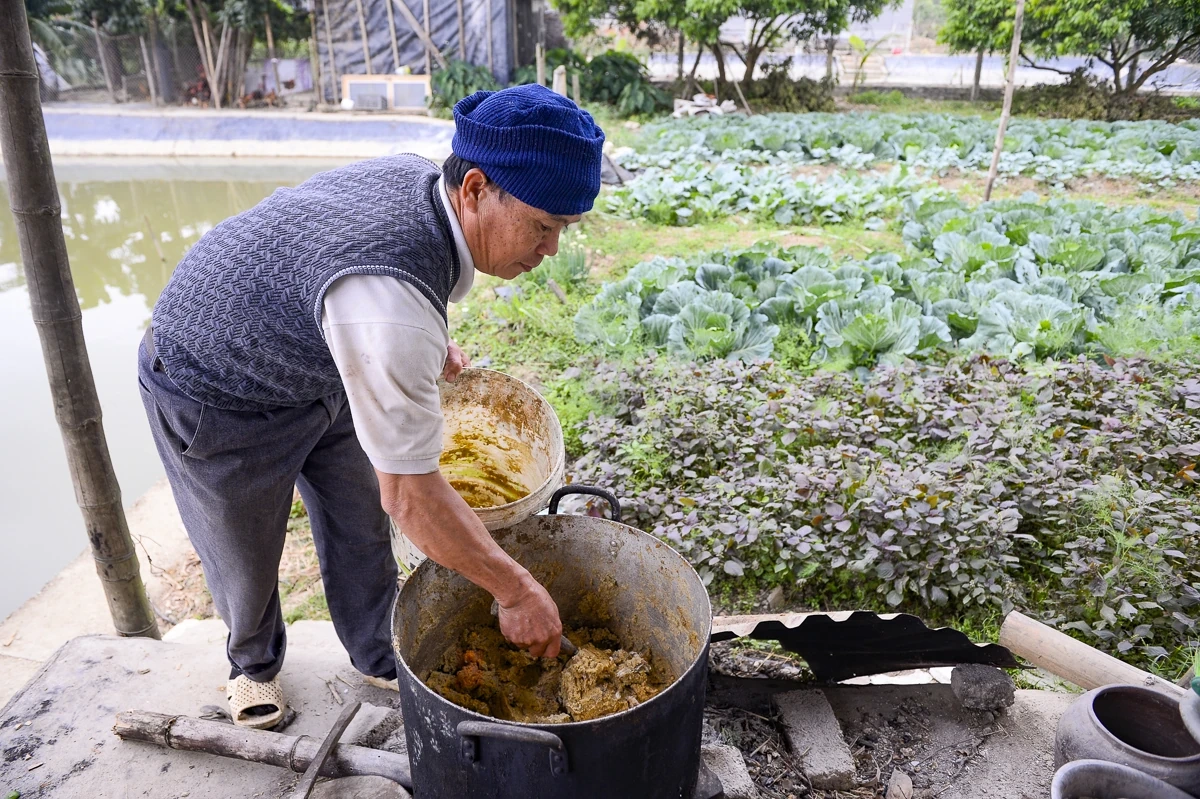
The main food for the giant freshwater prawns is tilapia and other locally available fish, which Mr. Hanh cooks and mixes with cornmeal.



In the same area, Mr. Mai Van Sy's family (55 years old) raises freshwater prawns on an area of 2,000m2 , earning nearly 100 million VND in profit each year.

According to Mr. Sy, the key to success is having control over the food supply. His family dedicates 0.5 hectares to raising tilapia; the marketable fish are sold, while the smaller and miscellaneous fish are used as feed for shrimp, significantly reducing input costs.

By freezing trash fish as feed, Mr. Mai Van Sy proactively manages the nutritional source for freshwater prawns, contributing to improved efficiency in the integrated prawn and rice farming model.

Currently, Mr. Tran Xuan Hanh is also the head of the Quang Trung Ward's Giant Freshwater Prawn Farming Cooperative with 3 members, a total farming area of approximately 20,000 m² , and an annual production of nearly 3 tons. Residential Area 1 alone has about 50 hectares of land for aquaculture, creating significant potential for expanding the model. In the future, the Cooperative will continue to encourage households to switch from the fish-rice farming model to giant freshwater prawn farming, gradually expanding the scale, creating large-scale production, and aiming to participate in supply chains after achieving VietGAP certification.

According to experienced farmers, it is possible to raise two shrimp crops per year, with the main crop in the summer when the shrimp grow well thanks to natural food sources from rice. Giant freshwater prawns are bottom-feeding, so determining the appropriate amount of feed is crucial. Overfeeding can easily pollute the water environment, while underfeeding can lead to cannibalism. In the initial stage, farmers should feed the shrimp using sieves for easy monitoring and adjustment. The appropriate stocking density is about 5 shrimp/ m² .

During the rainy season, the water environment is often acidic, so farmers need to regularly check the pH level, maintaining it at 7.5 - 8.5; if the pH exceeds the permissible limit, it should be treated with diluted lime water. In addition, during the molting period, shrimp need to monitor shell hardness, the uniformity of molting, and supplement minerals promptly when necessary.
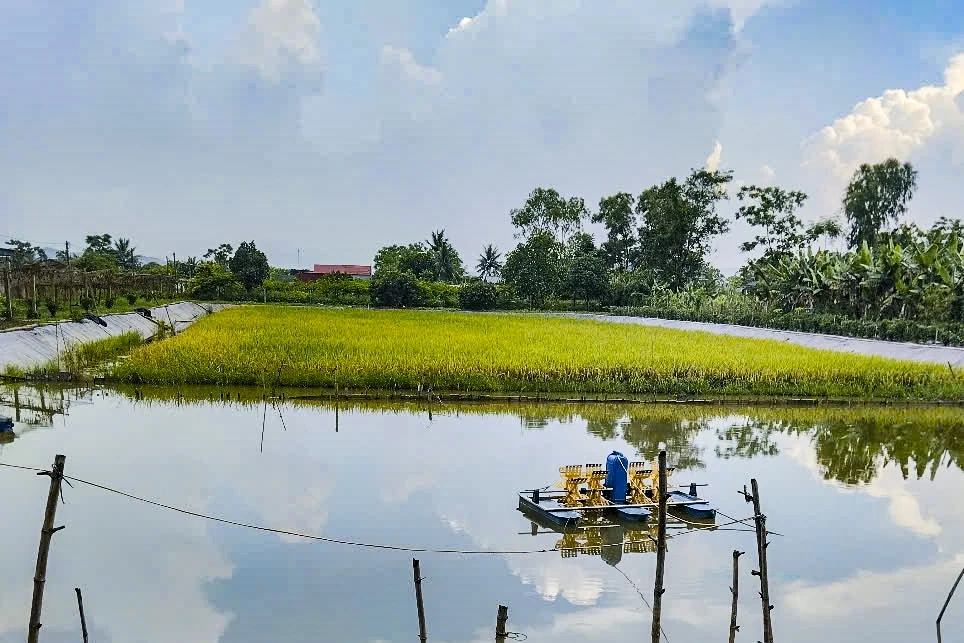
The model of raising giant freshwater prawns in combination with rice cultivation creates an effective symbiotic relationship: prawns eat algae and stir up mud, helping to improve the environment for rice growth; conversely, the rice field provides a safe haven for prawns during molting, and the rice itself is an important natural food source.

Ms. Tong Thi Hong Lien, Vice President of the Quang Trung Ward Farmers' Association, said that after more than 3 years of implementation, the model has proven its clear economic effectiveness. Participating households have mastered the technical process, creating a favorable foundation for expanding production. Having VietGAP certification will open up opportunities to bring products into supermarkets and large distribution systems. Based on this, the locality plans to expand the area and encourage households with less efficient aquaculture land to switch to livestock farming, contributing to the sustainable development of agriculture .
Hoang Dong
Source: https://baothanhhoa.vn/tom-cang-xanh-giup-ruong-lua-sinh-loi-276201.htm



![[Image] Ho Chi Minh City: Ma Lang area, Chicken-Rice Market about to change its appearance](https://vphoto.vietnam.vn/thumb/1200x675/vietnam/resource/IMAGE/2026/06/25/1782377698627_ndo_br_m1-jpg.webp)
![[Photo] General Secretary and President To Lam receives Palestinian Ambassador Saadi Salama](https://vphoto.vietnam.vn/thumb/1200x675/vietnam/resource/IMAGE/2026/06/25/1782365384740_a1-bnd-9423-8322-jpg.webp)
![[Image] Schools organize meetings and introduce teaching models to students admitted to grade 10.](https://vphoto.vietnam.vn/thumb/1200x675/vietnam/resource/IMAGE/2026/06/25/1782368077271_ndo_br_z7970052192242-1ec8daeb77a6eed1a4e9f58c564ddd3e-jpg.webp)










![[GALLERY] Voidling Bound takes Steam by storm with 94% positive reviews.](https://vphoto.vietnam.vn/thumb/402x226/vietnam/resource/IMAGE/2026/06/25/1782396892878_tua-1-png.webp)