Ho Chi Minh City is reorganizing its neighborhoods.
On June 13th, wards, communes, and special zones in Ho Chi Minh City simultaneously solicited public opinion on a plan to reorganize neighborhoods and hamlets in their areas, with the deadline extending to June 18th.
Báo Sài Gòn Giải phóng•14/06/2026
Ho Chi Minh City has 168 commune-level administrative units, with 5,947 neighborhoods, hamlets, villages, and residential areas (collectively referred to as neighborhoods and hamlets) comprising over 5.3 million households. Specifically, 66 wards, communes, and special zones formerly belonging to Binh Duong and Ba Ria-Vung Tau provinces currently maintain 10,795 self-governing residential groups and community groups. Due to incompatibility with Government Decree 185/2026, Ho Chi Minh City is developing a plan to comprehensively reorganize neighborhoods and hamlets and terminate the model of self-governing residential groups and community groups.
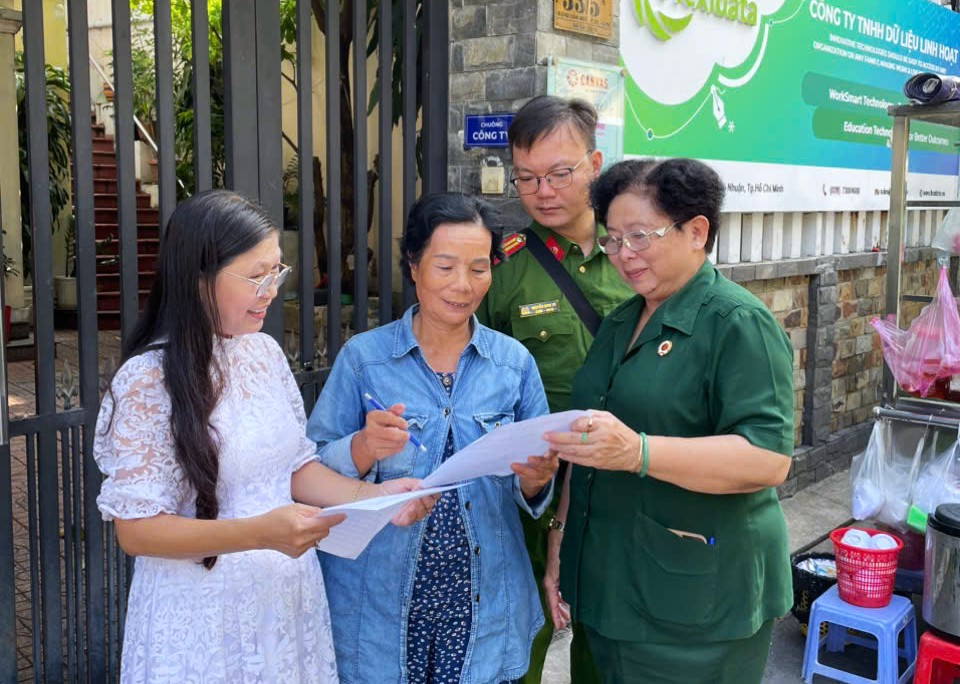
Part-time activists are gathering opinions from residents of Phu Nhuan District (Ho Chi Minh City) regarding neighborhood reorganization.
PHOTO: NGUYEN VU
Ho Chi Minh City reduces the number of neighborhoods by more than 2,000.
Comparing the household number standards in Decree 185/2026, there are 1,737 residential areas that have not reached 700 households and 986 hamlets, villages, and residential zones that have not reached 500 households, so they need to be reorganized. According to the overall plan, Ho Chi Minh City will reduce the number of residential areas and hamlets from 5,947 to 3,944 (a reduction of 2,003 units, equivalent to nearly 34%), and simultaneously cease the operation of all self-governing people's groups and residential groups.
After reorganization, Ho Chi Minh City has 91 residential areas (KPs) and 23 hamlets (Ấp) with a household size ranging from 2,000 to 25,000 households, many times larger than the standard. These KPs and hamlets are located in areas with a high concentration of high-rise apartment buildings; export processing zones, and industrial parks with a large number of workers living in concentrated worker housing and dormitories. During the planning process, the wards and communes assessed these as stable, concentrated communities, and the localities ensured effective management of these areas throughout the past period, therefore, they did not consider splitting or reorganizing them.
Regarding the implementation process, Ms. Pham Thi Thanh Hien, Director of the Department of Internal Affairs of Ho Chi Minh City, said that wards and communes will gather public opinions and complete the dossiers to submit to the People's Council at the same level for approval, no later than June 22nd. In addition, local authorities will also allocate the number and positions of part-time personnel and those participating in activities at the neighborhood and hamlet levels. Before June 30th, wards, communes, and special zones will complete the settlement of benefits and policies for part-time personnel who cease their participation.
In the central area of Ho Chi Minh City, Phu Nhuan Ward has reorganized its residential areas from 31 to 24, with 13 remaining unchanged and 18 having their boundaries altered. Ms. Nguyen Thi Nhu Y, Chairwoman of the Phu Nhuan Ward People's Committee, stated that in addition to the number of households, the ward also considered the cultural aspects of the community and divided the areas along streets and alleys for easier management.
Regarding personnel, according to general regulations, each neighborhood has three non-professional positions: Party branch secretary, neighborhood leader, and head of the Fatherland Front working committee. A favorable point for the ward is that most of the elderly people working in the old neighborhoods continue to participate in the new neighborhoods after the merger. "These are people with rich experience, many years of service in the neighborhoods, and high prestige in the community," Ms. Nhu Y said. In addition, the ward is also planning to allocate non-professional personnel to the neighborhoods to strengthen the workforce with young people and support digital transformation. After the reorganization, the 24 neighborhoods will rotate activities at 12 offices. The ward will continue to invest in and upgrade computers, printers, and internet connections in the neighborhoods to ensure working conditions and support residents in submitting online applications directly at the neighborhood offices instead of going to the ward office.
Not far from Phu Nhuan, Nhieu Loc Ward reduced the number of hamlets from 52 to 30 (equivalent to 42%), with 2 hamlets remaining unchanged but having their names changed. The number of part-time hamlet workers also decreased from 254 to 90. In the suburban areas, Vinh Loc commune reduced from 76 hamlets to 39, and Thai My commune reduced from 31 hamlets to 16…
RENAM THE NEIGHBORHOOD WITH A MEMORIZABLE NAME
According to a survey by Thanh Nien newspaper, many wards are reorganizing by increasing the number of new residential areas (KPs) due to their large populations and high number of households. As the most populous ward in Ho Chi Minh City, Di An Ward currently has a population of 256,000 living in 19 KPs. Mr. Nguyen Van Dong, Secretary of the Party Committee of Di An Ward, said the ward will increase from 19 KPs to 28 because many KPs have very large populations, households, and residents. This increase will ensure a more equitable distribution among KPs and facilitate effective state management.
Regarding the naming of the residential areas, Mr. Dong said that Di An Ward had organized conferences, discussions, and solicited opinions on naming the new residential areas, determining the boundaries between the residential areas, and the methods for gathering public opinion. The ward also proposed that Ho Chi Minh City should have a fair compensation system for those working in residential areas who will be laid off after the reorganization. Ms. Trinh Thi Nho (a resident of Di An Ward) said: "People like the heads of residential areas have worked for many years, some for more than 16 years, helping to ensure security and order in the residential areas, as well as environmental sanitation and the lives of the people. Now, with the reorganization of the residential areas, many people will have to leave their jobs, so we propose that there should be policies and benefits for these people to ensure their livelihoods after they are laid off."
Mr. Le Thanh Long, Secretary of the Party Committee of Phu Loi Ward, said that the ward will reduce the number of residential areas from 22 to 14. Regarding the naming convention, previously the residential areas were numbered 1, 2, 3… After the implementation of the two-tiered local government system, the residential areas in the ward will be named after the old ward name followed by a number, such as Phu Loi 1, 2, 3… Phu Hoa 1, 2, 3… and Hiep Thanh.
Mr. Long stated that the ward is currently seeking public opinion on the names of 14 new residential areas (KPs), aiming to revert to the names of long-standing KPs and hamlets that reflect the unique cultural characteristics of the community. For example, Phu Loi 9 KP will be renamed Binh Thoai KP, and Phu Hoa 9 KP will be renamed Hoa Thanh KP. Additionally, Phu Loi ward is also considering the names of existing KPs, such as Cho Dinh KP, Phu Thuan KP, and Vinh Son KP, based on the folk traditions of some residents. Residents in the ward also suggested that after the reorganization, any surplus old KP headquarters should be converted into community activity centers, parks, or schools.



![[Image] Schools organize meetings and introduce teaching models to students admitted to grade 10.](https://vphoto.vietnam.vn/thumb/1200x675/vietnam/resource/IMAGE/2026/06/25/1782368077271_ndo_br_z7970052192242-1ec8daeb77a6eed1a4e9f58c564ddd3e-jpg.webp)

![[Photo] General Secretary and President To Lam receives Palestinian Ambassador Saadi Salama](https://vphoto.vietnam.vn/thumb/1200x675/vietnam/resource/IMAGE/2026/06/25/1782365384740_a1-bnd-9423-8322-jpg.webp)
![[Image] Ho Chi Minh City: Ma Lang area, Chicken-Rice Market about to change its appearance](https://vphoto.vietnam.vn/thumb/1200x675/vietnam/resource/IMAGE/2026/06/25/1782377698627_ndo_br_m1-jpg.webp)