

Pilot project on Mai Chi Tho Street
Mr. Doan Van Tan, Director of the Urban Traffic Management Center (Ho Chi Minh City Department of Construction), said that the unit has issued the order to start construction of the dedicated bicycle lane project on Mai Chi Tho Street from Nguyen Co Thach Street to D1 Street.
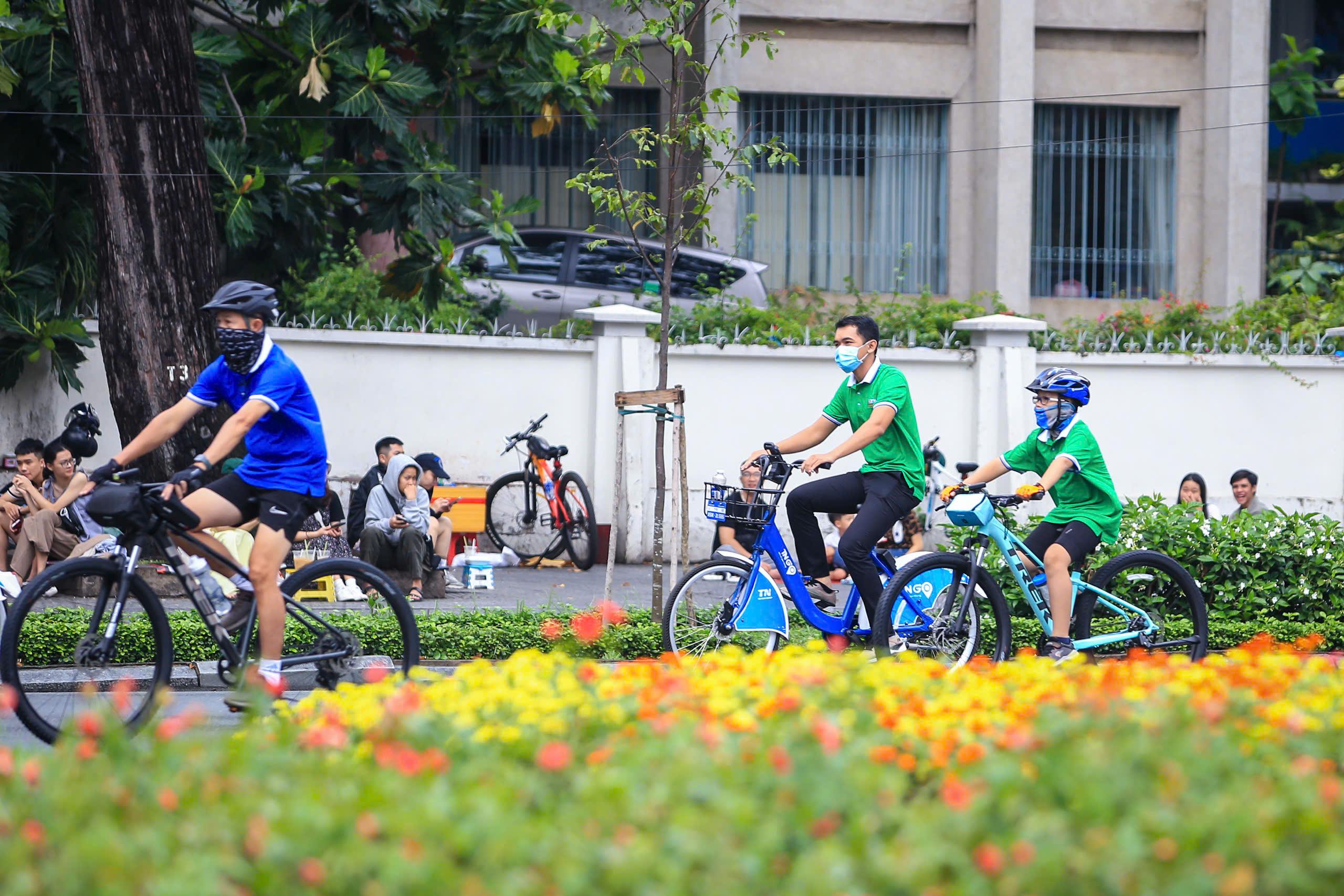
Recently, public bicycles have attracted many young people to use them for sightseeing in the central area of Ho Chi Minh City.
PHOTO: NHAT THINH
A dedicated lane, 5.8 km long and 2 m wide, is provided on the sidewalk, with a width of 1.5 m over the bridge, and a design speed of 20 km/h. The road surface is made of asphalt concrete and painted in a different color to clearly distinguish the bicycle lane from the motor vehicle lane. The total investment for the project is 12.7 billion VND. The project is scheduled for completion before December 31st so that by early 2026, this road will have a new, environmentally friendly traffic appearance, including a dedicated bicycle lane.
Explaining the choice of Mai Chi Tho Street as the first location for dedicated bicycle lanes, Mr. Tan stated that the road has integrated infrastructure and a sufficiently wide corridor to accommodate dedicated bicycle lanes. In the initial phase, the project will connect three residential areas, including Sala, New City, and The Sun Avenue, with major shopping centers.
In 2026, the Urban Traffic Management Center is expected to complete the dedicated bicycle lane from Nguyen Co Thach Street to the Saigon Riverfront Park, a newly landscaped and modern area of the Thu Thiem new urban area. Simultaneously, after the An Phu intersection project is completed and the land is handed over, the center will construct an additional section from D1 Street to Rach Chiec Station on Vo Nguyen Giap Street. At that time, the dedicated bicycle lane will create a continuous connection, linking the Saigon Riverfront Park, commercial centers, and the metro station.
According to the design, there will be 5 public bicycle stations along Mai Chi Tho Street. Cyclists can go to the station, lock their bikes, and then go to the shopping mall or rent public bicycles along the route. Dedicated lanes next to bus stops will make it more convenient for people to use both bicycles and buses. Along with the organization of dedicated bicycle lanes on Vo Nguyen Giap Street and several other routes, the integration of bicycles with buses and the metro will create a new and improved transportation landscape for Ho Chi Minh City.
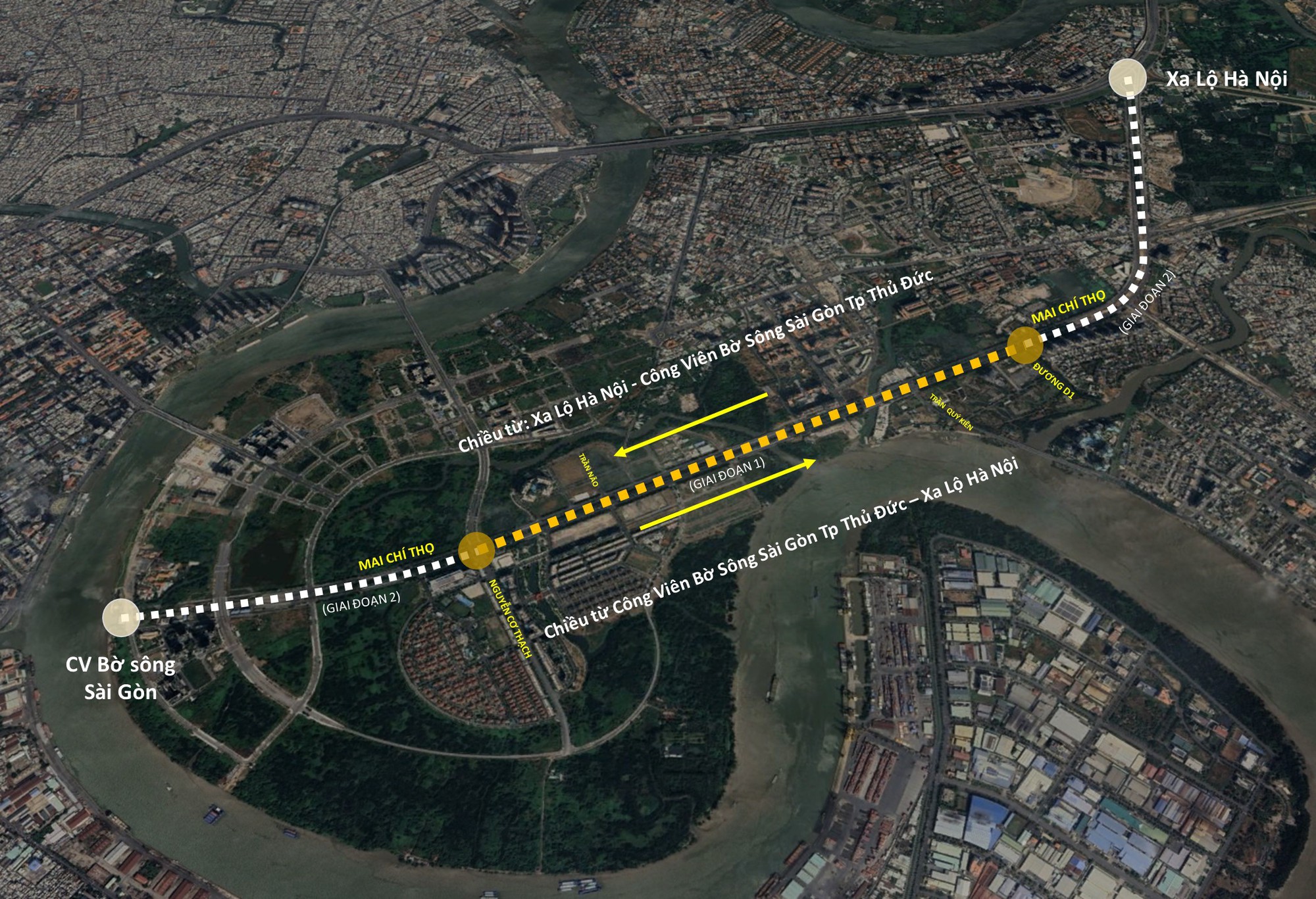
Plans to create dedicated bicycle lanes on Mai Chi Tho Street.
PHOTO: HO CHI MINH CITY URBAN TRAFFIC MANAGEMENT CENTER
Towards prioritizing bicycles
According to architect Nguyen Truong Luu, President of the Ho Chi Minh City Architects Association, for many years, the urban cycling movement has been very strong in Nordic countries such as Finland, Denmark, Sweden, and Norway. Their organization is excellent; cyclists ride on the road, but if they encounter a high-traffic section, they move onto the sidewalk on a dedicated lane, allowing for faster travel. The dedicated lanes are painted in easily distinguishable colors, with bicycle symbols spaced at intervals. If a pedestrian enters this lane and a collision occurs, the cyclist is not held responsible.
Architect Nguyen Truong Luu supports the idea of creating dedicated bicycle lanes on Mai Chi Tho Street, as the road has wide sidewalks and almost no pedestrians. "Given the characteristics of older cities, where there isn't even enough space for pedestrians, it will be difficult to organize dedicated bicycle lanes. Where there is space, pilot projects should be implemented, gradually expanding the program," Architect Nguyen Truong Luu explained.
Mr. Nguyen Kien Giang , Deputy Head of the Department of Maintenance and Operation of Transportation Works (Ho Chi Minh City Department of Construction), said that 10 years ago, they studied the possibility of organizing bicycle lanes on about 20 roads, but faced a lot of resistance when consulting with relevant units, so it was not implemented. Currently, Mr. Giang believes that piloting dedicated bicycle lanes would be more advantageous because it connects to the metro, allowing people to travel short distances from home to the parking area and then use public transport. "The number of cyclists will increase if the number of motorbikes decreases," Mr. Giang assessed, adding that the implementation will be done in stages.
Regarding the suggestion to expand the project to other routes, Mr. Giang stated that this requires thorough research to ensure compliance with regulations and alignment with the traffic network plan, the needs of cyclists, the traffic volume of other types of vehicles, and especially the current state of infrastructure. He explained that the current road width in the central area of Ho Chi Minh City is insufficient to meet the needs of other vehicles, leading to slow traffic flow, making it difficult to create dedicated bicycle lanes. After the dedicated bicycle lane project on Mai Chi Tho Street is put into operation, the Department of Construction will monitor and evaluate it before expanding it.
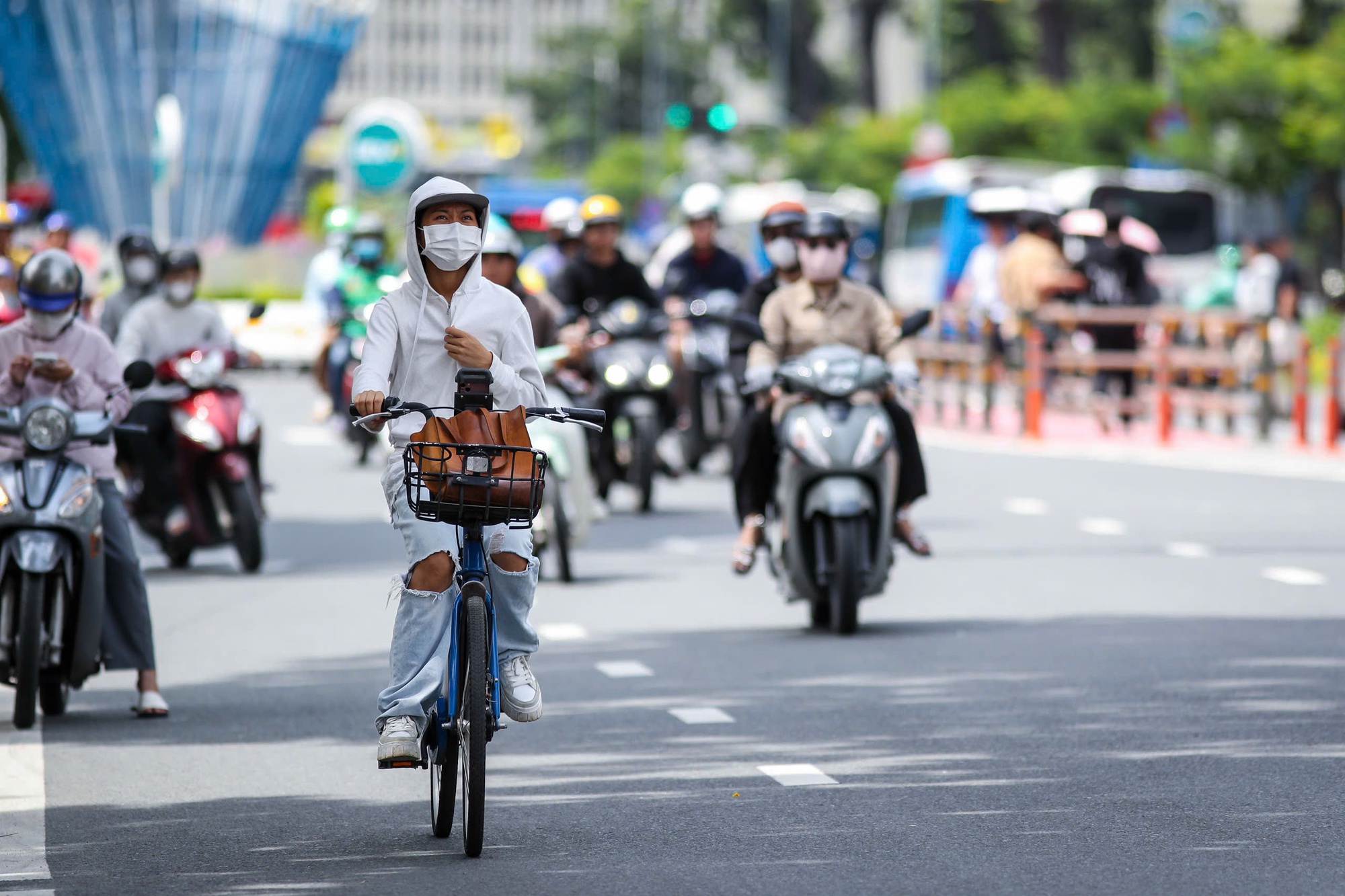
Currently, Ho Chi Minh City does not have dedicated lanes for bicycles, so cyclists share lanes with motorbikes and cars.
PHOTO: NHAT THINH
Metro connection
Architect Nguyen Truong Luu believes that Ho Chi Minh City has not been decisive enough in rectifying urban order in the past, citing the inconsistent temporary leasing of sidewalks and the lingering tendency to gauge public reaction. However, the arrangement of dedicated bicycle lanes on sidewalks to encourage a switch to environmentally friendly transportation should be supported, as Ho Chi Minh City is a megacity and cannot remain uninvolved.
According to him, dedicated bicycle lanes, if properly implemented, would become an effective means of connecting older urban areas with metro stations. This is because, at the time of the construction of Metro Line 1 (Ben Thanh - Suoi Tien), urban development had not yet followed the Transport for Development (TOD) model, so the distance between stations and residential areas was often more than 500 meters, even 1-2 kilometers. This distance is inconvenient for pedestrians, but would be suitable for bicycles.
"Personal vehicles cannot be abandoned, but it is entirely possible to switch to bicycles. People are very afraid of riding bicycles on the road, so having dedicated lanes would encourage them to participate," architect Nguyen Truong Luu commented.
Lieutenant Colonel Nguyen Van Binh, Deputy Head of the Traffic Police Department (PC08) of the Ho Chi Minh City Police, stated that to organize dedicated bicycle lanes safely and practically, PC08 emphasizes the need to meet infrastructure and legal requirements. Specifically, bicycle lanes must be clearly separated from motorized vehicle lanes (by median strips and lane dividers) and have space for pedestrians. As demonstrated in the pilot model on Mai Chi Tho Street, sidewalks must be wide enough to accommodate both bicycle lanes and maintain a clear, unobstructed pedestrian walkway.
Simultaneously, bicycle lanes must have separate, easily recognizable signs and markings, and be seamlessly integrated with other public transportation systems such as metro stations and bus stops to encourage green transportation. In particular, authorities must implement strict management measures to prevent motorcycles from encroaching on bicycle lanes, and to prevent bicycles from entering areas designated for pedestrians, ensuring the highest priority for pedestrians on sidewalks.
"Organizing dedicated bicycle lanes would be more feasible if Ho Chi Minh City implemented a comprehensive set of solutions to limit and gradually reduce the number of motorbikes in the inner city. This would free up existing road space, creating favorable conditions for designing safe bicycle lanes without increasing traffic congestion," Lieutenant Colonel Nguyen Van Binh commented.
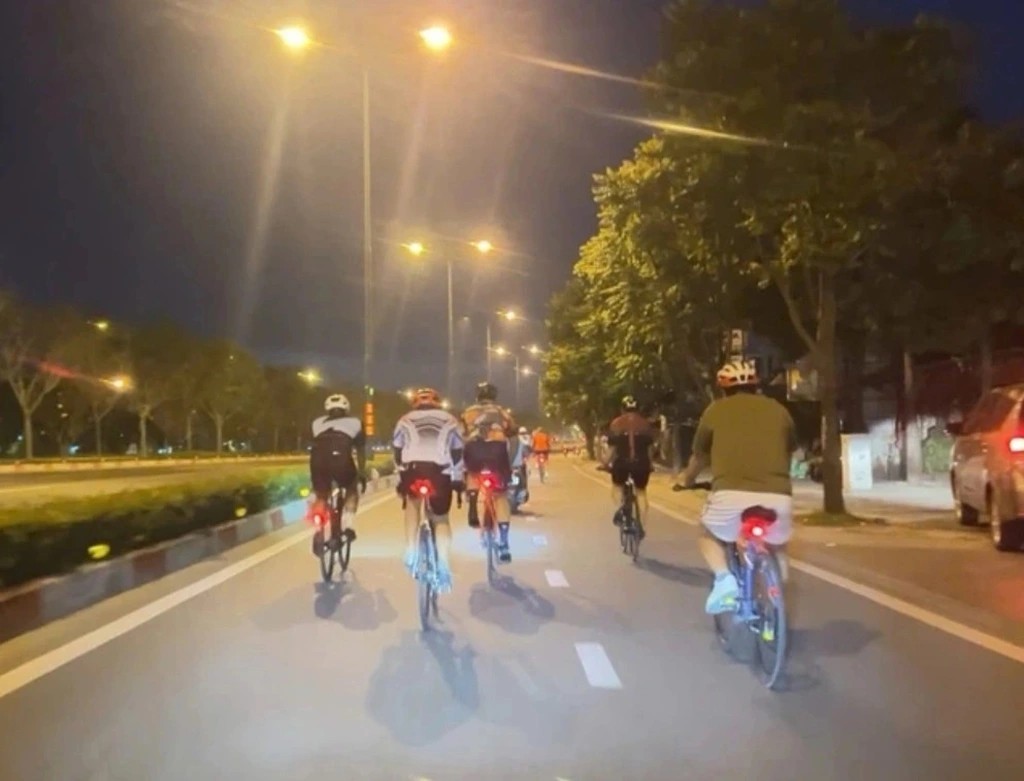
Having bicycles lined up side-by-side poses many dangers.
PHOTO: TRAN DUY KHANH
Bicycles lined up side-by-side: a lurking danger.
The Traffic Police Department (PC08) of the Ho Chi Minh City Police assessed that the behavior of people cycling for exercise in groups, encroaching on the lanes reserved for cars on major thoroughfares such as Pham Van Dong, Dien Bien Phu, Vo Van Kiet, and Mai Chi Tho, is extremely dangerous and poses a very high risk of traffic accidents.
According to Government Decree 168/2024, the fine for cycling on a lane designated for cars and cycling on the sidewalk is the same, ranging from 100,000 to 200,000 VND. However, cycling in the car lane on a major road is far more dangerous in terms of traffic safety risks due to the significant difference in speed and vehicle volume.
Thanhnien.vn
Source: https://thanhnien.vn/tphcm-thi-diem-lan-duong-rieng-cho-xe-dap-185251004224512429.htm




![[Photo] National Assembly Chairman Tran Thanh Man successfully concludes his participation in IPU-152](https://vphoto.vietnam.vn/thumb/1200x675/vietnam/resource/IMAGE/2026/04/18/1776502638199_vna-potal-chu-tich-quoc-hoi-ket-thuc-tot-dep-chuong-trinh-tham-du-ipu-152-8709975-jpg.webp)






















































































Comment (0)