Roads connecting to Dong Nai City are being rapidly developed.
The My Thuan Project Management Board has just submitted to the Ministry of Construction the revised feasibility study report for Component 1A of the Tan Van - Nhon Trach section, Phase 1, of the Ho Chi Minh City Ring Road 3. The revisions include the addition of a 19.75m wide Nhon Trach 2 bridge unit, increasing the scale of the entire route to 6 to 8 lanes of complete expressway with mixed lanes, bridge approach roads, and the addition of ITS, ETC systems, and vehicle weight inspection stations.
According to the My Thuan Project Management Board, the research and proposal of additional comprehensive investment options for Component Project 1A aims to ensure consistency with the approved plan, alignment with the investment timing of other component projects, meet long-term transportation needs, and align with the urban spatial development orientation of Ho Chi Minh City and Dong Nai City. Regarding progress, after completing the review procedures, the expansion project is striving to commence construction at the end of this year or the beginning of next year, aiming for the simultaneous completion of the entire route by 2028.
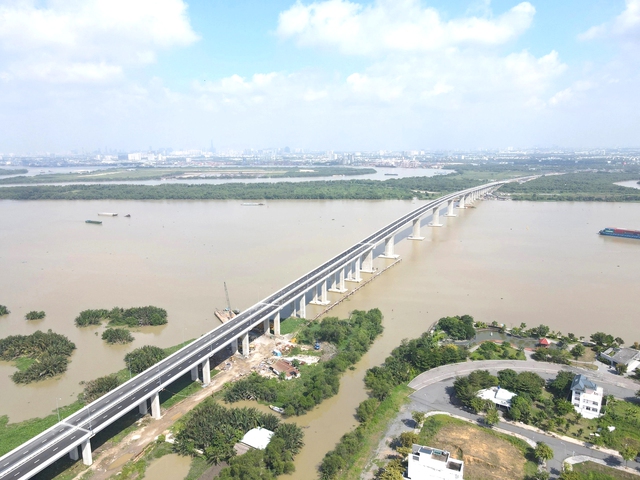
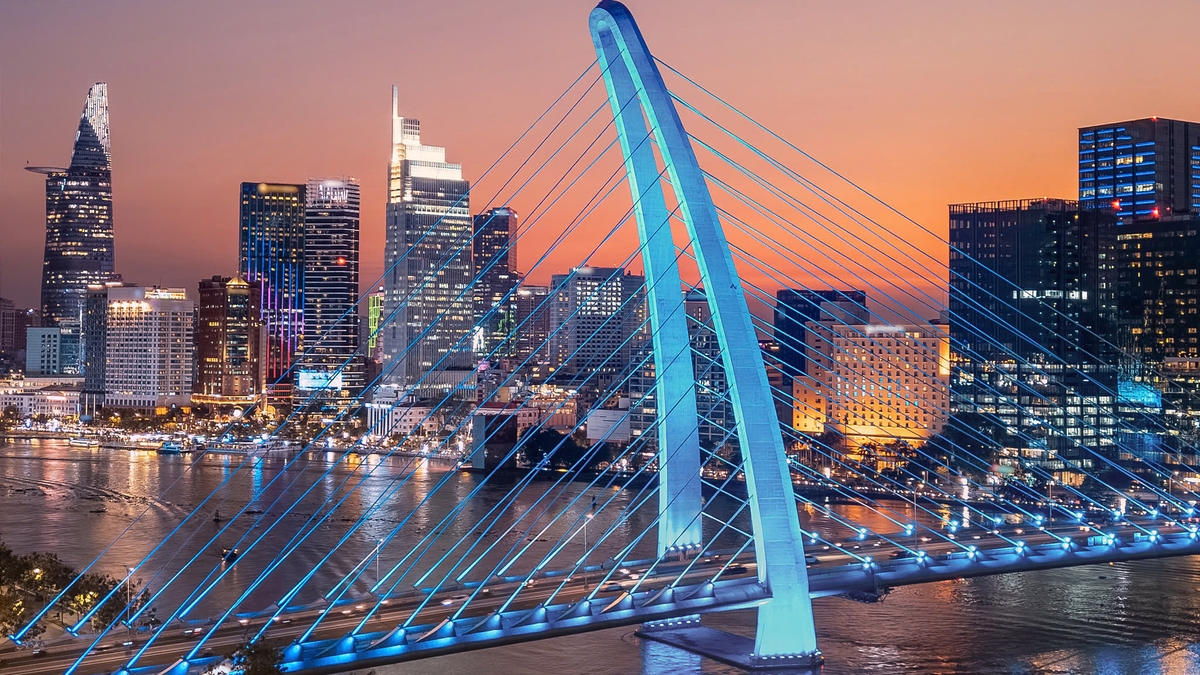
The Nhon Trach Bridge, along with component project 1A of the Tan Van - Nhon Trach section construction investment project (phase 1), helps shorten the journey from Ho Chi Minh City to Dong Nai City and vice versa.
PHOTO: GIA KHANH
Investing in the expansion of the Nhon Trach Bridge to its full scale now is crucial to anticipating and preventing localized congestion in the near future. Planning experts predict that when the Ring Road 3 opens and, especially, when the Long Thanh International Airport officially begins operation, the volume of traffic on this route will increase exponentially. If the bridge only relies on its initial phase, it risks becoming a "bottleneck," reducing the efficiency of the entire expressway. Therefore, urgently expanding the bridge is a vital step to ensure high-speed traffic flow without congestion, maximizing the logistics chain connecting Ho Chi Minh City to Long Thanh Airport and the Cai Mep - Thi Vai deep-water port complex, creating extremely strong growth momentum for the entire Southeast region.
Not only the Nhon Trach bridge, but with the new position of Ho Chi Minh City and Dong Nai City in the overall picture of the southern key economic region, the two localities have agreed on a plan to urgently invest in a trio of large-scale bridges across the Dong Nai River. Among them, the Cat Lai bridge, which had its groundbreaking ceremony on January 15th, will directly connect Thu Duc (Ho Chi Minh City) with Nhon Trach (Dong Nai City). This bridge is of particular importance to the southern key economic region, not only replacing the Cat Lai ferry route which has been overloaded for many years, but also playing a strategic role as a connecting axis between Ho Chi Minh City and Dong Nai City. At the same time, it will effectively link with Long Thanh airport, the seaport system, industrial zones, urban areas, and national arterial transportation routes.
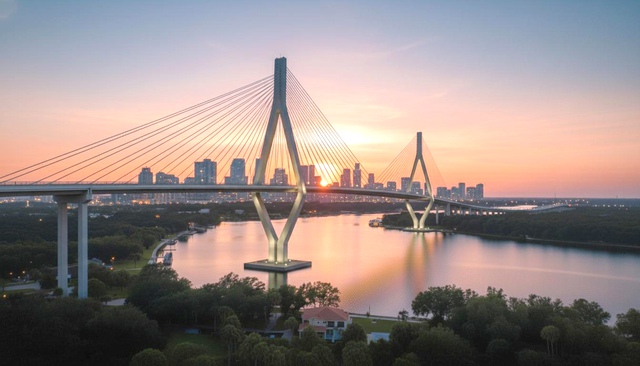
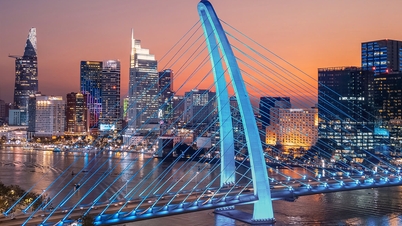
Perspective view of Phu My 2 bridge connecting the southern part of Ho Chi Minh City (formerly District 7) to Nhon Trach (Dong Nai City).


PHOTO: SXD
In addition, the Phu My 2 Bridge is planned to have 8 lanes, connecting the southern part of Ho Chi Minh City (formerly District 7) to Nhon Trach. This project has an estimated total investment of approximately 9,000 billion VND and is urgently completing legal procedures to begin construction in the second quarter of 2026. The Phu My 2 Bridge plays a crucial role in Ho Chi Minh City's strategy to develop 10 high-speed transportation axes. Upon completion in 2029, the project will create a continuous transportation corridor connecting Tan Son Nhat International Airport and Long Thanh International Airport, effectively resolving traffic congestion and reducing the burden on the existing Phu My Bridge, National Highway 1, National Highway 51, and the Ho Chi Minh City - Long Thanh - Dau Giay Expressway. Beyond its transportation value, the project will also expand urban development space and promote sustainable economic linkages between Ho Chi Minh City and neighboring provinces.
Finally, the Dong Nai 2 Bridge – a strategic connection point from Thu Duc to Bien Hoa – has been included in the list of priority inter-regional investment plans, with efforts to implement investment preparation steps within the next five years. Upon completion, the project will not only solve traffic problems but also act as a catalyst for socio-economic development in the entire region. The bridge will shorten travel time, boost trade, attract investment, and create a seamless development corridor between the two major economic centers.
The opening of bridges and roads at this time is significant as a leverage to "throw open the door" for the wave of population decentralization and industrial relocation in the southern economic region. These connecting roads will immediately help form satellite urban areas, where people can easily commute to work in the core of Ho Chi Minh City in the morning and return home to Nhon Trach in the evening, while simultaneously transforming Dong Nai into a solid production and logistics "rear" for the commercial center of Ho Chi Minh City.
Expanding a series of gateways
Along with the eastern connecting axis, the western and northern gateways and the border area with Binh Duong (formerly), Tay Ninh is also witnessing a boom in inter-regional transportation infrastructure.
At the gateway to trade with the rapidly developing Binh Duong and Central Highlands regions, the project to expand National Highway 13 ( đoạn from Binh Trieu intersection to Binh Phuoc intersection), with a massive investment of over 21,000 billion VND, is urgently clearing land. This road will be upgraded and expanded to 60 meters wide, and an additional elevated bridge system over 3 km long will be built to eliminate the biggest traffic bottleneck in the northeastern part of Ho Chi Minh City. The project is expected to finalize the investor in the third quarter and begin construction in early 2027.
In the direction towards the Western provinces, the mega-project to expand the Ho Chi Minh City - Trung Luong - My Thuan expressway, undertaken by the Vietnam Expressway Investment and Development Corporation (VEC), is accelerating the handover of land to ensure completion and full traffic flow by mid-2028. Simultaneously, in the South, the project to upgrade and expand Le Van Luong road (connecting the former District 7 and Nha Be areas to Can Giuoc, Tay Ninh province) from 6m to 30-40m, with a total capital of nearly 10,000 billion VND, is also urgently completing the planning steps and preparing a medium-term investment plan.
Currently, strategic transportation projects such as Ring Road 2 and Ring Road 3 are basically nearing completion; next will be Ring Road 4 and inter-regional connecting routes with Dong Nai City, Tay Ninh Province, etc. Once completed, the synchronized transportation system will create a foundation for Ho Chi Minh City to develop faster and more sustainably.



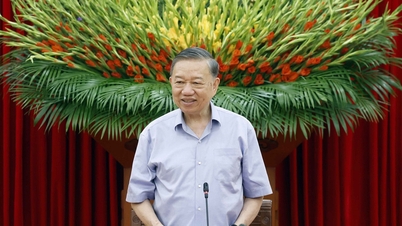
Chairman of the People's Committee of Ho Chi Minh City, Nguyen Van Duoc
In particular, the two strategic "golden rings" of the Ring Road 3 and Ring Road 4 are making decisive progress. The Ring Road 3, over 76 km long, is accelerating its progress after a period of delays, determined to complete the entire route this year. Meanwhile, the entire Ring Road 4 project, over 207 km long, passing through three provinces/cities (Ho Chi Minh City, Dong Nai City, and Tay Ninh Province) with an estimated total capital exceeding 100,000 billion VND, is racing against time to complete land clearance, aiming for simultaneous commencement of construction along the entire route on September 2nd.
Chairman of the Ho Chi Minh City People's Committee, Nguyen Van Duoc, affirmed that investment in technical infrastructure, especially transportation infrastructure, always plays a key role in the development of any country or locality. For Ho Chi Minh City, promoting and expanding inter-regional transportation projects at this time not only thoroughly solves the transportation problems of the people but also has particularly important significance. This is considered a crucial task that creates a strategic leverage to unlock development space, create a smooth flow of economic resources, and firmly affirm Ho Chi Minh City's central position for the entire region.
Source: https://thanhnien.vn/tphcm-toc-luc-mo-duong-ket-noi-lien-vung-185260610214541749.htm