

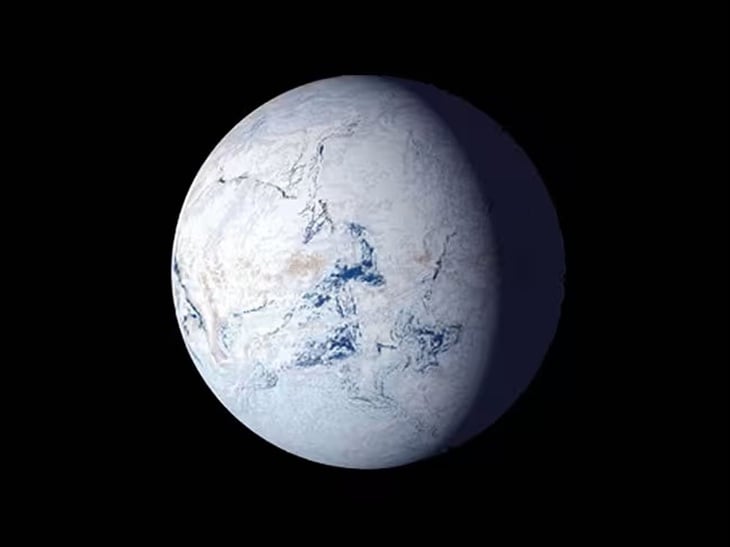
Some models estimate that about 20 days after the Sun disappears, the average global temperature will drop to freezing point - Photo: NASA
This scenario is almost impossible in reality, but it's a fascinating thought experiment that helps scientists explain how light, gravity, and life on Earth work.
Surprisingly, absolutely nothing happened during the first 8 minutes and 20 seconds, according to IFLScience on May 15th.
In fact, 8 minutes and 20 seconds is the time it takes for sunlight and gravity from the Sun to travel approximately 150 million kilometers to reach and impact Earth.
In other words, if the sun were to disappear right now, people would still be able to see it in the sky for another eight minutes.
The Earth continued to revolve around the position where the Sun once existed until "information" about its disappearance reached it.
After the 8-minute and 20-second mark, things started to change rapidly.
The Earth would be plunged into complete darkness and would plummet straight into space from the last position it was under the influence of the Sun's gravitational pull.
Other planets in the Solar System also share a similar fate. However, the likelihood of them colliding is relatively low because the distances between the planets are actually very large.
A notable exception might be Jupiter, the largest planet in the Solar System, which has a gravitational pull strong enough to disrupt the asteroid belts if the Sun were to disappear.
For humans, celestial collisions are not the greatest threat; the cold is.
Within just a few days, the Earth's surface temperature will drop below 0°C. Some models estimate that about 20 days after the sun disappears, the global average temperature will fall to the freezing point of water.
Without sunlight for photosynthesis, most plants will die quickly. The food chain collapses, dragging animals and humans down with it. Millions of people could die in a short time due to freezing temperatures and food shortages.
Over time, Earth's temperature will continue to drop to levels only a few tens of degrees above absolute zero, similar to the current environment on Pluto.
However, life may not be completely over yet.
Scientists believe that the deep ocean may remain liquid for extended periods thanks to heat from the Earth's core. Organisms living around hydrothermal vents on the seabed could continue to survive without relying on sunlight.
Humans can also survive in environments that utilize geothermal energy. Iceland is considered one of the few places capable of sustaining life long-term due to its heavy reliance on geothermal energy for heating and electricity production.
Although it's just a scientific hypothesis, this scenario shows just how dependent life on Earth is on the Sun: not only for providing light, but also for keeping the entire Solar System stable and for life to continue.
Source: https://tuoitre.vn/trai-dat-se-ra-sao-neu-mat-troi-dot-nhien-bien-mat-20260515150842696.htm














![[INFOGRAPHIC] Ugreen FineTrack 2 Soccer Design](https://vphoto.vietnam.vn/thumb/402x226/vietnam/resource/IMAGE/2026/05/25/1779680273219_info-bongdinhvi-a-thumb-jpg.webp)






















































































Comment (0)