

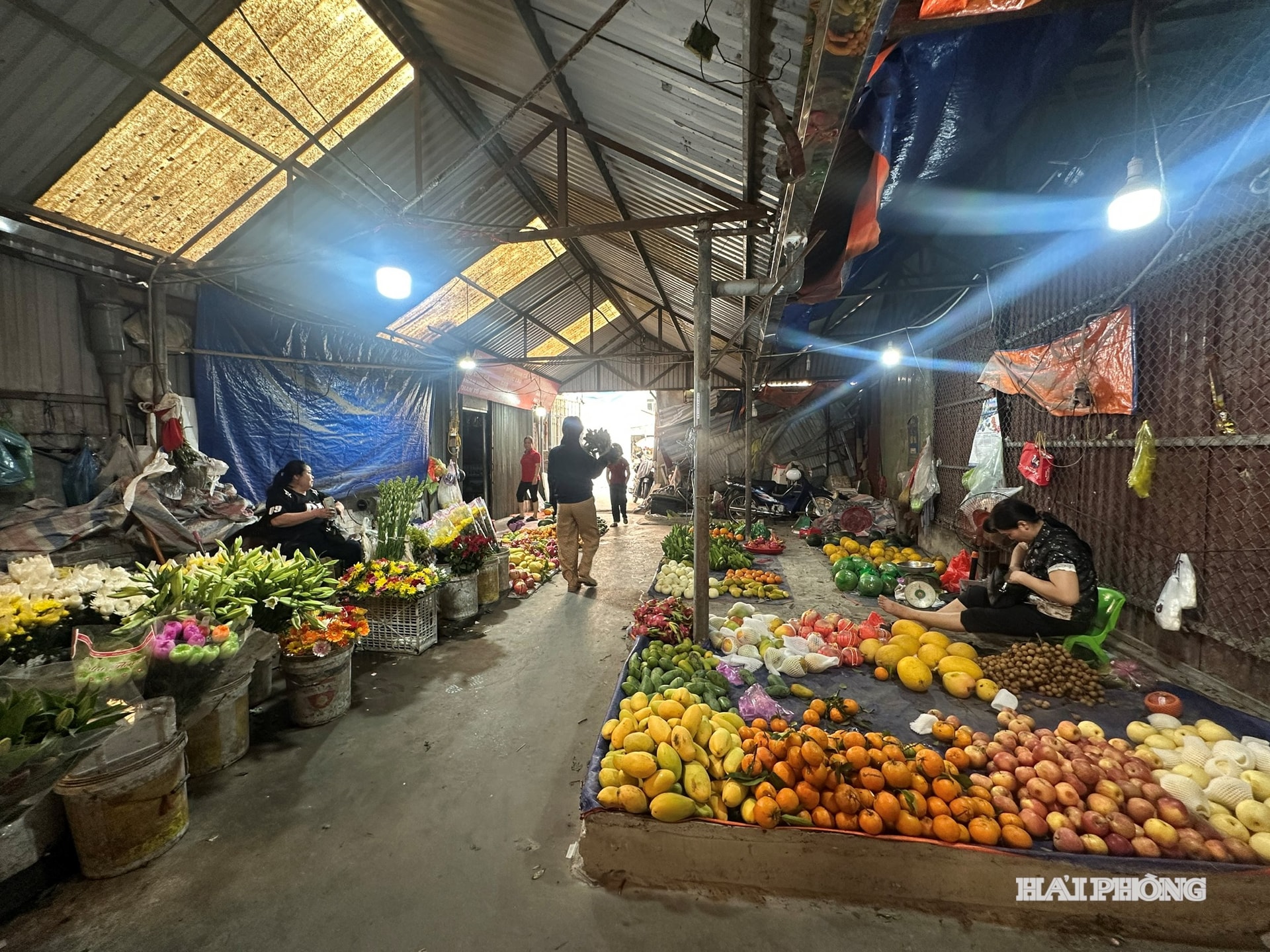
The market is dilapidated and unsafe.
Having existed for nearly 30 years, Quy Kim Market (Nam Do Son ward) was once a bustling trading hub in the southern part of the former Do Son district. However, due to not being included in the city's market network development plan, the market is now in serious disrepair.
Many structures at the market have deteriorated over time. The roofs are leaking, and the market floor is low, causing flooding whenever there is heavy rain. The electrical and fire safety systems are not synchronized, while the wastewater treatment and drainage areas are also dilapidated, causing the fresh food trading area to frequently emit unpleasant odors. Faced with this situation, many small traders have had to spend their own money to raise the floor, put up tarpaulins, and make temporary repairs in order to maintain their business operations.
Ms. Phung Thi Huong, who has been selling clothes at the market for nearly 30 years, shared: "Every time it rains, water floods into our stalls, and the roof leaks everywhere. We've spent our own money on repairs, but they're only temporary fixes. We just hope the market will be repaired soon so we can do business with peace of mind in the long term."
According to the People's Committee of Nam Do Son ward, the conversion of the management and operation model of Quy Kim market has not yet been implemented due to obstacles related to mechanisms and policies, as Quy Kim market is not included in the city's market network plan. In addition, attracting businesses and cooperatives to participate in investing in and managing the market has also faced many challenges.
Similarly, Go Cong Market (Phu Lien Ward), covering an area of over 3,343 m², was built in the 1970s and has also deteriorated after decades without comprehensive renovation. Many areas within the market are covered with makeshift tarpaulins, and the electrical system is a tangled mess, posing a high risk of fire and explosion.
According to the People's Committee of Phu Lien Ward, the market currently has 44 businesses selling various goods. However, the dilapidated infrastructure not only affects trading activities but also directly impacts the safety of residents in the surrounding area.
This situation is not unique to Quy Kim or Go Cong markets, but is a common problem in many local markets throughout the city. According to a review by the Department of Industry and Trade, Hai Phong currently has 352 markets of all types, of which 303 are classified as category 3, mainly local markets.
Most of the markets invested in by the State were built many years ago. Repairs carried out over various periods have been mostly piecemeal and inconsistent, leading to a series of shortcomings such as poor drainage systems, dilapidated roofs, narrow walkways, lack of parking spaces, and potential fire safety hazards.
A comprehensive investment plan is needed.
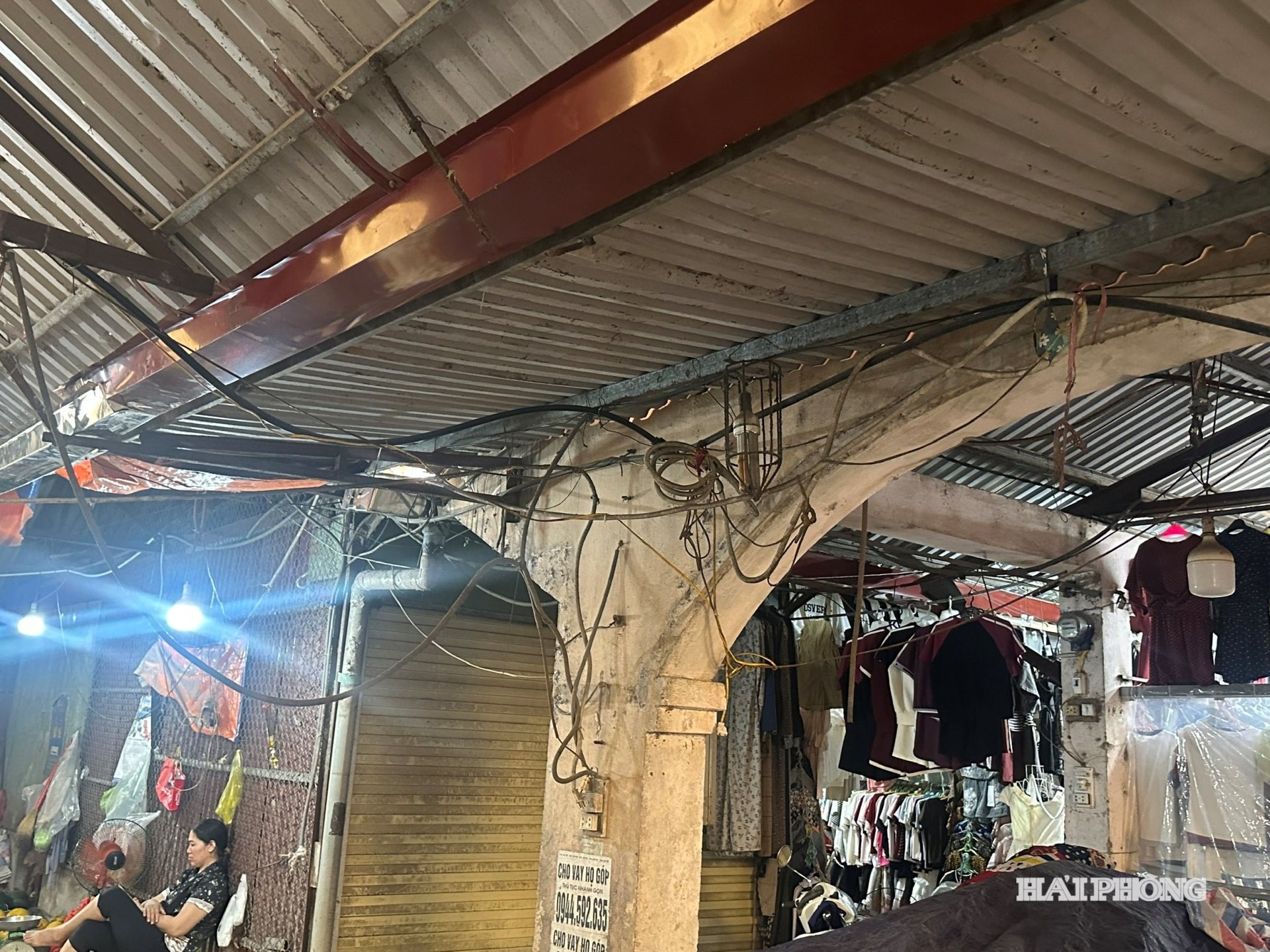
In response to this situation, the city is developing a Market Development Plan for the period 2026-2030 with many comprehensive solutions aimed at reviewing, classifying, and gradually upgrading the system of local markets.
According to the concluding statement of Vice Chairman of the City People's Committee Hoang Minh Cuong at the meeting on the market development plan for the period 2026-2030, the city requires that the plan must be developed in accordance with Government Decree No. 60/2024/ND-CP on market development and management; and at the same time, a comprehensive review of the current state of the market system in the area must be conducted to propose appropriate solutions for each type of market.
Notably, the city is aiming to develop a set of criteria for evaluating each market to determine whether to continue maintaining, renovating, upgrading, transforming the management model, relocating, or investing in new markets. This is considered a necessary approach to avoid scattered investments or piecemeal repairs that drag on for many years.
According to a proposal from the industry and trade sector, by 2030, Hai Phong aims to repair and renovate at least 50 state-invested markets to meet operating conditions, especially fire safety requirements; and at the same time, convert at least 30 markets to a business or cooperative model for management and operation.
To ensure the effectiveness of the plan to renovate local markets, many opinions suggest prioritizing investment in markets that are severely dilapidated, have a high density of vendors, and play a crucial role in serving the needs of the local population. The upgrades should not be limited to repairing roofs or raising the floor level, but should be implemented comprehensively, encompassing drainage systems, electricity, fire safety, parking, environmental sanitation, and rearranging business spaces.
Besides budget funding, it is also necessary to build an attractive mechanism to mobilize social resources and attract businesses to participate in investing in and managing markets in a civilized and modern way, while still being suitable for the characteristics of traditional markets.
Local markets are not only places for exchanging and buying goods, but also closely linked to the livelihoods of thousands of small traders and the essential needs of the people. Therefore, the early renovation and upgrading of dilapidated markets is not only a requirement for urban infrastructure but also a matter of social welfare and people's well-being that needs to be given due attention in the current period.
HAI VANSource: https://baohaiphong.vn/cho-dan-sinh-xuong-cap-543720.html
![[Image] Close-up view of the interchange connecting the two expressways and Long Thanh Airport.](https://vphoto.vietnam.vn/thumb/1200x675/vietnam/resource/IMAGE/2026/05/25/1779703378210_ndo_br_z7863716673926-224453a31600126cce10622af6290afd-4549-jpg.webp)
![[Image] Hanoi's urban life under the challenge of a "scorching hot" environment](https://vphoto.vietnam.vn/thumb/1200x675/vietnam/resource/IMAGE/2026/05/25/1779706979265_nang-nong-t5-2026-minh-duy-7-4636-jpg.webp)























































































Comment (0)