According to estimates by MB Securities (MBS), approximately VND 58,500 billion of corporate bonds will mature in the second quarter of 2026, a 140% increase compared to the same period last year and 3.3 times higher than the first quarter of 2026. This is a dramatic increase, reflecting the return of financial pressure after a period of relative calm at the end of 2025.
The pressure of loan repayments is mounting on real estate businesses.
Notably, the majority of maturity pressure remains concentrated in the real estate sector. In May and June 2026 alone, the total value of bonds maturing was approximately VND 30,500 billion, with the real estate sector accounting for 75.6%, equivalent to about VND 23,000 billion. This indicates that the capital structure of many real estate companies still heavily relies on the bond market while sales revenue has not yet recovered sufficiently.
According to many analytical organizations, the period from 2020 to 2022 was a time when real estate companies intensified bond issuance to expand land reserves, conduct mergers and acquisitions (M&A) of projects, and supplement working capital. After 3-5 years, the majority of these bonds are entering their maturity cycle at a time when the real estate market has not yet fully recovered. Therefore, the current pressure is not only about debt repayment, but also a test of the true financial health of the businesses.

Amidst increasing maturity pressure, bond issuance activity has also become more vibrant. In April 2026 alone, the total value of corporate bonds issued reached approximately VND 51,700 billion, a 60% increase compared to the previous month. Of this, nearly 59% of the issuance came from the real estate sector, totaling approximately VND 30,400 billion, a 110.8% increase year-on-year and the highest level in the past six months.
Real estate companies with significant issuance volumes during this period include Vingroup , Vinhomes, Minh An Real Estate Investment and Development Joint Stock Company, and many other project development companies. Notably, Vingroup successfully issued an international bond issue worth US$350 million, with a face value of US$200,000 per bond and a 5-year maturity, demonstrating that large enterprises still have access to foreign capital.
Cumulatively from the beginning of the year to date, the total value of corporate bonds issued has reached approximately VND 93,300 billion, an increase of 26.3% compared to the same period last year. Of this, real estate continues to be the leading sector with a total issuance value of approximately VND 54,400 billion, a significant increase of 278% and accounting for 58.3% of the entire market. The largest issuers since the beginning of the year include Marina Center Investment Co., Ltd., Vingroup, and T&T New Era Joint Stock Company.

According to VIS Rating's assessment, approximately VND 99 trillion in real estate bonds will mature in 2026. This means that a significant portion of the newly raised capital is actually being used for debt refinancing, easing liquidity pressure, or restructuring financial obligations, rather than for expansion investment.
If core business cash flow has not improved, continuously issuing new bonds to pay off old debt could lead to greater accumulated risk in the future.
Businesses are still "starving for capital" due to tightened credit.
The market continues to record cases of delayed principal and interest payments on bonds. In April 2026, an additional 4 bond codes were found to be overdue in payments, with a total value of nearly VND 2,900 billion. By the end of April, the cumulative value of bonds with overdue payments was estimated at approximately VND 31,500 billion, equivalent to about 2.3% of the total outstanding corporate bond debt in the market.
While this figure is lower than the peak crisis period of 2022–2023, it still shows that credit risk has not disappeared. Many businesses are currently facing three major pressures simultaneously: weakening sales cash flow, high cost of capital, and short-term maturities.
If the real estate market recovers more slowly than expected, there is a risk of increased debt restructuring or extended bond repayment periods.
One of the core reasons is that the market still lacks a sufficiently strong medium- and long-term capital channel to replace bank credit. For many years, the Vietnamese financial system has been heavily dependent on bank credit. For real estate, banks have been almost the primary source of funding for both developers and homebuyers.
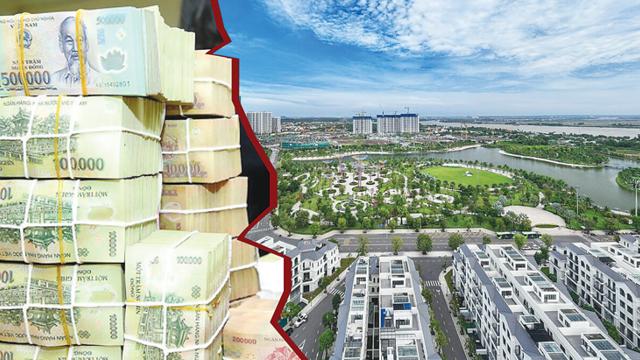
However, after a period of rapid credit growth in 2025, particularly in the real estate sector, the State Bank of Vietnam began tightening control over credit growth to limit macroeconomic risks. This made it difficult for many real estate businesses to access new loans, forcing them to return to the bond market as an alternative fundraising channel.
According to Mr. Tran Van Hieu, General Director of OBCHolding, the market currently faces a major paradox: many housing projects serving real housing needs still struggle to access capital because they are subject to the same credit mechanisms as speculative or high-end real estate segments.
Mr. Hieu argued that the current credit management system, based on a general market rate, forces businesses developing affordable housing to bear capital costs similar to those of resort or speculative projects with much higher risks. This not only increases financial pressure on businesses but also drives up product prices.
"Affordable housing developers are being 'trapped' in the same interest rate environment as speculative segments. This increases capital costs, thereby pushing housing prices in the opposite direction of social welfare goals," Mr. Hieu said.
Based on this reality, OBCHolding proposes that the State Bank of Vietnam should develop a mechanism for classifying credit according to each real estate segment instead of applying it uniformly as currently. Accordingly, affordable housing projects, housing serving real living needs, or those with good liquidity should have access to capital at more reasonable costs compared to high-end or resort segments.
According to many experts, if capital continues to be "tightly restricted" across all segments, the market could face a shortage of real housing supply while speculative projects are not effectively screened. This would also make the goal of lowering house prices and achieving a sustainable market recovery more difficult.
The biggest challenge is restoring market confidence.
The perspective from businesses suggests that current credit policies are still applied equally across all real estate segments, while the level of risk and capital absorption capacity of each type of property varies greatly.
Many experts believe that if the goal is to both control credit risk and support a healthy market recovery, regulatory authorities need to quickly develop a mechanism for classifying credit by segment instead of tightening it uniformly. Accordingly, social housing projects, affordable housing projects, or projects serving real housing needs should be prioritized in accessing capital at more reasonable costs.
In the long term, experts believe that Vietnam's real estate market needs to shift from a model dependent on banks to a more balanced and multi-tiered capital ecosystem.
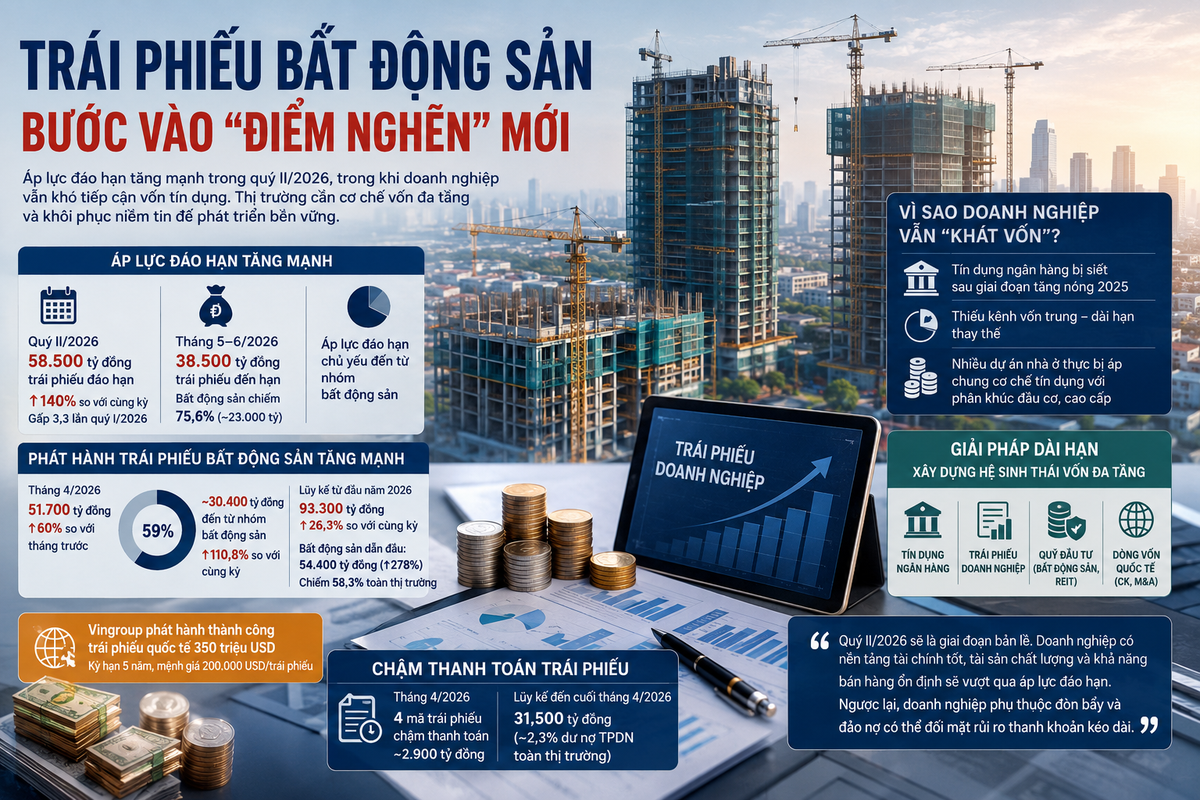
Mr. Nguyen Duc Thuan, Advisor to the Board of Directors of HASCO Holdings, believes that the connection between the financial and real estate markets in the coming period needs to be built on four pillars: bank credit, corporate bonds, investment funds, and international capital flows.
Regarding bank credit, Mr. Thuan believes that funding should not be based solely on collateral but should comprehensively assess the project's legal status, implementation capacity, sales plan, cash flow, and the enterprise's actual ability to repay the debt.
"Banks should not only play a role in providing funding but also need to become entities that monitor cash flow, control the use of capital, and support debt restructuring to suit the project's lifecycle," Mr. Thuan emphasized.
Regarding corporate bonds, this expert believes they should become a healthy medium- and long-term capital channel for the market, while also putting pressure on businesses to improve transparency in financial management. According to him, the bond market can only develop sustainably when accompanied by higher standards in credit rating, information disclosure, cash flow transparency, and monitoring of capital utilization.
Furthermore, real estate investment fund models such as REITs need to be promoted to create more long-term, professional, and transparent capital sources for the market. In addition, foreign capital flows through the stock market and M&A activities are also expected to play a larger role in the coming period.
In reality, the biggest risk today does not lie in the bonds themselves, but in the quality of the issuing company and the confidence of investors.
Following a period of rapid growth and a previous crisis of confidence, investors are now much more cautious. This forces businesses seeking to raise capital to demonstrate their financial capacity, project progress, and ability to generate real cash flow.
The second quarter of 2026 will therefore become a pivotal period for the real estate bond market. Businesses with strong financial foundations, quality assets, and stable sales capabilities will have the opportunity to overcome maturity pressures. Conversely, businesses that rely too heavily on financial leverage and debt refinancing may continue to face prolonged liquidity risks.
Source: https://phunuvietnam.vn/trai-phieu-bat-dong-san-buoc-vao-diem-nghen-moi-238260522181125588.htm























































































![[INFOGRAPHICS] 25 targets and groups of targets that Can Tho City strives for by 2030](https://vphoto.vietnam.vn/thumb/402x226/vietnam/resource/IMAGE/2026/05/25/1779688983034_1779688951.webp)












Comment (0)