

HANOI Stepping into the farm, I felt as if I had wandered into a forest, my ears filled with the sounds of birds and squirrels, and my eyes were enlivened by the sight of frogs, toads, red-eyed bees, praying mantises...
HANOI Stepping into the farm, I felt as if I had wandered into a forest, my ears filled with the sounds of birds and squirrels, and my eyes were enlivened by the sight of frogs, toads, red-eyed bees, praying mantises...
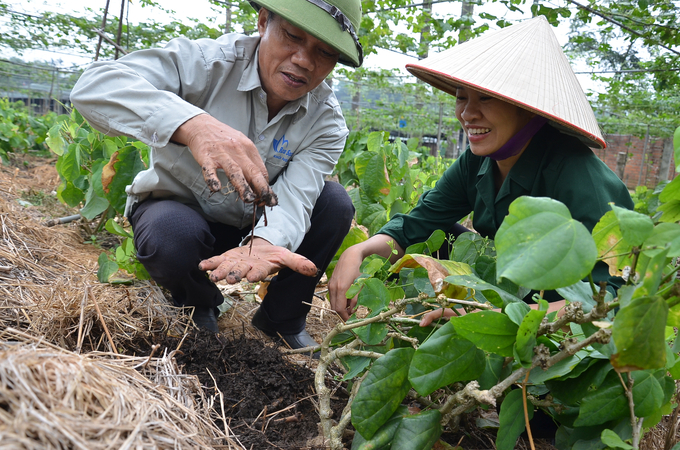
Ms. Truong Kim Hoa checks the growth rate of earthworms. Photo: Duong Dinh Tuong.
They reproduce naturally on the farm to eliminate pests according to the principle of natural balance. She taught hundreds of farm workers how to distinguish the cocoons of red-eyed bees from those of other insects, leaving behind or preserving the egg clusters of natural predators like praying mantises. Only when there are too many insects do they use homemade herbal remedies like garlic and chili peppers soaked in alcohol to kill them; otherwise, they leave the red-eyed bees with places to lay their eggs. If all the insects are eliminated, it means there will be no place for the red-eyed bees to lay their eggs. As for weeds, they have to pull them out by hand or hoe them down to the roots to get rid of them.
She is Truong Kim Hoa - owner of Hoa Vien Farm (Yen Binh, Thach That, Hanoi ). Every year, this huge farm supplies the Hanoi market and surrounding areas with thousands of tons of organic vegetables under the Dai Ngan brand, meeting the organic standards of the most demanding countries such as the US (USDA), Europe (EU) and Japan (JAS).
The journey into agriculture for a bank employee in downtown Hanoi began in 2004 when she bought an 8,000m2 plot of land to establish a farm, hired someone to look after it, but failed. Because of this, she had to stay on-site to manage the farm. Although she was prone to illness, her health has improved significantly since engaging in organic farming, and her spirits remain high.
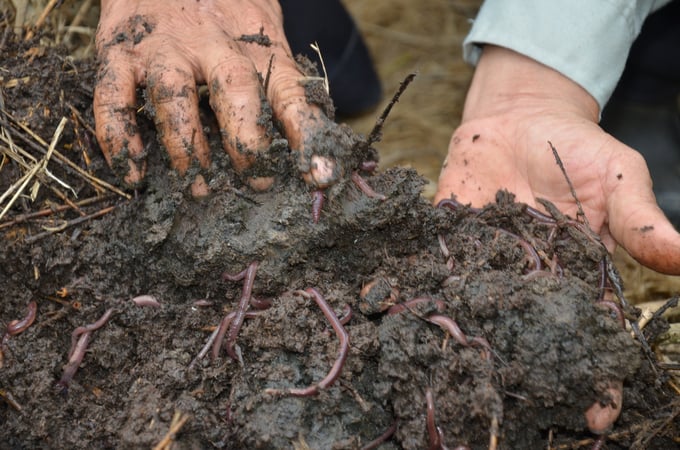
Earthworms are raised to feed on by-products and produce fertilizer. Photo: Duong Dinh Tuong.
With the profits from growing vegetables, as well as the savings accumulated year after year, she bought more land to expand to over 60 hectares as it is today, turning it into a typical ecological, circular, and self-contained farm in Hanoi in particular and Northern Vietnam in general.
Achieving the current diverse ecosystem with numerous natural predators is the result of a long and diligent process in which she applies crop rotation and intercropping methods to vegetable crops; intercropping multiple species with perennial plants; and planting cover crops to improve soil (green manure crops such as soybeans, mung beans, peanuts, etc.). Furthermore, she also plants trees and preserves the buffer zone of primary forest, creating an environment for various animal and plant species to live and thrive.
Fortunately for someone passionate about organic farming like her, the land here has not been affected by chemical pesticides, chemical fertilizers, or pollution from industrial production. On this foundation, she grows legumes to take advantage of their nitrogen-fixing ability, combined with worm compost produced by the farm itself to increase soil fertility and aeration.
The farm uses pure spring water from Mount Vua Ba to irrigate the plants. Because it adheres to strict international organic standards, the farm does not use any chemicals in any stage of production. The farming area is completely isolated from residential areas and the farmlands of local farmers. All waste from harvesting and processing is collected by workers and used as food for earthworms. The earthworm castings are then returned to the fields to fertilize the vegetables.
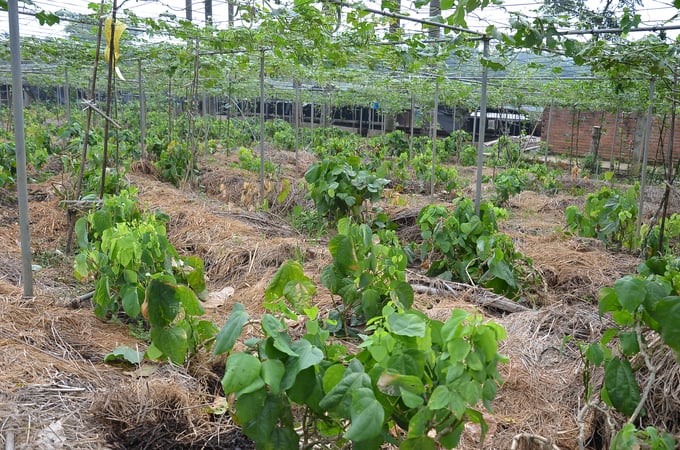
Native plants are grown organically in rows on the farm. Photo: Duong Dinh Tuong.
Regarding crop varieties, the farm does not use genetically modified plants but prioritizes native plants readily available in the Ba Vi mountain forest such as wild spinach, wild spinach, wild spinach, red amaranth, bitter melon, and bitter melon. As for medicinal herbs like Gynostemma pentaphyllum, Rhus chinensis, Ophiopogon japonicus, Codonopsis pilosula, Lonicera japonica, and Tinospora cordifolia, she initially only intended to grow them to treat the pigs on the farm. Later, realizing that producing them for humans would be more beneficial, she persevered in pursuing this. These herbs are high-value but take a long time to harvest, so she has to grow vegetables and raise earthworms to generate income in the short term, intercropping and staggered planting to ensure that the 100 farm workers always have work and jobs.
As someone who lives by the gentle philosophy of Buddhism, Ms. Hoa always keeps in mind that organic farming brings health to the environment, to the producers, to the consumers, and to the future of humanity. It is also a way for ethical farmers to create blessings for the world.
Source: https://nongsanviet.nongnghiep.vn/trang-trai-huu-co-hon-60ha-dat-tieu-chuan-cua-my-eu-nhat-ban-d406812.html





















![The Essence of Viet Bac Villages: [Part 3] The Precious Fragrance of Nghinh Tuong](https://vphoto.vietnam.vn/thumb/402x226/vietnam/resource/IMAGE/2026/05/29/1780020600366_5237-tinh-tuy-ban-lang-viet-bac-bai-3-chuyen-o-nghinh-tuong-050626_700.jpeg)
![The Quintessence of Northern Vietnam's Villages: [Part 2] The Famous Cassava Noodles of Kunming](https://vphoto.vietnam.vn/thumb/402x226/vietnam/resource/IMAGE/2026/05/28/1779937455892_3929-3144-mien-dong-15-nongnghiep-023138.jpeg)
![The Essence of the Village: [Part 1] Wine on the mountain, tea in the clouds - Bang Phuc](https://vphoto.vietnam.vn/thumb/402x226/vietnam/resource/IMAGE/2026/05/27/1779841729178_3821-1jpg-nongnghiep-103814.jpeg)




















![[Video] Sunset at Lap An Lagoon – Where the sun sets over the fishing nets](https://vphoto.vietnam.vn/thumb/1200x675/vietnam/resource/IMAGE/2026/05/31/1780192137701_beach-landscape-sea-water-nature-grass-745871-pxhere-com.jpeg)































Comment (0)