

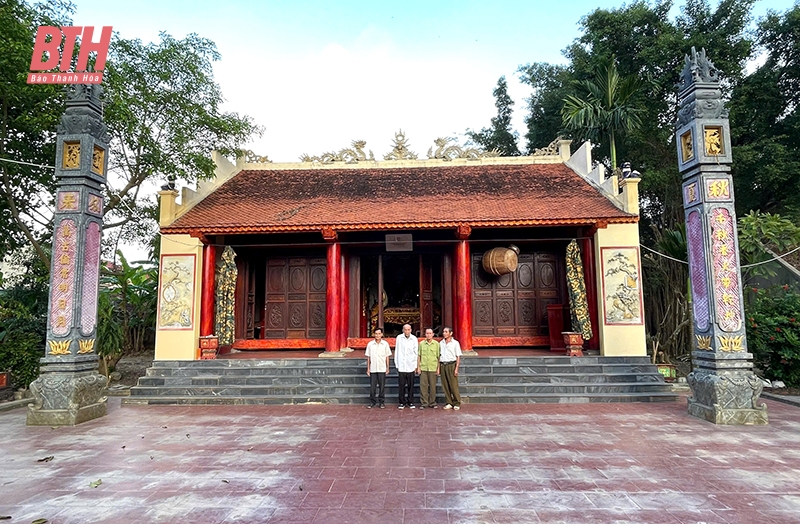
The ancient village of Quần Thanh is located in Khuyến Nông commune (Triệu Sơn district) today. It houses a temple dedicated to the village's tutelary deity, General Trần Huệ, who played a key role in reclaiming and developing this land.
In the 3rd century, an uprising led by the siblings Trieu Quoc Dat and Trieu Thi Trinh took the Nua mountain region as their base. To protect their base, the Trieu siblings built fortifications along the Hoang River, including a part of Quan Thanh village. During the Tran dynasty, to prepare for a long war against the Mongol invaders, the Tran king and officials moved from Thang Long to Thanh Hoa , building fortifications behind the Hoang River, establishing a battle line so that they could retreat to the Nua mountain region to preserve their forces if necessary. The fortifications were planted with thorny bamboo, hence the name "Thorn Fortress". Remnants of these ancient fortifications still remain in Quan Thanh today.
During the Tran Dynasty, when the Champa army attacked Thanh Hoa, the king assigned General Tran Khat Chan and Tran Hue (later the tutelary deity of Quan Thanh village) to defend the Hoang River line. Currently, the villages of Quan Nham, Quan Truc, Quan Thanh, Hoa Trieu, and My Thon still retain traces of the Gai Citadel and the area known as Dong Thanh. Among them, Quan Thanh was a military outpost.
Mr. Nguyen Xuan Dong, 91 years old, head of Quan Thanh village, said: "In ancient times, the land of Quan Thanh was wild and teeming with wildlife. The people of Quan Thanh always believed that the village's tutelary deity was the brave general Tran Hue. He was originally from Loi Duong, now Tho Xuan district, and followed the famous general Tran Khat Chan to fight battles. When he came to Quan Thanh, seeing that the land was fertile and suitable for building a career, he brought his relatives from Quan Lai and Quan Doi (Tho Xuan) to clear the land and establish a village initially called Xanh village, later changed to Quan Thanh. The word 'Quan' implies a reminder to descendants not to forget their origins. The tutelary deity of Quan Thanh village, with his extraordinary intelligence, was not only skilled in battle but also adept at guiding the people in farming, building their livelihoods, and teaching them proper conduct, creating the fine customs and traditions of this land along the Hoang River."
When the assassination attempt on Ho Quy Ly at Don Son failed, the renowned general Tran Khat Chan was beheaded, and his subordinates, including General Tran Hue, suffered the same fate. Grateful for his contributions in reclaiming land, establishing settlements, and developing this region, the people revered him as the village's guardian deity and erected a temple in his honor.
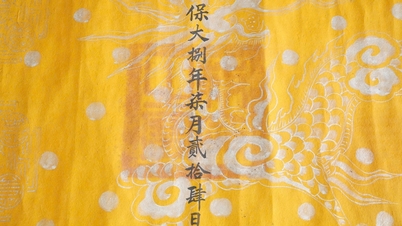
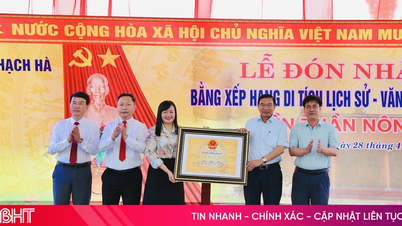
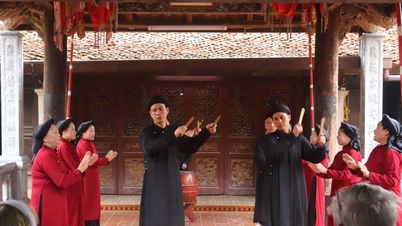
The Quan Thanh Temple received 12 royal decrees from various feudal dynasties (from the Canh Hung era in 1783 to the Khai Dinh era in 1924). These decrees recognized the deity's meritorious service in protecting the nation and its people, its upright character, its miraculous powers, and bestowed upon it the titles of Great Sage, Great King, and Supreme Deity. In 2000, the Quan Thanh Temple was classified as a provincial-level historical and cultural relic. Also in that year, the village mobilized residents to contribute to the restoration of the temple, making it as magnificent as it is today and a place of religious activity for the local people. Every year on the 10th day of the first lunar month, the Quan Thanh village festival is held to commemorate the village's tutelary deity.
Khac Cong
Source: https://baothanhhoa.vn/tren-dat-lang-co-quan-thanh-233307.htm














































































Comment (0)