Located on the Tuan Ngu River (a branch of the Ma River), Quan Noi village, Long Anh ward ( Thanh Hoa City), was formerly part of Hoang Anh commune (Hoang Hoa district). For a long time, this area served as the administrative center of Hoang Hoa district. Today, Quan Noi is a cultural village space with place names and relics associated with the formation and development of this ancient land.
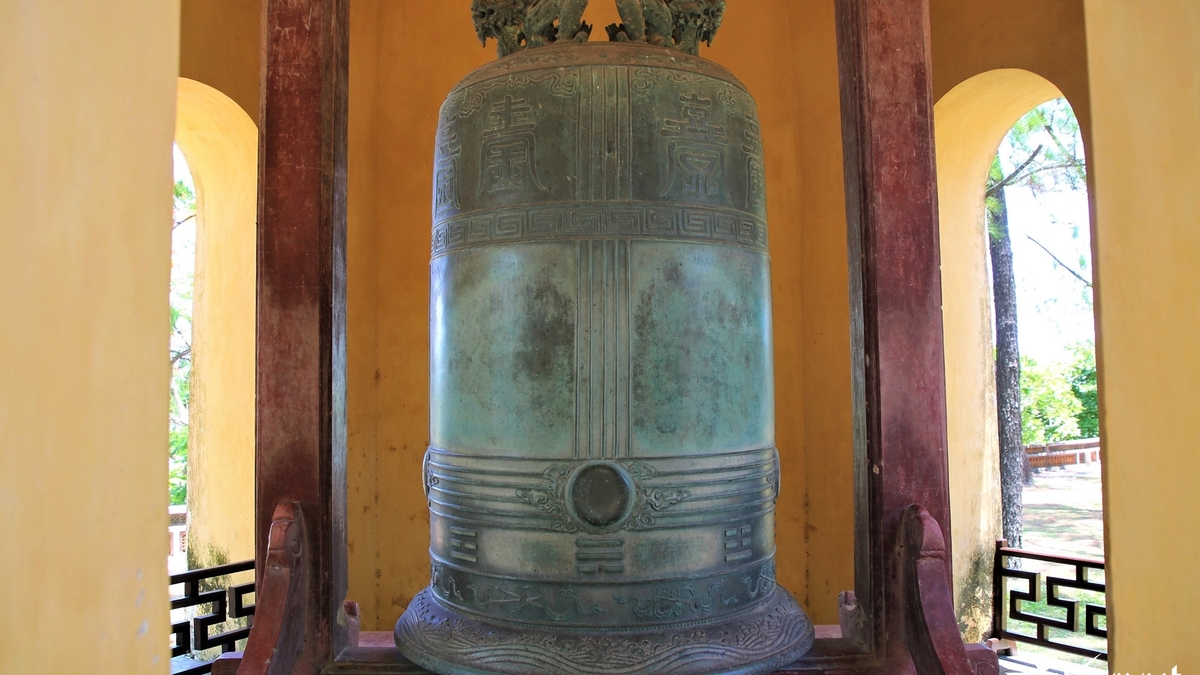
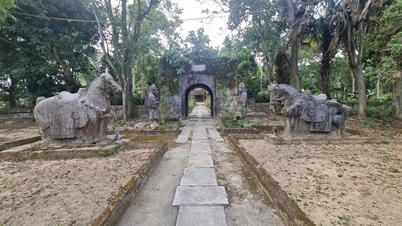
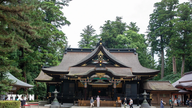
 The Quan Noi communal house and temple complex still preserves traces of ancient architecture. Photo: Khanh Loc
According to local records and oral traditions, Quan Noi village has a history dating back to the Ly-Tran dynasties. Legend has it that the village was founded by Mr. Dao Tinh, a man from the Kinh Bac region who, while traveling through the mountains and rivers, found the land along the Tuan Ngu river fertile and flat, and decided to settle there.
With its advantageous location: "The Tuan River stretches far and wide / Boats travel upstream and downstream, boats return like stars in the sky," perhaps that's why, during its development, Quan Noi became the administrative center of Hoang Hoa district. On the land of Quan Noi village was the "District Market" - the most bustling trading center in the region. The market was usually held on market days (the 3rd, 8th, 13th, 18th, 23rd, and 28th of the lunar month), attracting a large number of traders from all over. The lively and bustling market days remain a fond memory often recounted by the elders of the village.
“The boat trading business of Quan Noi village is closely associated with Huyen Market. Historical records indicate that before the Ma River flowed to Ham Rong, Huyen Market was very bustling. It was considered a major trading port of Hoang Hoa, with the boat trading industry originating in the 14th century. Quan Noi boats were made of wood, about 15-20 meters long, and could carry around 5 tons of goods. Each owner had one boat, some had two or three. At that time, there were as many as 50-60 such boats in the commune. The boats traveled far and wide, sometimes heading north, sometimes south, buying goods to sell wholesale or retail at Huyen Market and other markets in the region... During Tet (Lunar New Year), Huyen Market became even more crowded, with boats and brown sails stretching from Quan Noi all the way to Cau Tao... Due to the development of the boat trading business, Quan Noi village became one of the villages with many wealthy families in the district.” (From the book "History of the Party Committee and Revolutionary Movement of the People of Hoang Anh Commune").
Thanks to the early development of trade and commerce, not only did the economy of the land along the Tuan River flourish, but it also contributed to creating a distinctive village space with valuable cultural architectural works in Quan Noi village.


The "picture" of Quan Noi village is described as follows: "At the beginning of the village is the long-standing market, a lasting landmark of a rural area with a riverside population. Standing at the end of the village, looking out over the fields to the south, there is an altar dedicated to the God of Agriculture (now called the 'banyan tree altar'). According to old customs, on the 15th and 1st of each month, villagers would often go there to light incense and pray to the God of Agriculture for a bountiful harvest. Looking to the west, there is Long Khanh Pagoda, dedicated to Buddha and Saints... To the northeast, next to the district market, is a large, ancient temple dedicated to the Four Holy Mothers." (From the book "History of the Party Committee and the Revolutionary Movement of the People of Hoang Anh Commune").
In particular, the village of Quan Noi formerly housed the National Mother Temple, a source of local pride for a courageous and patriotic mother. Legend says that in the early 15th century, there was a woman named Ha Thi Cai in Quan Noi. In her old age, having no children or grandchildren, she traveled down the Ma River to the village of So (now Nghia Huong village in Hoang Xuan commune, Hoang Hoa district) and opened a water stall along the dike. At that time, King Le Loi of Binh Dinh raised the banner of rebellion to drive out the invading Ming army. During one of his pursuits, while crossing the Ma River, he encountered Ha Thi Cai's water stall, and she cleverly helped the leader of the Lam Son rebellion escape danger. After ascending the throne, not forgetting the water vendor's kindness, King Le Thai To invited her to the capital Thang Long. Upon her death, she was posthumously honored as the National Mother, and the king decreed that the people of Quan Noi and Nghia Huong villages (now So village) should build a temple to worship her. From then on, the two villages had a close, fraternal relationship.
 The temple dedicated to the Great Saint in Quan Noi village has been renovated and looks much more impressive.
Over time, amidst the ups and downs, some architectural structures in Quan Noi village have inevitably suffered damage. Nevertheless, with pride and respect for the traditional cultural values of their ancestors, the people of Quan Noi have collectively contributed funds to restore and preserve these relics. As a result, many architectural works in Quan Noi today, closely linked to the spiritual life and serving as cultural "highlights" and "spiritual anchors" for the local people, are being preserved and their value is being promoted.
This is the Duc Thanh Ca Temple, dedicated to the Four Holy Mothers. This majestic temple, situated by the Tuan River, dates back to the Le Dynasty. In 2011, it was renovated and expanded on its original foundation. Ms. Le Thi Sot, a resident of Quan Noi village who looks after and maintains the incense offerings at the Duc Thanh Ca Temple, proudly stated: “Historically, the Duc Thanh Ca Temple played a significant role for many generations of local people, contributing to the unique culture and customs of Quan Noi. Therefore, when the plan to renovate the site was announced, the people were very enthusiastic and eager to contribute. The renovation was completed in just one year. At the Duc Thanh Ca Temple, on the 15th day of the first lunar month each year, a festival is held, attracting a large number of people, including descendants from near and far, to participate.”
Along with the Duc Thanh Ca Temple, the Quan Noi communal house and temple complex is also a cultural highlight of this ancient land. With its architecture featuring a communal house in the front and a temple in the back, the complex has a history of construction spanning many periods. In particular, the Quan Noi temple still preserves many architectural features from the past. Ms. Nguyen Thi Diu, a cultural and social affairs official of Long Anh ward, said: “The Quan Noi communal house and temple complex houses the worship of many revered figures (celestial and human deities). Because of this, the complex has several different names, such as the communal house and temple dedicated to the local deity, or the Quan Noi communal house and temple, each with its own explanation. However, this does not affect or diminish the value of the complex.”

Amidst the hustle and bustle of modern life, the people here still cherish traditional cultural values. These include the village gate, the village well, the communal house, the temple, and the pagoda. All of these coexist, creating the unique beauty of Quan Noi village.
Text and photos: Khánh Lộc
Source
![[Photo] General Secretary and President To Lam working with the Technical and Professional Center, Ministry of Public Security](https://vphoto.vietnam.vn/thumb/1200x675/vietnam/resource/IMAGE/2026/07/06/1783318005842_a1-bnd-1129-2263-jpg.webp)