Quietly searching for memories of the old profession.
(GLO) - At the end of 2025, the book "Traditional Weaving Crafts of Binh Dinh Province (from the 19th Century to the Present)" by Master Hoang Binh will be released to readers as a meticulously researched work on a craft that was once closely associated with the lives of the people of Binh Dinh province.
Báo Gia Lai•16/03/2026
Mr. Hoang Binh, born in 1975, is from An Tuong Tay commune, Hoai An district, Binh Dinh province (now An Tuong commune, Gia Lai province). He graduated with a major in Information and Library Science from Hanoi University of Culture in 1996 and a Master's degree in Vietnamese History from Quy Nhon University in 2020.
He is currently the Deputy Head of the Administrative and General Affairs Department (Provincial Library), and a member of the Folk Arts Branch ( thuộc the Provincial Association of Literature and Arts).
Behind the book "Traditional Weaving Crafts of Binh Dinh Province (from the 19th Century to the Present)" lies the memories of the countryside and the persistent journey of collecting, reading documents, and conducting fieldwork by a librarian who is passionate about local history and culture.
From memories of the countryside to pages of traditional crafts.
* What motivated you to spend many years researching and compiling the book "Traditional Weaving Crafts of Binh Dinh Province (from the 19th Century to the Present)"?
- From a young age, I was familiar with the image of mulberry cultivation and silkworm rearing in my hometown, especially in the hamlets of Buong and Cui. However, I only heard about weaving from my father, because by the time I grew up in the village, no family still practiced the craft.
Reading old documents, I realized that weaving once played a significant role in the economic and cultural life of Binh Dinh. Particularly during the French colonial period, the Delignon textile factory was built in Phu Phong (Tay Son) in 1903. However, in-depth research on weaving in Binh Dinh is still quite limited, and the available materials are scattered across many sources.
Over 10 years ago, I began researching and collecting materials. Initially, it was just personal notes, but the more I read, the more interesting things I discovered. The materials about weaving villages and the textile products that were once widely traded gradually formed in my mind the idea of undertaking a scholarly work on this subject.
* To write this book, you must have accessed many sources of information…
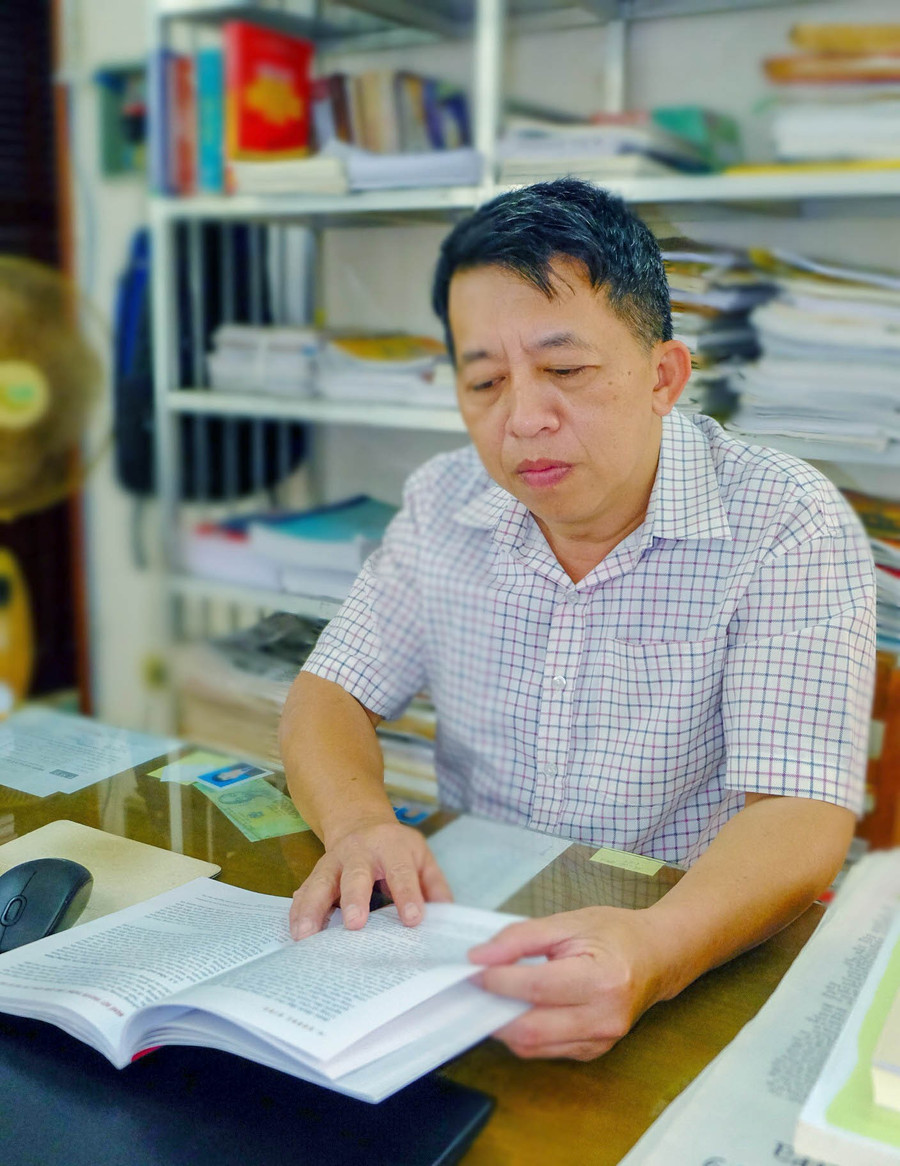
MSc. Hoang Binh has devoted much effort to the book "Traditional Weaving Crafts of Binh Dinh Province (from the 19th Century to the Present)". Photo: NN
- That's right. I used quite a few different sources, and that's necessary for comparison and contrast.
First, there are geographical and historical books from the Nguyen dynasty such as: Dai Nam Nhat Thong Chi, Dong Khanh Du Dia Chi, along with many archival documents on trade and handicrafts in Central Vietnam.
In addition, there are other works related to Binh Dinh such as: Nguyen Dinh Dau's study of the Nguyen Dynasty's land registers, specifically the Binh Dinh province section; Quach Tan's work on the landscape of Binh Dinh; Bui Van Lang's study of the geography of Binh Dinh province; and excerpts from Tran Duy Duc's memoirs about weaving or fabric trading activities...
I also accessed a lot of French-language materials from the open data archives of the French National Library, the French School of Far Eastern Studies, and several sources on the internet.
Besides reading documents, I spent time doing fieldwork in several craft villages, meeting with elderly people to record their memories. Stories that seemed very ordinary, such as weaving at home or selling fabric at the market, provided many vivid details for my research.
* In your opinion, what are the notable characteristics of traditional weaving in Binh Dinh?
- In the past, Binh Dinh had many traditional weaving villages, among which the most famous was "bean silk." "Bean" refers to the process of combining many silk threads together for weaving. Bean silk is divided into several types such as bean 2, bean 3, bean 4, and bean 6; of which bean 4 is commonly used for making clothing.
However, since the beginning of the 20th century, with the strong development of industrial textiles, many traditional weaving villages have gradually shrunk or disappeared. Therefore, documenting the history of weaving is also a way to preserve a part of the local cultural memory.
Nurturing a passion for research from a "living archive" of resources.
* Working at the library, especially being in charge of the Information and Documentation Department for a period of time, how did this influence your research path?
- I think the library environment has helped me a lot. When I spent time working in the field of local history, I had the opportunity to access many documents related to the history, culture, and people of various localities.
For me, the library's local history collection holds a wealth of "living documents." It contains books, newspapers, magazines, research papers, and sometimes even rare materials.
The process of reading and organizing documents helped me gain a deeper understanding of regional history and culture, and also sparked new research directions.
* In your opinion, what contributions can the library's local history collection make to the preservation and promotion of localcultural and historical values ?
- The provincial library's local history archive currently holds over 3,000 books and documents related to cultural heritage such as Champa culture, the Tay Son movement and Tay Son dynasty, Binh Dinh traditional martial arts, traditional opera, and folk singing... In addition, there are more than 7,600 digitized excerpts from local history.
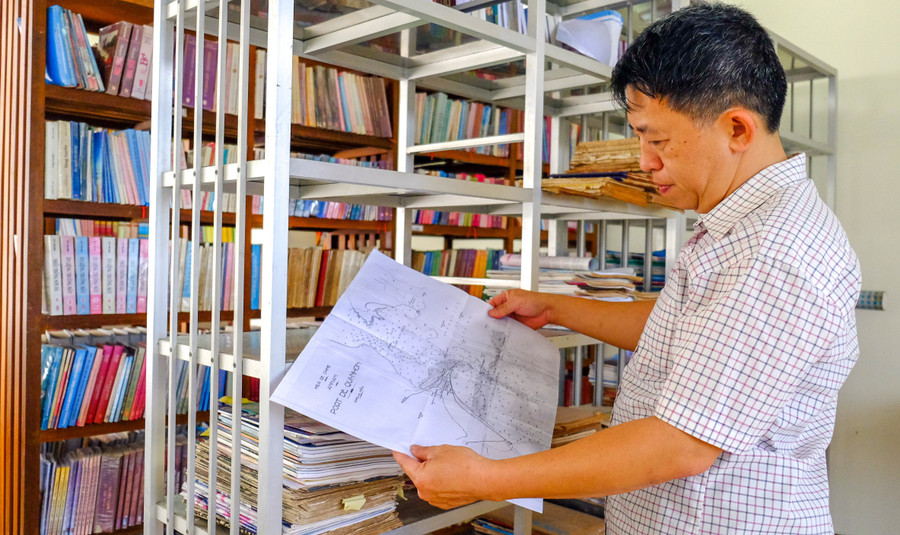
In addition, there are many French-language documents translated from libraries both domestically and internationally, reflecting on the trades, traditional crafts, the ancient land of Quy Nhon - Binh Dinh, Quy Nhon port, etc.
This is an important comprehensive source of information, providing systematic details about the geography, history, economy, society, and culture of Binh Dinh province from the past to the present.
In my research on the textile industry, I also drew upon many documents from this local history archive.
The local history archives at the Provincial Library were utilized by Master's student Hoang Binh for his research project. Photo: NN
Passionate about researching the heritage of Han Nom documents.
In addition to his professional work at the Provincial Library, Mr. Hoang Binh also dedicates a significant amount of time to the Han-Nom heritage.
* What led you to self-study Chinese characters and research Sino-Vietnamese studies?
- My father used to be the Director of the Provincial Library. When I was little, I often went to the library with him to read. When I saw the books and documents written in Han-Nom script, I was very curious because I thought they must contain a lot of valuable information, even though I couldn't read them at the time.
Later, when I started working at the library in 1997, I often encountered documents written in Sino-Vietnamese script and always felt regretful that I couldn't read their contents. Therefore, I decided to learn Chinese characters.
I sought out Mr. Nguyen Chat - former Deputy Director of the Dao Tan Traditional Opera Theatre (now the Provincial Traditional Arts Theatre) - to learn Chinese characters.
My uncle guided me on how to learn the alphabet and the rules of writing characters, and then I continued to learn more on my own through books and discussions with experienced people. It was quite difficult at first, but gradually I was able to read basic materials.
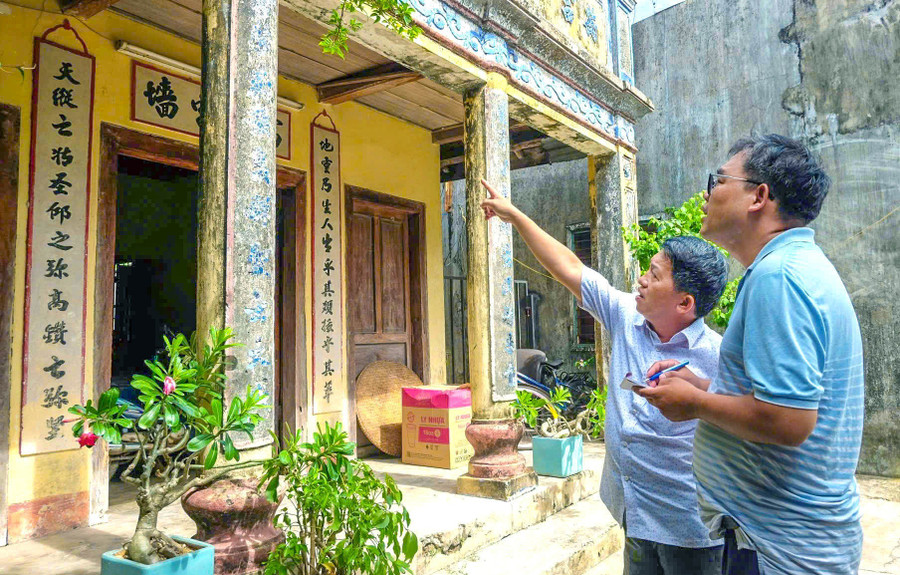
MSc. Hoang Binh (left) and Dr. Vo Minh Hai (Quy Nhon University) during field trips to research Sino-Vietnamese documents and learn about the history and culture of their homeland. Photo: NN
* What types of Sino-Vietnamese documents have you been involved in translating?
- The majority are royal decrees, genealogies, promissory notes, couplets from ancestral temples, or handwritten copies preserved in folklore. Some acquaintances also ask for my assistance when they need to read or translate Sino-Vietnamese documents. I see this as a small contribution to exploring the value of Sino-Vietnamese documentary heritage.
* Do you plan to continue your research in the future?
- I still want to continue researching traditional crafts as well as historical and cultural documents related to Binh Dinh; especially since there are still quite a lot of Sino-Vietnamese documents that have not been explored.
I am currently continuing my research project on the city of Quy Nhon during the period 1874-1945. This project develops from my 2020 master's thesis, which focused on the history of Chanh Thanh village in the city of Quy Nhon.


![[Image] Hanoi's urban life under the challenge of a "scorching hot" environment](https://vphoto.vietnam.vn/thumb/1200x675/vietnam/resource/IMAGE/2026/05/25/1779706979265_nang-nong-t5-2026-minh-duy-7-4636-jpg.webp)

![[Image] Close-up view of the interchange connecting the two expressways and Long Thanh Airport.](https://vphoto.vietnam.vn/thumb/1200x675/vietnam/resource/IMAGE/2026/05/25/1779703378210_ndo_br_z7863716673926-224453a31600126cce10622af6290afd-4549-jpg.webp)














































































Comment (0)