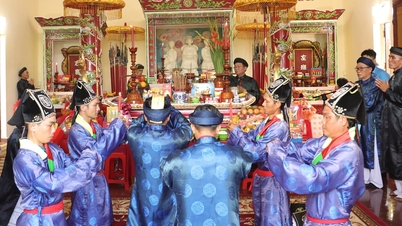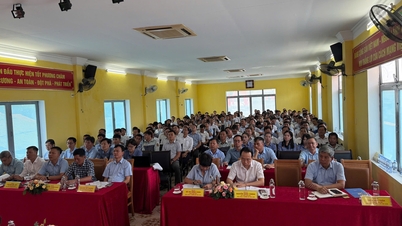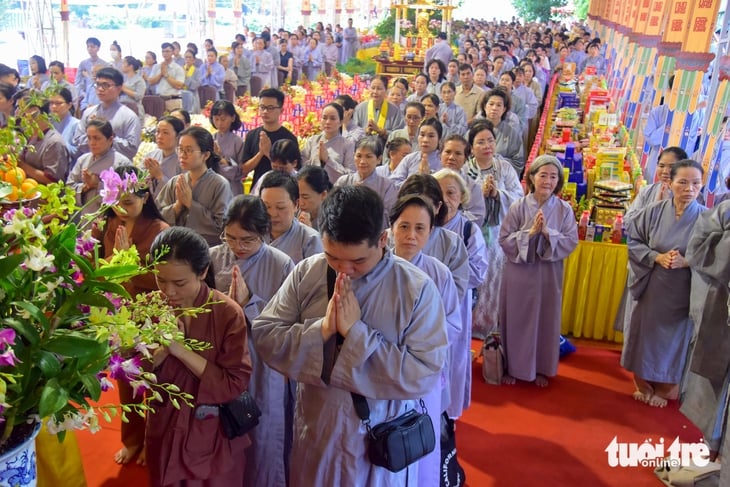
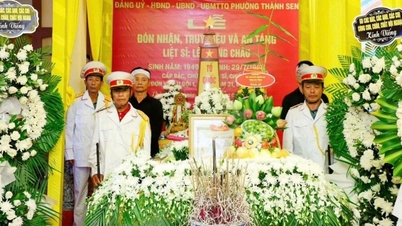
Hundreds of monks, nuns, and Buddhist followers arrived early to attend the memorial service, commemorating and paying tribute to the heroic martyrs, soldiers, and patriotic citizens who sacrificed their lives for national independence - Photo: TRI DUC
It is not just a spiritual ritual or a historical commemoration, but also a cultural thread connecting the past with the present, helping each generation understand that the peaceful life we enjoy today was bought with the blood, sweat, and sacrifices of those who came before us.
No one is forgotten.
These days, as thousands of people flock to Le Thi Rieng Park to attend a memorial service for fallen soldiers and patriotic citizens, many are deeply moved when they think of those whose lives have been buried for nearly six decades.
According to historical documents and preliminary survey results, the old Do Thanh cemetery area may still contain more than 900 remains of cadres, soldiers, and patriotic citizens who sacrificed their lives during the Tet Offensive and Uprising of 1968, which have yet to be collected.
Those numbers are not just historical data. They represent people who once had names, hometowns, families, and unfulfilled dreams. They passed away at a very young age, leaving behind parents, spouses, children, and a future they never had the chance to build.
Time may change the landscape and landmarks. A cemetery of yesteryear has now become a cultural park in the heart of the city, but the memory of that sacrifice has not faded.
Therefore, the search for and collection of the remains of fallen soldiers is not simply a professional task or an administrative responsibility. It is also a moral act, a response from today's generation to those who fell for the independence and freedom of the nation.


A nation may become wealthy thanks to its resources, science and technology, or favorable geopolitical position, but for a nation to endure, it also needs memory and gratitude – a nation that appreciates its past will not easily lose its future.
From filial piety within the family to loyalty to the country.
In Vietnamese culture, gratitude and repaying kindness are traditions that have been preserved for millennia. Vietnamese people commemorate their ancestors and honor their parents and grandparents not out of superstition, but as a way of remembering their roots and that every achievement today is built upon the efforts of those who came before. This spirit is also clearly evident in Buddhist teachings.
The Buddha taught about the four great debts of gratitude: gratitude to parents, gratitude to the Three Jewels (Buddha, Dharma, Sangha), gratitude to the nation and society, and gratitude to all sentient beings. Those who live according to the Dharma not only show filial piety to their families but also express gratitude to their homeland, country, and community. From this perspective, the memorial service for fallen soldiers at Le Thi Rieng Park is not merely a religious ritual. It is a meeting point between national morality and the spirit of Buddhism.
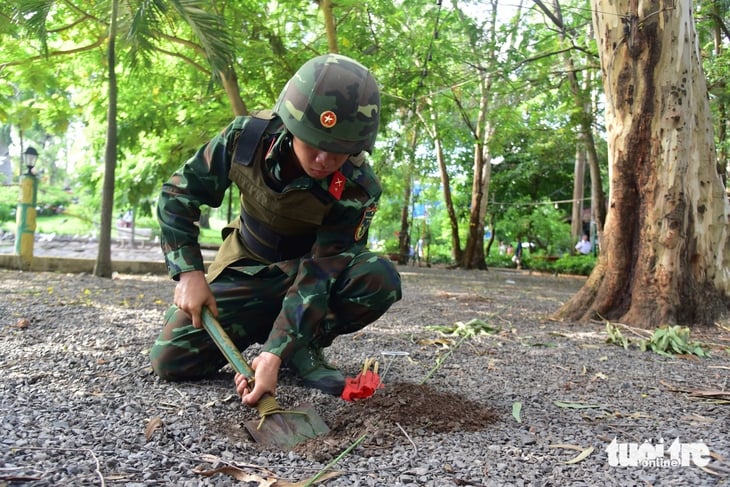
Surveying an area for the search for the remains of fallen soldiers in Le Thi Rieng Park.
When the Ksitigarbha Sutra is chanted throughout the night, and when offerings are prepared according to the customs of all three regions, it is not simply a ritual for the deceased, but also a way for the living to express gratitude, remembrance, and wishes for the well-being of all.
In modern life, people are sometimes so preoccupied with work, technology, and material goals that they forget the value of gratitude. But as society develops, people increasingly need a source of spiritual support.
That foundation lies in the ability to remember one's roots, to respect those who came before, and to live responsibly towards history.
That is also why the proposal to build a memorial or cemetery park in Le Thi Rieng Park has received the support of many people. Because that place would not only preserve the remains of martyrs but also preserve the memory of the city, the memory of a tragic period of history that future generations need to know.

Gratitude doesn't bring the past back to life, but it helps the past continue to illuminate the present. A stick of incense, a prayer, or a historical monument may seem insignificant compared to the sacrifices of thousands of people. But it's a way for us to tell those who have passed away that they have never been forgotten.
Amidst the hustle and bustle of modern life, the memorial service at Le Thi Rieng Park reminds us of a beautiful national value: remembering the source of the water we drink and the person who planted the tree that bears the fruit we eat.
It's not just a slogan. It's a beautiful way of life that our ancestors have passed down through generations. And it's also the moral foundation that has helped the Vietnamese people overcome war and loss to reach the future with gratitude, loyalty, and compassion.
Source: https://tuoitre.vn/tri-an-nep-song-dep-ngan-doi-20260614232613738.htm




























![[Image] Ho Chi Minh City: Ma Lang area, Chicken-Rice Market about to change its appearance](https://vphoto.vietnam.vn/thumb/1200x675/vietnam/resource/IMAGE/2026/06/25/1782377698627_ndo_br_m1-jpg.webp)