Notably, along with the determination to implement the plan, the city is also gradually preparing the infrastructure, support mechanisms for residents, and a suitable roadmap for the LEZ to gradually become a part of daily life.
An inevitable step
For many years, air pollution has been one of the major challenges facing Hanoi. Periods of poor, even very poor, air quality index (AQI) levels are no longer isolated incidents but are occurring with increasing frequency, especially during transitional seasons. This directly impacts public health, the quality of life of residents, and affects tourism as well as the image of a city striving for green development.
Numerous studies indicate that traffic is one of the largest sources of emissions in urban areas. According to data from the Hanoi People's Committee, during the period 2023-2025, traffic activities accounted for approximately 25% of the total PM2.5 fine particulate matter emissions across the city. These figures show that without controlling emissions from vehicles, it will be very difficult to achieve the goal of improving air quality. Therefore, implementing LEZ (Land Use Zone) is an essential step. This is also a model that has been adopted by many cities around the world to limit high-emission vehicles, encourage the use of clean vehicles, and gradually build a sustainable transportation system.
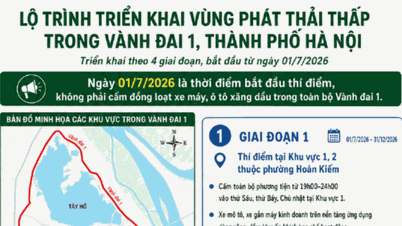
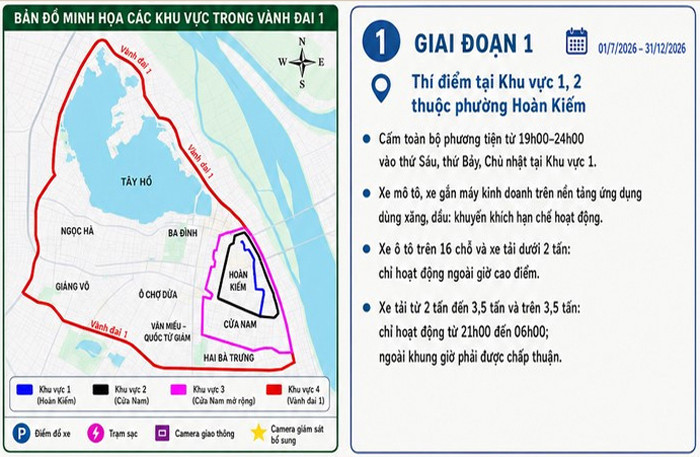
To achieve this, Hanoi has chosen a cautious approach. The city does not aim to immediately ban fossil fuel vehicles, but rather builds a multi-stage roadmap, starting from the central area, implementing and evaluating the plan as needed for adjustments. This shows that LEZ is a process of changing traffic management methods and travel behavior towards a more environmentally friendly direction.
Implementation in phases


Looking solely at the date of July 1st, many might think LEZ is a new policy. However, in reality, it is the result of years of preparation, from finalizing the legal framework to investing in infrastructure and developing supporting solutions.
The 2026 Capital City Law has created a legal framework for the implementation of low-emission zones. Therefore, on June 15th, at its fourth session (special session), the Hanoi City People's Council approved the Low-Emission Zone Project within Ring Road 1, clearly defining the scope, roadmap, and responsibilities for implementation. Based on this, the City People's Committee has developed a phased implementation plan, ensuring it aligns with the actual conditions of the capital city. Simultaneously, the city is preparing conditions to provide residents with more options when changing their mode of transportation.
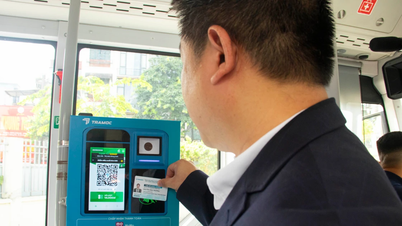
Within the Ring Road 1 area, there are currently 45 bus routes in operation; from July 1, 2026 to June 30, 2027, passengers using subsidized bus routes within this area will be exempt from fares. In addition, Hanoi has arranged 220 parking areas, developed 44 public bicycle stations with hundreds of bicycles, and is researching the construction of transfer parking areas (Park and Ride) to connect with buses and urban rail. The city is also gradually improving its surveillance camera system, vehicle identification, and expanding the network of charging stations and battery swapping points to serve clean energy vehicles.
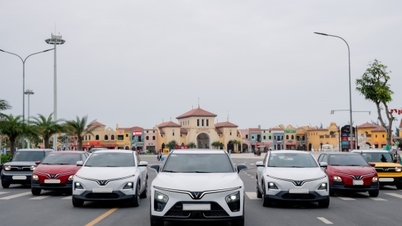
More broadly, LEZ is not a single policy. It is a link in a chain of solutions that Hanoi is implementing to build a green transportation system, from converting fossil fuel-powered buses to electric buses, accelerating urban rail lines, developing the TOD (Transit-Oriented Development) model, to investing in underground parking, transfer parking lots, and infrastructure serving green vehicles. When these links are connected synchronously, LEZ will have a foundation to be effective instead of just remaining administrative measures.
Towards a livable city.
The implementation of the new LEZ is just the beginning. The success of this model will depend on whether the city can create the conditions necessary to encourage people to change. The first condition is that public transport must truly become an attractive option. People will only reduce their use of private vehicles when buses become more convenient, the metro network gradually develops, and switching between different modes of transport becomes easier.
Next is the infrastructure for green vehicles. Charging stations, battery swapping points, transfer parking lots, underground parking lots, and connections to public transport need to be invested in comprehensively. This is not only a requirement of LEZ but also the foundation for the green transportation transition in the coming years. Another important factor is support mechanisms. The city is researching various policies such as preferential loan terms, support for vehicle conversion, fee waivers and reductions, and the development of clean energy infrastructure. These solutions will help reduce the cost burden on citizens and businesses during the transition.



Most importantly, social consensus is crucial. LEZs will be difficult to achieve if people view them merely as a regulation restricting vehicles. Conversely, when everyone understands that the ultimate goal is cleaner air, better health protection, and a more livable city, the transition will proceed much more smoothly. Therefore, along with infrastructure investment and policy refinement, public awareness campaigns, dialogue, and listening to people's opinions must continue to be prioritized throughout the implementation process. Thus, LEZs are not the destination but the starting point of a long-term transformation. After the pilot phase, Hanoi will have more basis to evaluate effectiveness, refine the mechanism, and gradually expand the scope to suit its actual conditions.
If implemented synchronously, with a suitable roadmap and with the support of the people, low-emission zones will not only be an environmental policy, but also become the foundation for the goal of building the capital into a green, smart, and modern city by 2035.
Source: https://hanoimoi.vn/trien-khai-lez-de-phat-trien-ben-vung-1210238.html