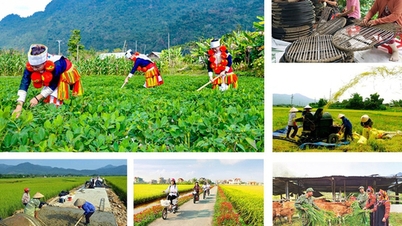
When mentioning the purple ginseng plant in Thai Hoa commune, many people immediately think of Tay Son village - one of the pioneering areas to introduce this medicinal plant into production and achieve clear economic benefits. On hills previously mainly planted with eucalyptus and acacia trees or left fallow due to low efficiency, a new green color of thriving purple ginseng gardens has now appeared.
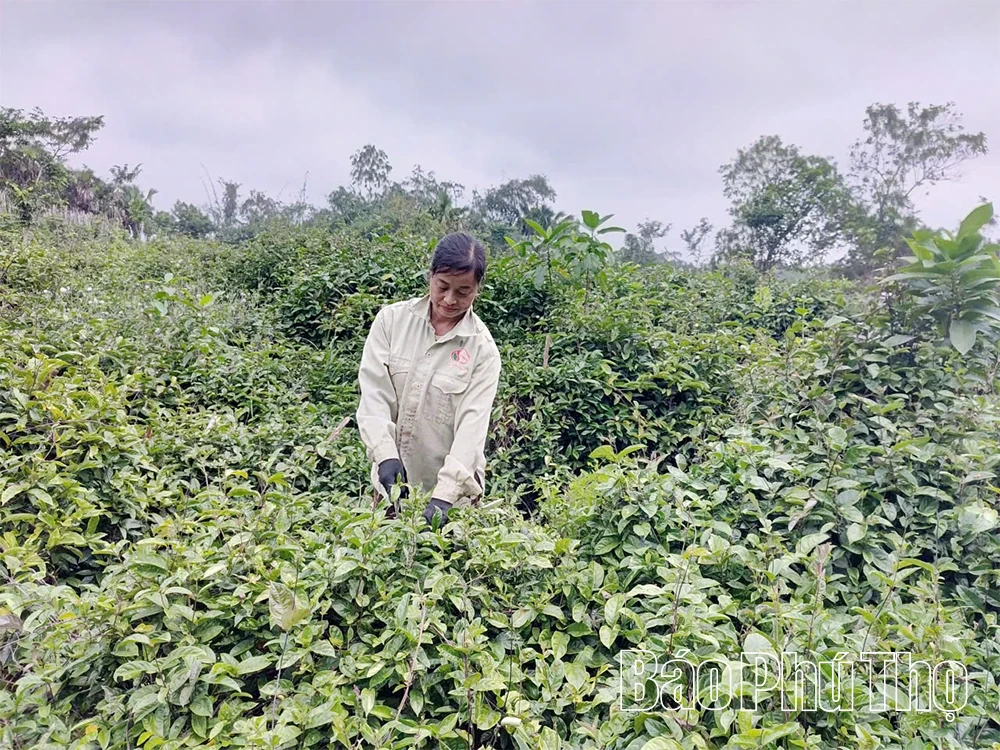
The people of Tay Son village, Thai Hoa commune, are cultivating purple ginseng, a new economic development direction that is bringing high efficiency to the hilly land.
The family of Ms. Tran Thi Hien, in Tay Son village, was one of the first households to boldly experiment with growing purple ginseng in the area. Recalling the early days of her involvement with this plant, Ms. Hien said that many people were skeptical because it was a new, uncommon crop, requiring a long investment period, and there weren't many successful models to learn from. However, after thoroughly researching its growth characteristics and economic potential, her family decided to plant several thousand plants on their hillside land.
Ms. Hien shared: “The purple ginseng plant doesn't require much care, is quite drought-resistant, and is suitable for hilly areas. After 4-5 years, it can be harvested with a price of about 700 million VND/hectare depending on the variety. From planting a few thousand plants as an experiment, my family has now expanded to 2 hectares.”
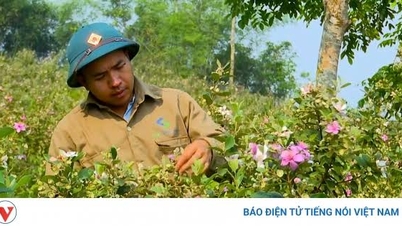
Leading us on a tour of her lush purple ginseng garden, Mrs. Hien weeded around the base of the plants while explaining the cultivation techniques her family uses. “My husband and I wear gloves almost every day to weed. We only weed during the first two years, not tilling the soil, for fear of damaging the roots. We only started covering the plants with plastic sheeting in the third year. Letting the weeds grow before weeding helps the soil ‘breathe’ and become more porous,” Mrs. Hien explained.
Besides focusing on weeding, Mrs. Hien's family also chooses organic farming methods, minimizing the impact on the plant's root system. "We only use manure, applying it to the surface of the soil. Ba kích (a type of medicinal plant) is a wild plant, so it has good resistance, is less susceptible to pests and diseases, and doesn't require much pesticide spraying," Mrs. Hien added.
The systematic, persistent approach, tailored to the plant's biological characteristics, has helped Mrs. Hien's family's purple ginseng garden thrive. Her success has become an inspiration for many households in Tay Son village to boldly learn from and replicate the model.
Currently, in Tay Son village alone, nearly 10 households are involved in growing purple ginseng, covering a total area of over 8 hectares. Many households have invested from a few thousand to tens of thousands of plants, forming concentrated growing areas, facilitating the sharing of experiences, linking consumption, and building product brands.
Not only in Tay Son village, the movement to develop purple ginseng cultivation has spread to many other residential areas in the commune. According to statistics, Thai Hoa commune has now developed more than 30 hectares of purple ginseng, becoming one of the localities with the largest ginseng cultivation area. Thanks to suitable climate and soil conditions, the plant grows well, yielding stable productivity and quality.
Encouragingly, some households have begun to link up with medicinal herb cooperatives to sell their products and move towards further processing. This is an important direction to increase added value and reduce market risks.
Not only is the consumption of fresh or dried rehmannia root limited, but the locality is also gradually developing processed products from rehmannia, most notably rehmannia extract, a product considered to have great market potential.
Using raw materials of purple ginseng grown in safe conditions, production facilities carry out preliminary processing, remove the core, and cook and concentrate the ginseng according to a process that ensures food safety and hygiene to create high-quality purple ginseng extract.
This product retains many valuable active ingredients, is convenient to use, has a longer shelf life, and offers higher economic value compared to selling the raw material. Developing the extract of *Ba Kich* (a type of medicinal herb) not only contributes to extending the value chain of medicinal plants but also opens up opportunities to build a unique brand for Thai Hoa purple *Ba Kich*.
According to farmers who cultivate Codonopsis pilosula, the market demand for this medicinal herb is currently quite high. Codonopsis pilosula is not only consumed fresh but is also processed into various products such as Codonopsis pilosula wine, herbal tea, Codonopsis pilosula extract, and health care products. This is a key advantage that ensures a stable market and significantly higher economic value compared to traditional crops.
Previously, the hilly land in Thai Hoa was mainly used by locals to grow eucalyptus, acacia, or some short-term forestry crops with low yields. Now, the shift to developing medicinal plants has opened up a promising new direction.
Introducing the purple ginseng plant into production not only effectively utilizes hilly land but also aligns with the current trend of developing organic, green, and sustainable agriculture .
With its resistance to pests and diseases and minimal need for pesticides, the Ba Kich plant contributes to protecting the ecological environment, maintaining soil fertility, and producing safe products for consumers.
Besides its direct economic value, the purple ginseng cultivation model also creates regular and seasonal jobs for about 30-35 laborers in the village, mainly middle-aged and elderly people. The work of weeding, caring for, and harvesting, although not strenuous, provides a stable income and helps many households find additional employment right in their local area.
Comrade Phung The Hai - Standing Deputy Secretary of the Commune Party Committee, assessed: “Developing the purple ginseng plant is a suitable direction for the local conditions. This is a plant with high economic value, suitable for hilly land, easy to care for, and aligns with the orientation of developing commercial and organic agriculture that the commune is currently implementing. In the future, the commune will continue to encourage people to expand the area in a concentrated manner; at the same time, strengthen links with businesses and cooperatives to build a sustainable value chain.”



To ensure the long-term development of purple ginseng, the commune is focusing on providing technical support for cultivation, planning concentrated production areas, encouraging production linkages through cooperative models; and at the same time, gradually building a brand for Thai Hoa purple ginseng products associated with processed products such as ginseng extract, aiming towards becoming a distinctive local OCOP product.
As can be seen, from a once unfamiliar plant, purple ginseng has gradually asserted its position in Thai Hoa commune. With favorable natural conditions, the consensus of the people, and the attention and guidance of the local government, purple ginseng is expected to become the main crop of the commune in the coming years.
From the ginseng plants growing on the hills today to the processed products bearing local brands in the future, Thai Hoa is gradually opening up a promising new direction for economic development from this valuable medicinal plant.
Hoang Huong
Source: https://baophutho.vn/trien-vong-cay-ba-kich-tim-253701.htm


![[Image] A look back at the capital's preparations for the century-long master plan.](https://vphoto.vietnam.vn/thumb/1200x675/vietnam/resource/IMAGE/2026/06/29/1782750453122_quy-hoach-100-nam-minh-duy-1-2118-jpg.webp)
![[Photo] General Secretary and President To Lam works with the Party Committee of the Government on the work of preventing and combating storms, floods, extreme natural disasters and climate change.](https://vphoto.vietnam.vn/thumb/1200x675/vietnam/resource/IMAGE/2026/06/29/1782729441945_a1-bnd-0385-9454-jpg.webp)