

The Ho Chi Minh City People's Committee has just issued a decision to establish a Task Force to ensure the security of the gold market in the city (hereinafter referred to as the Task Force). The Task Force's nhiệm vụ is to collect and analyze information, data, and the situation regarding customers buying and selling gold bars in the city. It will also inspect organizations and individuals suspected of speculation, profiteering, or causing instability in the gold market.
Gathering information on gold buyers.
The task force is also responsible for coordinating inspections and checks on compliance with legal regulations regarding gold trading by establishments buying and selling gold bars and producing and trading gold jewelry and handicrafts.
According to the decision of the Ho Chi Minh City People's Committee, a representative from the City Police Department will head the Task Force, tasked with gathering information and advising the City People's Committee on solutions to stabilize the gold market. They will also direct police units to monitor the situation and identify individuals and organizations suspected of gold smuggling or hoarding gold for speculative profit.
Implement professional measures to verify and investigate suspicions, combat and handle cases according to criminal law (if the elements of a crime are present), or transfer information to relevant authorities for handling according to regulations on administrative penalties.
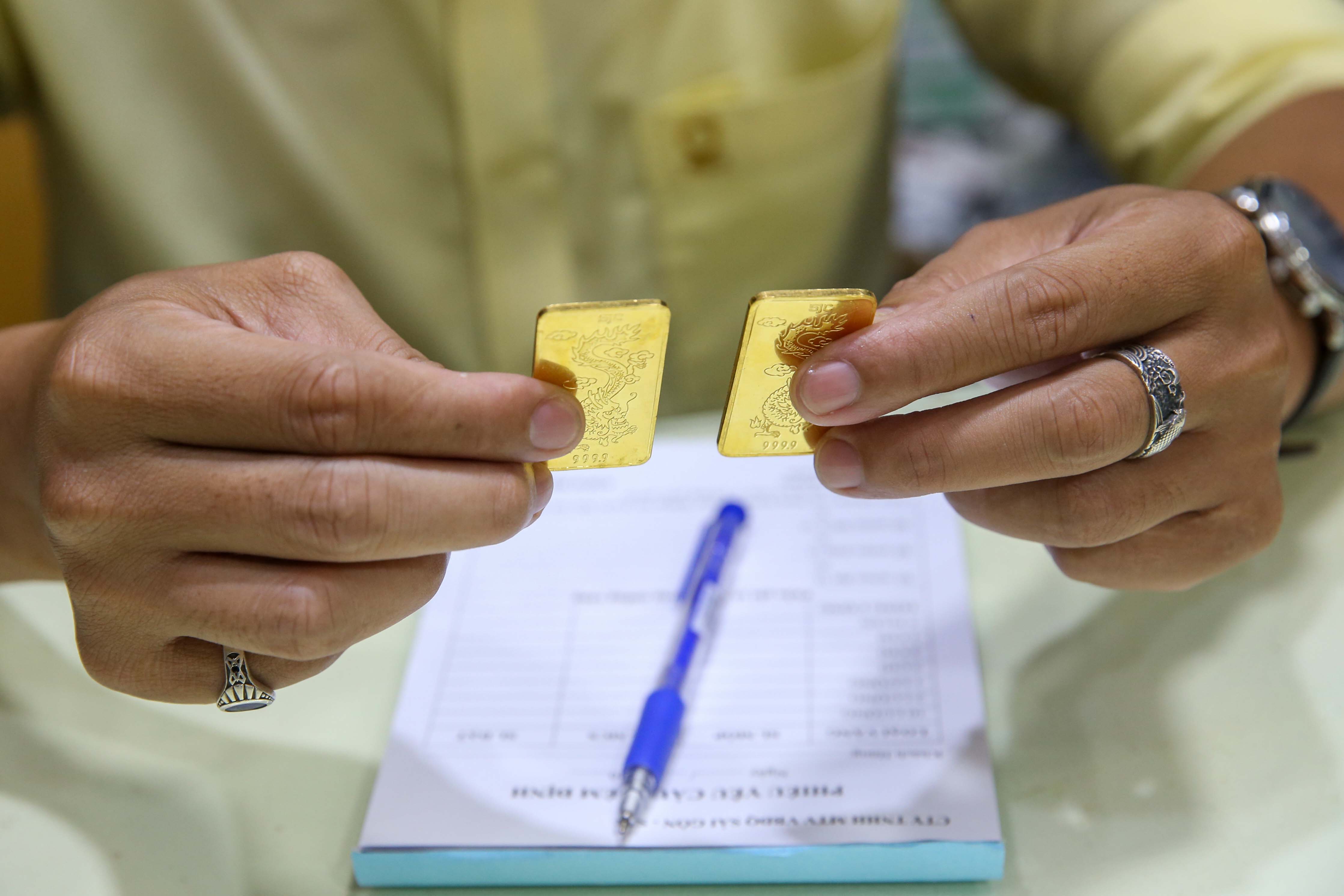
The purchase of SJC gold bars in Ho Chi Minh City will be strictly controlled to prevent speculation. Photo: HOANG TRIEU
The representative of the State Bank of Vietnam (SBV) Ho Chi Minh City Branch serves as the deputy head of the task force, responsible for collecting and transferring to the Ho Chi Minh City Police information, documents, and lists of individuals who purchased gold at SJC gold bar sales points of Saigon Jewelry Company (SJC) and four state-owned commercial banks: Vietcombank, Agribank , BIDV, and VietinBank (daily). They are also tasked with researching solutions and advising SJC and the four state-owned commercial banks to proactively identify suspicious individuals hired to purchase or collect gold; and promptly providing this information to the police force for the implementation of operational measures.
Other departments within the Task Force, such as the Ho Chi Minh City Tax Department and the City Market Management Department, are tasked with quickly verifying the flow and source of funds used to purchase gold and assisting in collecting documents from banks (account opening records, account statements, transaction documents, etc.) to clarify suspicions of gold hoarding and gold leasing. They will also strengthen inspections of gold trading establishments in the area to promptly handle violations within their jurisdiction, especially the trading of smuggled goods, goods of unknown origin, and counterfeit goods.
Regarding commercial banks, recently, Vietnam Foreign Trade Bank ( Vietcombank ) announced that it will only accept registrations to purchase SJC gold bars from individual customers who have active payment accounts opened at this bank.
Vietcombank explained that the change in the online registration conditions for purchasing SJC gold bars aims to improve service quality and facilitate customer information management; ensuring smooth and safe transportation of gold bars...
Previously, BIDV also implemented a registration program for purchasing SJC gold bars for customers who met the conditions of having a VND account at BIDV and having sufficient funds in the account at the time of registration.
The Vietnam Bank for Agriculture and Rural Development (Agribank) also plans to adopt this method. According to Agribank's leadership, selling gold to customers with accounts opened at the bank itself will help reduce the time spent on customer identification procedures and contribute to preventing money laundering.
We need a long-term solution.
Gold expert Tran Duy Phuong believes that the solutions recently implemented by the Ho Chi Minh City People's Committee, as well as those implemented by the Government and the State Bank of Vietnam, will contribute to narrowing the price gap between SJC gold bars and the world market. In particular, the city's new decision to collect information on SJC gold bar buyers will help prevent speculation, price manipulation, and profiteering in the gold market. "Then, only those with genuine needs and who intend to hold gold long-term will buy. The rush to buy SJC gold bars will decrease," said Mr. Tran Duy Phuong.
According to Associate Professor Dr. Nguyen Huu Huan, a senior lecturer at the University of Economics Ho Chi Minh City (UEH), in the past, when the State Bank of Vietnam implemented the direct sale of SJC gold bars to the public through the system of 4 state-owned commercial banks and SJC Company, a "two-price" situation emerged, meaning the official selling price and the price on the free market. The reason is that market demand remains high, but the number of people who can buy gold bars is not large, so these people have taken their gold to the open market to sell it for a profit. Therefore, in the long term, more solutions are needed to make the gold market more sustainable.
At a recent regular press conference, Deputy Governor of the State Bank of Vietnam, Dao Minh Tu, also acknowledged that the mechanism of selling gold directly through state-owned commercial banks has initially proven effective. The basic initial objective of managing and controlling the price difference between SJC gold bars and world gold prices within a suitable range has been achieved. However, this is only a short-term policy; how to make it suitable in the long term remains a difficult issue.
In fact, experts have repeatedly suggested that for the gold market to develop sustainably, it is necessary to study amending Decree 24/2012/ND-CP to eliminate the SJC gold bar brand monopoly and the gold bar monopoly, as well as the State Bank of Vietnam's gold import monopoly... Associate Professor Dr. Nguyen Huu Huan believes that a solution that could be implemented soon is to study imposing a property tax on gold to reduce the attractiveness of this investment channel.
"Gold hoarding causes significant harm to the economy, especially to macroeconomic stability. In fact, governments around the world want to remove gold from circulation because if people hold a lot of gold, it will greatly affect their domestic currency. For example, in the US, from 1933 to 1971, the country prohibited its citizens from owning 99.99% pure gold, only allowing the use of gold jewelry, and clearly regulating the percentage of gold in jewelry. Typically, countries regulate the percentage of gold in jewelry at around 60% - 70%, depending on the country. Vietnam may regulate gold jewelry below 75% to prevent profiteering," said Associate Professor Dr. Nguyen Huu Huan.
Another solution proposed by Associate Professor Dr. Nguyen Huu Huan is to conduct a pilot study on gold certificates. The US once banned the ownership of physical gold and switched to selling gold certificates to citizens when the domestic currency depreciated sharply.
Accordingly, the State Bank of Vietnam (SBV) can issue gold certificates through the state-owned commercial banking system and still hold gold as an important foreign exchange reserve. People can buy and sell gold certificates through the state-owned commercial banking system; when they need capital, they can bring them to the bank to exchange for VND or use them as collateral for loans. The price of gold is set by the SBV.
"Issuing gold certificates will reduce the attractiveness of the gold market, because people holding a piece of paper is different from holding physical gold. Measures are needed to limit people's desire to own physical gold, directing them towards other markets to better support economic development," proposed Associate Professor Dr. Nguyen Huu Huan.
Businesses must take responsibility for the origin of the gold.
The State Bank of Vietnam's Ho Chi Minh City branch has also recently sent a document to businesses operating in the production of gold jewelry and handicrafts in the area. According to Mr. Nguyen Duc Lenh, Deputy Director of the State Bank of Vietnam's Ho Chi Minh City branch, the production of gold jewelry and handicrafts is a sector that is directly related to and impacts the gold market, the effectiveness of macroeconomic management and market stability, and socio-economic development.
Therefore, businesses operating in this sector are required to strictly comply with and be legally responsible for the origin of raw gold used in the production of gold jewelry and handicrafts. Businesses must also comply with legal regulations regarding accounting procedures, and the preparation and use of invoices and documents.
Source: https://nld.com.vn/triet-dau-co-vang-mieng-sjc-196240730202119095.htm


































































































Comment (0)