

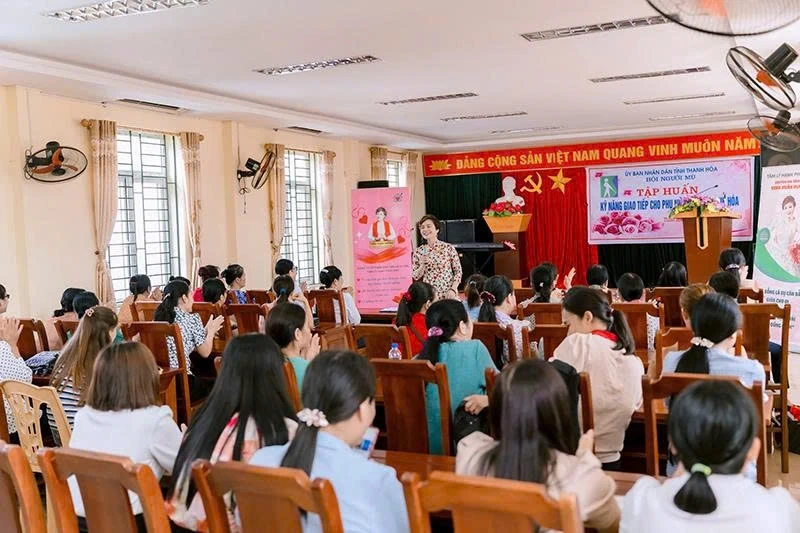
Skills training class for visually impaired women.
In the evening, at the Cuong Thoai massage parlor in Trieu Son commune, Ms. Bui Thi H. was preparing to finish her last shift of the day. The work was familiar, each step memorized by instinct. During the service, upon noticing a customer behaving inappropriately, she proactively stopped working, left the room, and reported it to the manager. The incident was handled immediately at the facility, and the information was forwarded to the association's officials for monitoring and support. "I was a little flustered at the time, but after being instructed again, I understood better what I needed to do," Ms. H. shared.
From a specific situation, the issue went beyond a workplace conflict, highlighting the need for greater assurance of the right to physical protection and the right to work in a safe environment for visually impaired female workers – fundamental rights that are easily violated due to a lack of information and support. Based on this, Ms. Lieu Thi Hai, owner of the Cuong Thoai massage parlor, reviewed and adjusted her operations to be safer: she no longer assigned members to work alone at night; maintained a supervisor on duty during shifts; standardized procedures for receiving, serving, and handling unusual situations; and provided communication devices in the work rooms so members could call for support immediately when needed.
At the association level, Ms. Nguyen Thi Mao, Vice President of the Thanh Hoa Provincial Association of the Blind, stated that the guidance provided to members, such as identifying behaviors that cross boundaries, stopping work at the right time, reporting procedures, and coordinating handling, did not arise from a specific incident but have been regularly implemented by the association during meetings and training sessions. The content is structured in a specific and easy-to-apply manner so that members can remember and apply it immediately in practice. From this approach, the law is no longer a set of general regulations but is concretized into clear steps for handling situations – helping workers, especially visually impaired women, proactively protect themselves in the workplace.
Blind women face numerous other risks not only in the workplace but also in other areas, particularly during telephone transactions.
Ms. Nguyen Thi Mao said that a member nearly lost all her savings because she followed instructions over the phone. Fortunately, she called back to ask for clarification before proceeding. Based on such cases, the Thanh Hoa Provincial Association of the Blind has established the "Three No's - One Call" principle: do not read OTP codes, do not transfer money in advance, and do not click on suspicious links; if there are any unusual signs, call a trusted person immediately. For visually impaired women, this is not just a reminder, but a way to protect themselves in very common situations. In such cases, the law begins by helping them identify risks and know when to stop.
If the Association of the Blind is the place for identifying and handling issues from within, then the Women's Union at all levels is the network that spreads support to the community. With a system extending to the grassroots level, it is often the first point of contact for vulnerable women when incidents occur. In reality, there have been cases where women working as masseuses have been cheated out of their wages or subjected to abusive behavior by clients, but initially did not report it. Only when the Women's Union approached them, provided advice, and supported them in resolving the issue were their rights protected. In such situations, the role of the Women's Union is not just support, but "a companion": guiding them in filing complaints, assisting in gathering information, and participating with members when working with authorities. Models such as "Trusted Addresses in the Community" and "Women's Clubs with the Law" also become initial points of contact and support at the grassroots level.
At the legal level, the Thanh Hoa Provincial State Legal Aid Center ensures that rights are fully enforced. Beyond providing advice, legal aid assistants participate in litigation, represent and protect rights, or accompany individuals from the initial stages of a case. From 2018 to 2025, the province has handled nearly 8,000 legal aid cases; in the 2024-2025 period alone, over 2,700 cases were received and resolved. The majority of cases benefit from the early involvement of legal aid assistants, helping vulnerable individuals avoid confusion or missing out on their rights. Legal aid services extend beyond the center's offices to the grassroots level, reaching villages and hamlets. For visually impaired women, having someone directly guide and assist with paperwork and accompany them throughout the process is crucial.
For vulnerable women, protection comes not only from regulations, but also from the thorough implementation of those regulations. Only when they no longer have to face risks alone can they speak up and exercise their rights.
Text and photos: Tang Thuy
Source: https://baothanhhoa.vn/tro-giup-phap-ly-nbsp-cho-phu-nu-yeu-the-283293.htm

























































































Comment (0)