

The successful pilot program for low-carbon rice production in the Mekong Delta provinces has opened up a new direction for agriculture in the green economy era, especially given that agriculture is a major contributor to greenhouse gas emissions in Vietnam.
High-quality rice production linked to green growth.
The Ministry of Agriculture and Rural Development is implementing the "Sustainable Development Project for 1 Million Hectares of High-Quality, Low-Emission Rice Cultivation Linked to Green Growth in the Mekong Delta by 2030". The project consists of two phases, implemented in 12 provinces and cities: An Giang, Kien Giang, Dong Thap, Long An, Soc Trang, Can Tho, Bac Lieu, Tra Vinh, Hau Giang, Ca Mau, Tien Giang, and Vinh Long; with a total area of approximately 1 million hectares of specialized rice cultivation by 2030.
According to the Ministry of Agriculture and Rural Development, the standards for high-quality rice production linked to green growth focus on many factors.
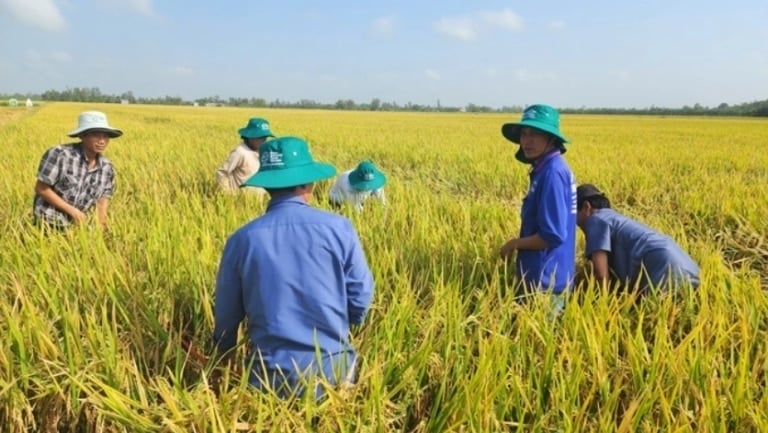
A low-carbon rice production model helps reduce greenhouse gas emissions in Thoi Lai district, Can Tho city. (Photo: Kim Anh/Vietnam Agriculture Newspaper).
Firstly, using certified rice varieties ensures high quality, meeting the increasingly high demands of domestic and international consumers. This could lead to the use of rice varieties that meet consumer nutritional needs and the demands of deep processing, creating value-added products from rice grains.
Secondly, sustainable farming practices should be implemented to reduce greenhouse gas emissions. High-quality rice-growing areas will have to adopt more sustainable farming practices, using inputs that reduce the use of chemical fertilizers, pesticides, and seeds. With this farming system, rice production will save resources, cause less environmental pollution, and reduce emissions.
Thirdly, high-quality rice-growing areas will be reorganized to promote cooperation and linkages, reducing production costs and increasing value through integrated production, processing, and consumption. Farmers will be reorganized into cooperatives and closely linked with businesses supplying input materials and businesses guaranteeing output. This will ensure farmers receive quality inputs at lower prices while selling their rice at stable, higher prices.
Fourth, large-scale high-quality rice-growing areas will be mechanized, have more synchronized infrastructure investment, digitize the growing areas, enable traceability, and integrate smart technologies for disease control and automated irrigation.
Fifth, high-quality specialized rice production areas must be sustainably developed, creating confidence and higher income for rice farmers, helping farmers feel secure in investing in rice production. At the same time, these specialized high-quality rice production areas will create added value by contributing to reducing greenhouse gas emissions, saving resources, reusing rice cultivation by-products according to a circular economy model, and building a rice brand.
The project sets targets to reduce seed sowing to 80 kg/ha, reduce the use of chemical fertilizers by 30%, and reduce irrigation water by 30% by 2025; and to reduce seed sowing to 80 kg/ha, reduce the use of chemical fertilizers by 40%, and reduce irrigation water by 30% by 2030.
Killing many birds with one stone.
This project is being implemented based on the successful results of the "Sustainable Agricultural Transformation in Vietnam" (VNSAT) project, which was carried out from 2015 to June 2022 in eight provinces and cities in the Mekong Delta region and funded by the World Bank.
Initial reports indicate that profits are approximately 20-30% higher than with traditional rice production.
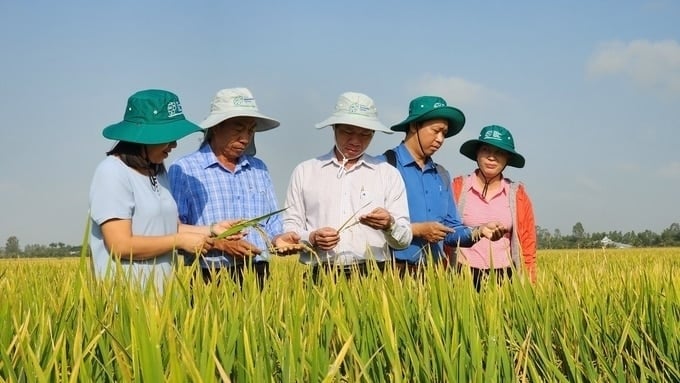
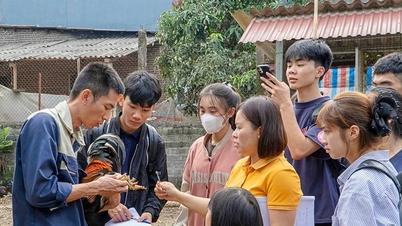
The Department of Agriculture and Rural Development of Can Tho City visited a low-carbon rice production model for the 2022-2023 winter-spring crop in Thoi Lai district, Can Tho City. (Photo: Kim Anh/Vietnam Agriculture Newspaper)
In Can Tho city, cost accounting for households participating in the model when applying greenhouse gas emission reduction production methods according to sustainable rice production standards has yielded technical efficiency as well as reduced investment costs (fertilizers, pesticides, labor, helping to reduce the amount of seeds sown by 1/3).
Preliminary estimates suggest that with rice yields of approximately 8-10 tons/ha, production costs are reduced by about 50% compared to the previous winter-spring crop, resulting in an additional profit of 5.5-6 million VND/ha. More importantly, these models help farmers gradually change their habit of dense sowing and reduce the number of pesticide applications. This leads to increased profits, protects health and the environment, and limits the impact of the greenhouse effect.
According to Carolyn Turk, Country Director of the World Bank in Vietnam: "The government plays a crucial role in promoting the green transition through strategically allocating public investment and enhancing the environment for private sector participation in green and modern agriculture."
According to the World Bank report "Towards a Green Agricultural Transformation in Vietnam: Shifting to Low-Carbon Rice Farming," published in September 2022, agriculture is currently a major contributor to greenhouse gas emissions in Vietnam. It is the second-highest emitting sector, accounting for approximately 19% of total national emissions in 2020. Shifting to low-carbon rice farming has the greatest potential for Vietnam to achieve its goal of reducing methane emissions by 30% by 2030 while simultaneously enhancing the competitiveness of this strategic export sector.
To accelerate the transition to low-carbon rice production in Vietnam, World Bank experts noted five key policy areas in the short to medium term, including ensuring policy consistency and adjusting plans and budgets, reorienting policy tools and public spending, promoting public investment, improving institutions, and facilitating the participation of the private sector and other stakeholders.
Thanh Luan












































![[Infographic] Vietnam's Economic Situation Report, Q1 2026: Strong Growth Momentum](https://vphoto.vietnam.vn/thumb/402x226/vietnam/resource/IMAGE/2026/04/04/1775298512042_tang-truong-kinh-te-viet-nam.jpeg)
![[Image] Close-up view of the 10-lane road connecting to Long Thanh Airport](https://vphoto.vietnam.vn/thumb/402x226/vietnam/resource/IMAGE/2026/04/04/1775291871988_ndo_br_1-resize-5690-jpg.webp)
















Comment (0)