

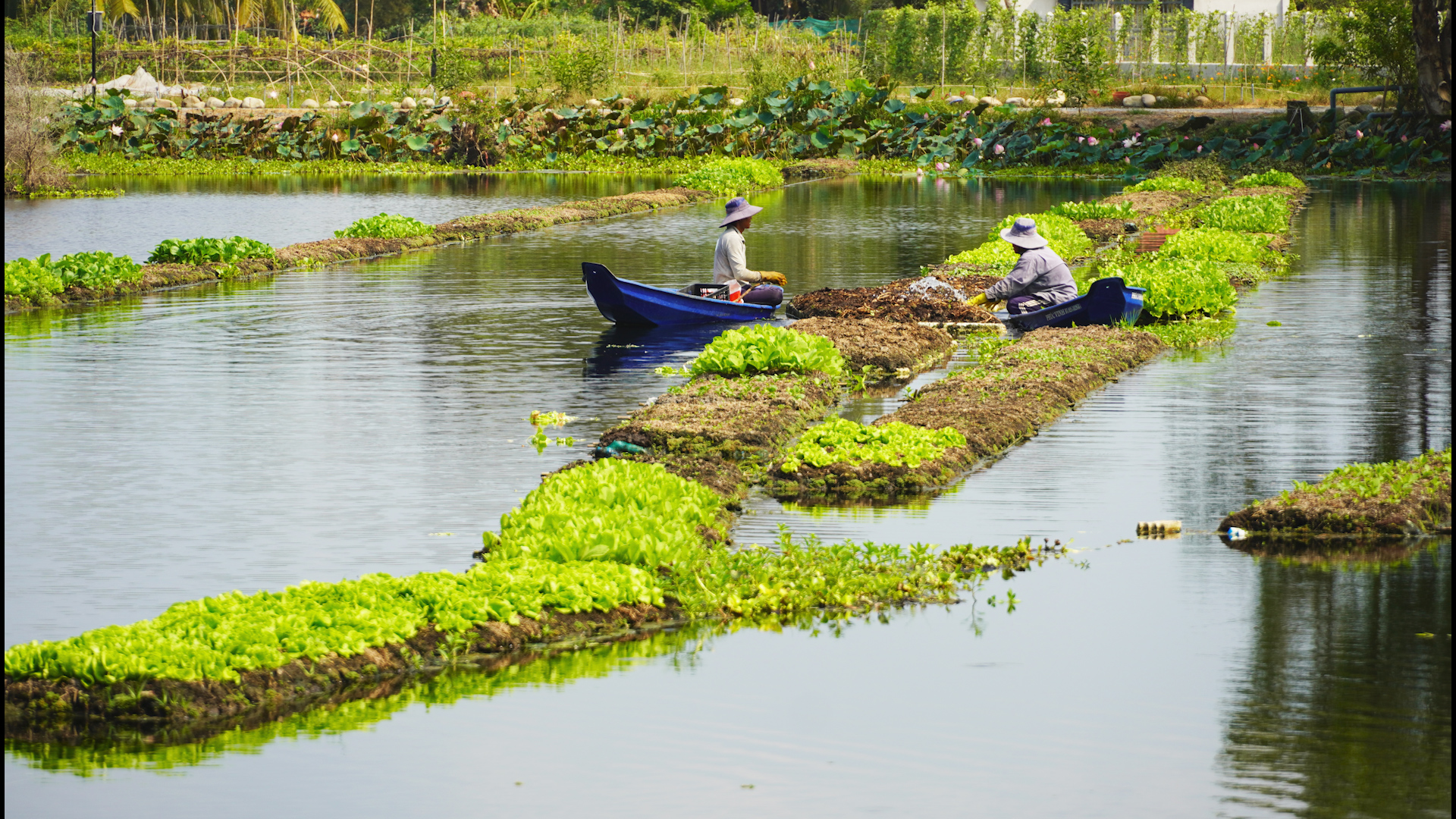
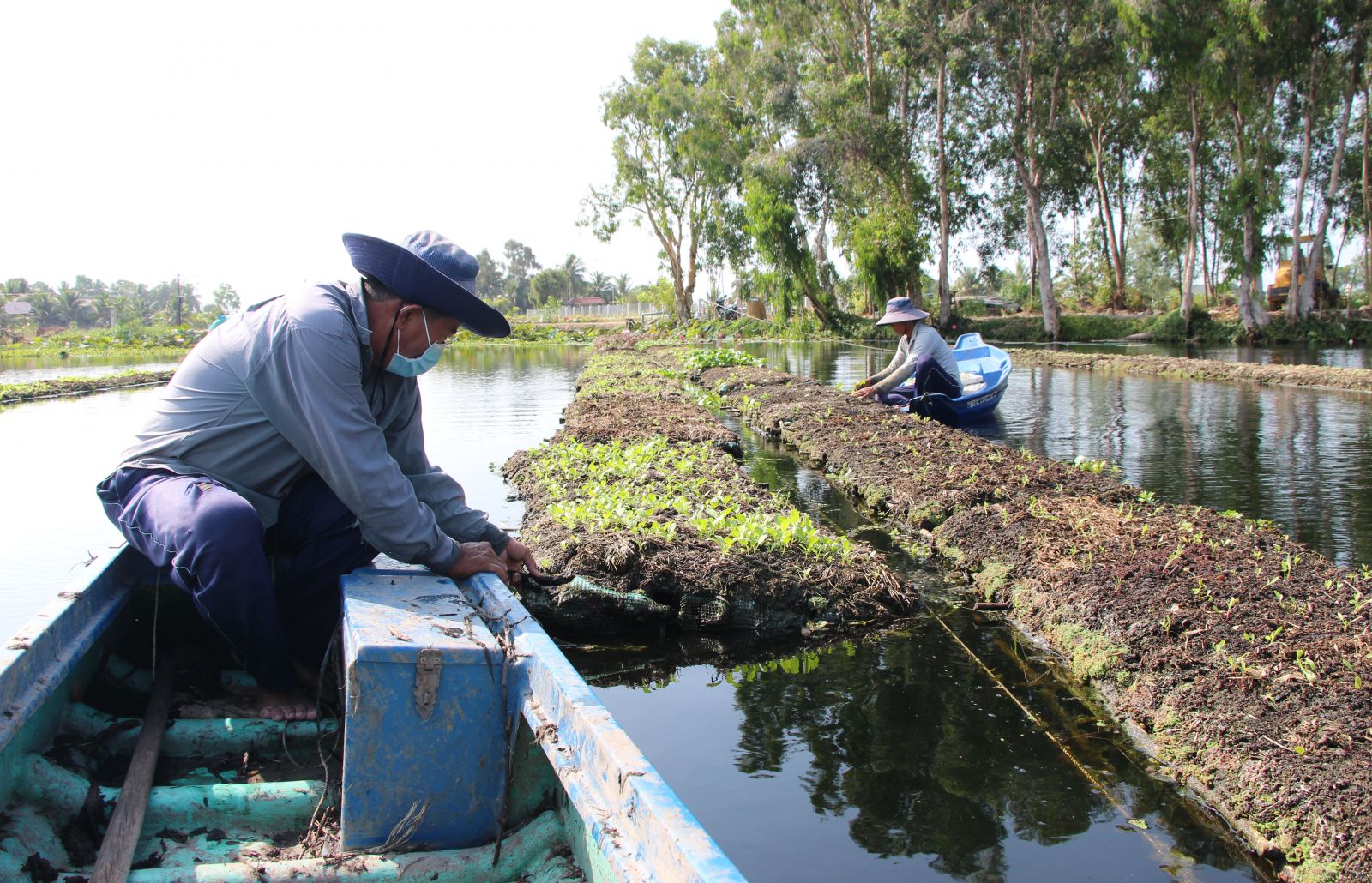
The model of growing vegetables in floating cages by Mr. Nguyen Van Dac in Hamlet 3, My An Commune, Thu Thua District, Long An Province. Photo: Mong Dao - Trung Hieu (Long An Newspaper)
In recent times, authorities have made many efforts to control water hyacinth on the Vam Co Dong River, and initial results show a downward trend. However, during peak months, water hyacinth still accumulates locally in some bends of the river, causing difficulties for waterway traffic and affecting the lives of local people.
Given this situation, we tried to find some solutions to deal with the problem, which would be both cost-effective and turn water hyacinth into a new resource.
Water hyacinths are still accumulating in localized areas on the river surface.
On May 23rd, at the Ben Dinh bridge area (Cam Giang commune, Go Gau district), the surface of the Vam Co Dong river was almost completely free of water hyacinths, wide and open, allowing for easy boat traffic. However, further upstream on the Vam Co Dong river, in the area of Truong Dong commune, Hoa Thanh town, the situation was not as favorable.
At a bend in the river, water hyacinths covered almost the entire surface. The Agricultural Development Joint Stock Company (part of the Thanh Thanh Cong Group) - the unit contracted by the Department of Transport to handle the water hyacinths - deployed two specialized barges to this section of the river to "clear the area".
After a frantic effort to cut and remove the water hyacinths, these two specialized vehicles created a wide open space on the water's surface. This allowed boats to navigate the river's length. However, crossing the river's surface remains very difficult for other watercraft. Many people live along both banks of the river in this area, often crossing to the western bank of the Vam River to cultivate their fields.
At noon on May 23rd, 23-year-old Nguyen Minh Do was operating a motorboat carrying goods from the west to the east bank of the Vam River. In the middle of the river, the motorboat easily cut through the waves, but near the shore, it was obstructed by dense water hyacinths, making movement very difficult.
As they got closer to the shore, the water hyacinths became denser. At times, the boat's engine stalled, and Mr. Do had to use a pole to push the water hyacinths away before the boat could move forward. Even though they were only about 5 meters from the riverbank, it took this local man nearly 15 minutes and he was drenched in sweat to reach it.
Originally from Ben Tre province, Mr. Do has been living and working in Tay Ninh for two years. His family runs a salt business, and every day he transports salt from the other side of the river to sell to residents along National Highway 22B. Mr. Do shared that, depending on the ebb and flow of the tide, the water hyacinths float up and down, so when the river is clear, it only takes 2-3 minutes to cross; when the water hyacinths are densely packed, it takes him more than 15 minutes to get the boat to shore.
"The smaller boats with weak engines can't cross the river; sometimes they get stuck in the middle of the stream and drift aimlessly. Therefore, when the river is covered with water hyacinths, I have to use larger boats with powerful engines to transport goods," Mr. Do explained.
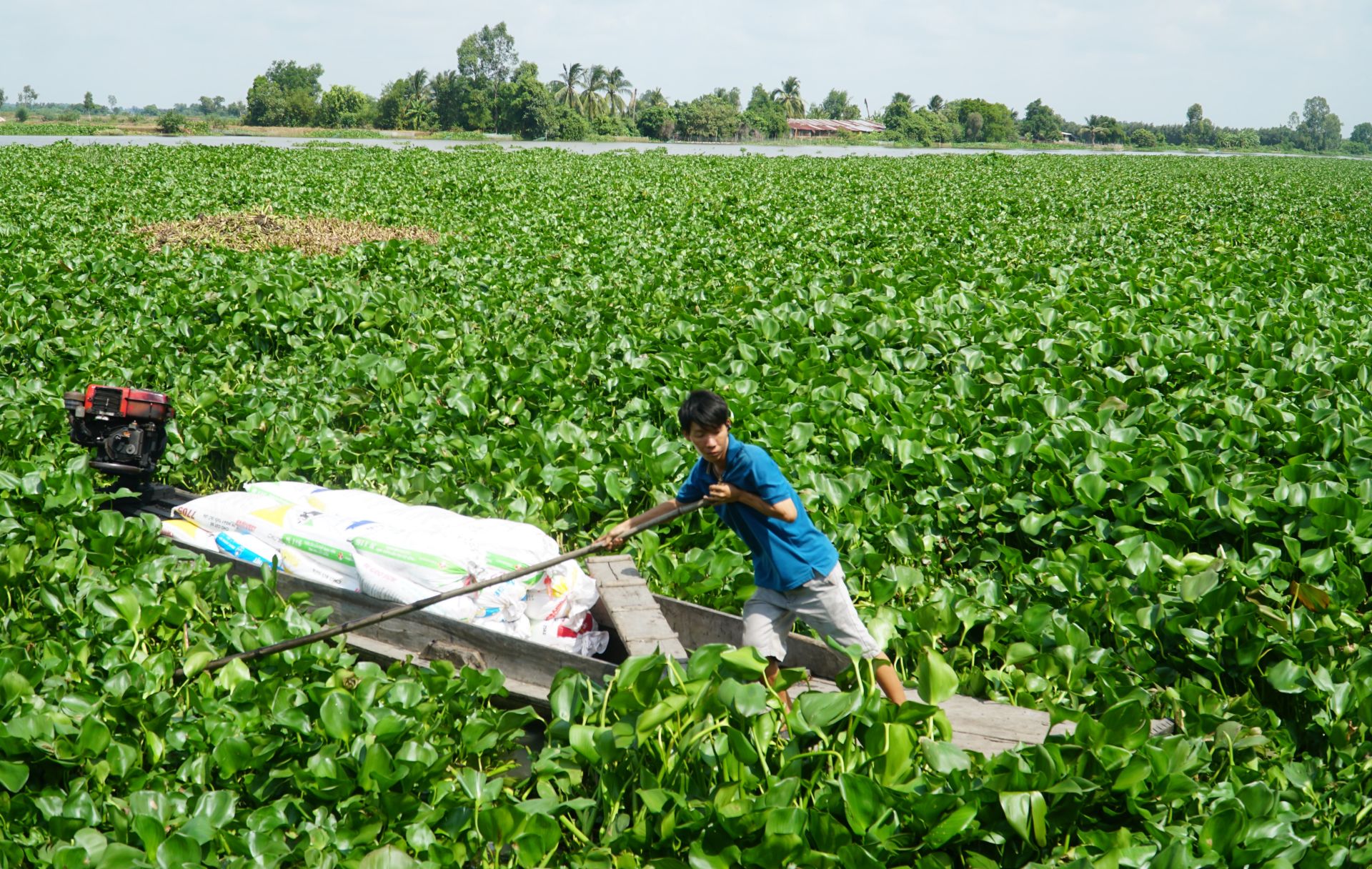
Mr. Do had to use a pole to push aside the water hyacinths in order to bring the boat ashore.
In recent years, Mr. Do has seen some barges come to the area to collect water hyacinths, but the water hyacinths grow rapidly, and people on both sides of the river remove fishing nets, pushing too many water hyacinths out, making it difficult to completely eliminate them.
The model of growing vegetables on water hyacinth can be applied.
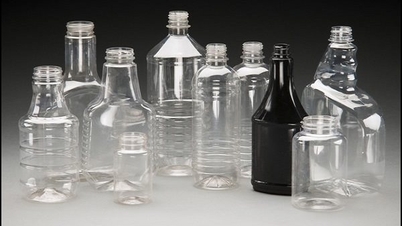
Recently, many people have become aware of Mr. Nguyen Van Dac in Long An province, who has achieved considerable success with his model of growing vegetables on water hyacinths. Mr. Dac uses plastic bottles wrapped in nylon mesh and secured with bamboo poles to create floating rafts. He then uses decomposed water hyacinths as a base material for these rafts and grows vegetables. To date, he has created over 300 floating vegetable beds.
Mr. Dac shared: “Each raft has an area of 3 square meters. It uses about 13 kg of plastic bottles and 80-100 kg of composted water hyacinth, without needing to mix in soil or fertilizer. After about two years of use, the water hyacinth on the raft will shrink, at which point you just need to add another layer of water hyacinth on top and continue growing vegetables; there's no need to remove the old layer.” On these floating rafts, Mr. Dac grows cucumbers, tomatoes, winter squash, pumpkins, gourds, loofah, mustard greens, etc.
Mr. Dac said that growing vegetables on rafts has many advantages over growing them on land, such as not having to spend money on irrigation, because the vegetables absorb water directly from the water surface. The rafts are far from the land, limiting many types of insects that harm the plants, so there is no need to use pesticides or organic fertilizers, thus producing clean organic vegetables to meet consumer demand.
Currently, Mr. Dac's green vegetables are sold in supermarkets and local traditional markets. The vegetables are grown using entirely new materials, so they don't contain the pathogens commonly found in long-cultivated soil. More importantly, the use of discarded plastic bottles and water hyacinth, which are proliferating in ponds, lakes, and rivers, contributes to protecting the ecological environment.
To date, Mr. Dac has over 5,000 square meters of floating vegetable farms, providing regular employment for 10-12 workers and a stable income. Mr. Dac said that many farmers in Long An and Dong Thap provinces have ordered 7,000-8,000 floating vegetable farms from him.
However, he also clarified that his hydroponic vegetable farming model has only been applied in ponds and lakes – places with calm water and relatively stable pH levels – and has not yet been tested on rivers and canals. This is because growing vegetables on rafts in rivers and canals would face other impacts such as waves, currents, and potentially fluctuating pH levels, which could affect the plants.
"Regarding building rafts on the river, I can design them by reinforcing them with some bamboo poles to reduce wave damage and provide a more secure anchor. As for the pH level, I need to test the specific water source at the intended planting location before I can determine the appropriate treatment," Mr. Dac said.
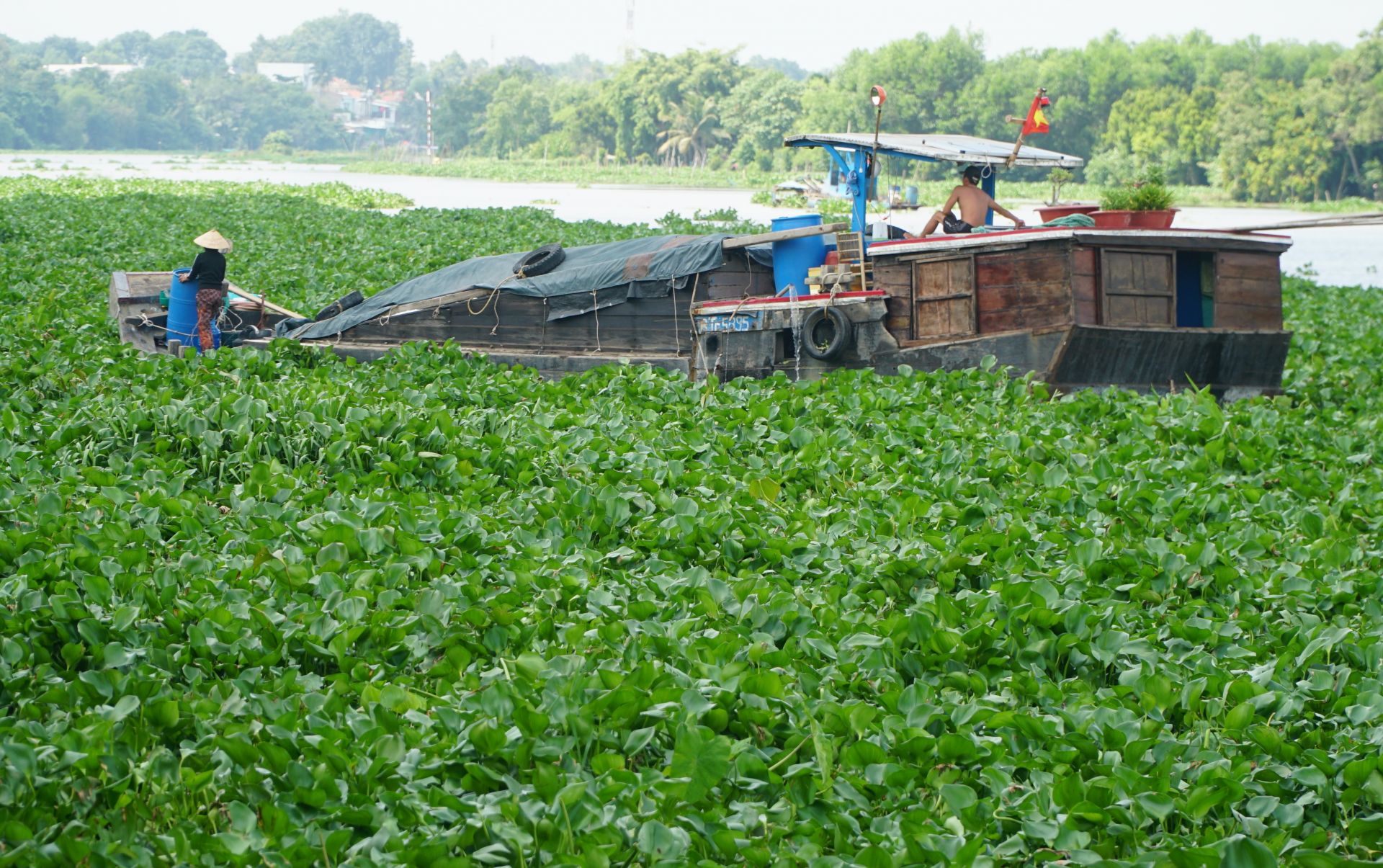
Boats are having difficulty navigating due to the water hyacinths.
Tay Ninh has abundant water hyacinth resources, the vast Vam Co Dong River, numerous abandoned ponds and lakes left over from land exploitation for construction materials, and piles of used plastic bottles at recycling centers. Tay Ninh's warm, sunny climate is suitable for cultivating various crops. All these potentials, if combined and exploited, could open up a new model for agricultural economic development.
The experience in Long An shows that Mr. Nguyen Van Dac's model of growing vegetables in floating cages has initially yielded high economic efficiency. If this model is widely implemented in our province, it has the potential to bring double benefits: utilizing the surface water of ponds, lakes, and canals to develop agricultural economy, while also saving costs on removing water hyacinths from the Vam Co Dong River.
Ocean
Source link






































![[Photo] Closing Ceremony of the 15th Conference of the Central Committee of the 13th Party Congress](https://vphoto.vietnam.vn/thumb/402x226/vietnam/resource/IMAGE/2025/12/23/1766462841764_a1-bnd-3731-1647-jpg.webp)














Comment (0)