

|

On November 24th, the National Space Science Center of the Chinese Academy of Sciences announced a bold new space strategy. During its "15th Five-Year Plan," the country intends to launch four groups of leading scientific satellites.
The projects include Hongmeng , Kuafu-2 , and eXTP , which carry out space observation missions. Among them, the project that has attracted the most attention is the Exoplanet Survey Satellite Program with the mission of "finding a new home for humanity" or "Earth 2.0".
Earth 2.0 and unraveling the mystery of life.
Although it may sound strange, the project to find a "second Earth" is not aimed at preparing for migration. Experts assert that, given the limitations of current aerospace technology, traveling to planets tens or hundreds of light-years away is impossible.
The project's scientific objective lies at a more fundamental level: Scientists believe that studying only Earth is insufficient to deduce a universal law of life in the universe.
Therefore, the Exoplanet Survey Satellite Plan was launched to collect and build a group of habitable planets for easier comparison by identifying all Earth-sized planets located within the Habitable Zone.
|
NASA's Transiting Exoplanet Survey Satellite (TESS) is led by MIT (Massachusetts Institute of Technology). Photo: NASA. |

Only through comparison and statistics can scientists answer the fundamental question: Is the emergence of life an "inevitable result of universal laws" or merely a "chance"? Therefore , the answer will help redefine the position of human civilization in the universe.
Accordingly, researchers will focus on collecting important data such as radius, mass, orbital position, temperature, and especially the atmospheric spectral composition. These factors will be used for analysis and the construction of statistical models.
With this statistical data, crucial scientific tasks can be accomplished. First, statistics can be compiled on the percentage of habitable planets, and evolutionary models can be developed to predict which types of stars are most likely to produce Earth-like planets.
More importantly, the data will help verify the prerequisites for life by searching for water and the availability of oxygen and methane. The presence of large quantities of these two gases (which normally react with and cancel each other out) is considered unusual evidence, implying the presence of a powerful force – most likely life continuously producing them.
Unified theory of planets
Humanity's current understanding of the planet is still fragmented and unable to explain many fundamental phenomena of the universe (e.g., why some planets have magnetic fields and others do not, or the formation mechanism of "hot Jupiters").
According to scientists, the planets in the Solar System, specifically Mars and Venus, although considered the closest "rocky planets" and located within the "habitable zone," cannot serve as a reference planet to Earth for the formation of life.
Researchers call these two planets "failure specimens." Specifically, Mars is a "dead planet" having lost its protective magnetic field, leading to its atmosphere being gradually stripped away by solar winds, plunging the planet into a perpetually cold and desolate state.
|
Mars and Venus, despite being in the "safe zone," are incapable of supporting life. Photo: NASA. |

Meanwhile, Venus is an "out-of-control greenhouse experiment," where temperatures are constantly rising, turning the planet into an uninhabitable "ball of fire."
Both of these planets are unrecoverable "specimens." They only provide an explanation for failure, but cannot help answer the core question about the laws that allow life to appear and sustain.
The discovery of a "second Earth" will provide statistical laws about planets (proportion of habitable planets, prevalence of rocky planets, relationship between planetary structure and host star type). According to scientists, this achievement will directly advance the development of scientific fields such as astrophysics, planetary dynamics, and atmospheric evolution models.
The 'boost' of technology and the role of life.
Beyond its scientific significance, the "Earth 2.0" search project also has immense practical implications, acting as a "technological breakthrough".
To detect the faint light of a tiny planet next to a star hundreds of light-years away, humans must overcome a series of technological limitations.
Specifically, they need to develop picometer-level optical stabilization techniques (1 picometer is equivalent to 1 trillionth of a meter) to help telescopes maintain near-perfect stability in space.
Alongside this is ultra-weak signal detection technology, essential for collecting faint reflected light from planets. Finally, ultra-sensitive interferometric and spectroscopic network technology is applied to analyze atmospheric composition from vast distances .
|
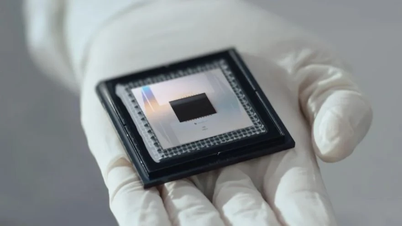
Photolithography is a technology that uses light to create intricate micro-patterns, often applied in silicon chips. (Image: QQNews ) |

These technological breakthroughs will bring significant benefits to the consumer industrial chain. For example, optical stabilization techniques can be applied to increase the accuracy of lithography machines, thereby improving the production quality of chips 7 nm (nanometers) and smaller. Other technologies are also expected to strongly boost the fields of telecommunications, medicine, materials, and precision measurement.
Ultimately, the "Earth 2.0" project addresses the most profound question: Are the conditions for maintaining stable life on a planet governed by "negative feedback" or "positive feedback" mechanisms?
Scientists explain that the Positive Feedback (as on Venus and Mars) is a dangerous mechanism where a small change (e.g., increased temperature) can lead to a larger, uncontrolled surge, causing the planet to heat up indefinitely and eventually collapse.
Conversely, negative feedback (as on Earth) is a "self-correcting" mechanism: When a planet is thrown out of equilibrium, it automatically activates repair systems to bring things back to a stable state.
From there, scientists put forward a groundbreaking hypothesis: Could life itself be part of that "self-regulating" mechanism, playing a key role in keeping the planet in balance and habitable?
Earth's history shows that the emergence of cyanobacteria significantly altered climate dynamics. They absorbed CO2 and produced oxygen during the Great Oxidation Event, preventing a powerful greenhouse effect and pushing Earth back from the brink of collapse to a stable state.
Therefore, the search for and cataloging of "Earth 2.0" planets will provide the ultimate evidence to prove whether life is a "savior" or a "destroyer" of a planet.
Source: https://znews.vn/trung-quoc-dang-tim-trai-dat-20-post1606148.html





![[Photo] Prime Minister Pham Minh Chinh receives the Chinese Ambassador to Vietnam](https://vphoto.vietnam.vn/thumb/1200x675/vietnam/resource/IMAGE/2026/04/05/1775397481797_ndo_br_dsc-5512-jpg.webp)


























































































Comment (0)