

(Labor and Social Affairs) - The Chinese government has launched initiatives to address age discrimination in recruitment.
Project manager David Li, 34, who lives in Guangzhou, southern China, has not been promoted after five years working at a technology company. This means the company doesn't value him. His job may be at risk.
Fear of losing his job led him to frequently work up to 12 hours a day in 2024 to prove to his superiors that he was still capable of working overtime. On weekends, he was always ready to take calls and handle unexpected work requests such as creating presentation slides.
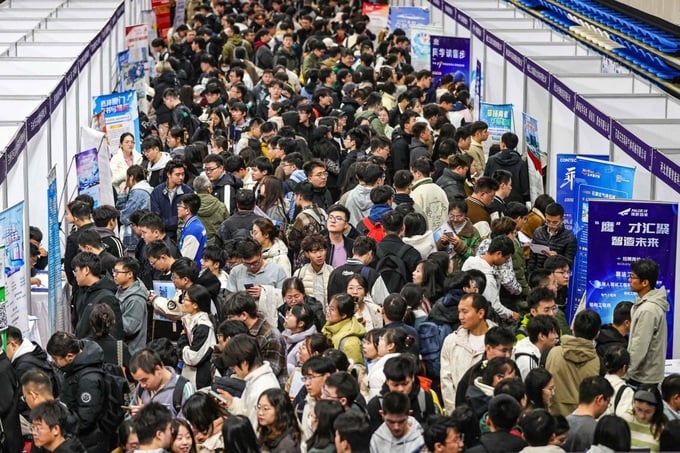
Mr. Li is not the only one feeling anxious about his job. The insecurity among Chinese workers after turning 35 is increasing as the "35 curse," or age discrimination in recruitment, intensifies amid a slowing economy .
The Chinese government is taking the lead in addressing the age-biased recruitment policies of employers by raising the age limit for civil service positions from 35 to 40, through adjustments to the age requirement for taking the civil service examination.
While career stagnation in China occurs relatively early, around age 35, this scenario doesn't follow the pattern in countries like Singapore, where the average age at which a career begins to stagnate is 48, according to a 2020 survey by recruitment firm Randstad.
In October 2024, the Chinese government announced it would raise the age limit from 35 to 40 for those taking the national civil service examination to join central government agencies.
Analysts suggest that changing the age limit for civil service exams is also a step to prepare the Chinese government to accept workers affected by employers' age policies and the slowdown of the economy.
This move also sends a message to private companies, encouraging them to raise the age limit for hiring.
The anxiety about turning 35 has become so widespread that in 2023, a temple in Chengdu, the capital of Sichuan province, was criticized for only accepting monks under the age of 35.
Dr. Jane Du, a researcher at the Soas China Institute in London (UK), believes that Chinese policymakers are trying to attract workers over 35 as a temporary solution.
"If the '35-year-old curse' continues amidst mass layoffs due to the economic slowdown and the lingering effects of the Covid-19 pandemic, it may become increasingly difficult for experienced or well-trained workers to reintegrate into the labor market after prolonged periods of unemployment," she said.
"China may also face labor shortages in the coming years due to its declining population. This underscores the need to maintain the efficiency and contribution of the current workforce," Ms. Du added.
The government has raised the retirement age for men from 60 to 63, effective from January this year. For women working in offices, the retirement age has increased from 55 to 58, while women in manual labor can work until age 55, compared to 50 previously.
Policymakers are also concerned about the bleak job prospects for a large number of postgraduate graduates who will enter the labor market in the coming years, due to the slowing economy.
Universities in China expanded enrollment in postgraduate programs to allow students to pursue higher education, aiming to alleviate job market pressure during the Covid-19 pandemic from 2020 to 2023. A record 12.2 million graduates are projected to enter the labor market by 2025.
As of November 2024, the unemployment rate in cities for the 16-24 age group was 16.1%, while the unemployment rate for the 25-29 age group was 6.7%. For the 30-59 age group, the rate was 3.8%.
Professor Pei Xiaomei of Tsinghua University hopes that other public institutions such as universities and research centers will follow the example of the national civil service examination. Doctoral candidates are worried about being too old to apply for positions in research institutes or educational institutions because the current age limit for recruitment is 35.
Most doctoral students in China graduate in their late 20s or early 30s, depending on their field of study. “If these students are considered the nation’s elite, they should have a fairer chance of securing jobs related to their training,” Professor Pei shared.
Professor Liu Erduo argues that a cultural shift is needed for the government to truly integrate those over 35 into the public sector. Nevertheless, the government's move to raise the national civil service age limit to address the "35-year-old curse" has received public support.
A hashtag related to this topic garnered 13.6 million views and generated 2,141 discussions, becoming one of the hottest topics on Weibo in November 2024.
However, some remain skeptical about the effectiveness of this change. One netizen suggested that the change "may be merely a formality" because recruiters could automatically exclude candidates over 35. "It will be easy for recruiters to find reasons to choose younger candidates," a netizen from Hunan province wrote on Weibo.
Duc Hoang (according to Straits Times)
Labor and Social Affairs Newspaper No. 8
Source: https://dansinh.dantri.com.vn/nhan-luc/trung-quoc-no-luc-xoa-bo-phan-biet-tuoi-tac-trong-tuyen-dung-20250117110800681.htm































































































Comment (0)