

According to the International Energy Agency (IEA), oil demand in China is growing faster than expected, potentially tightening the market further and driving prices higher.
Earlier this week, the IEA released its report on the global oil market. According to the report, the agency continued to raise its demand forecast to a record 102 million barrels per day this year, an increase of 2.2 million barrels compared to last year.
Of that, China contributed the majority of the increase, at 60%. Crude oil consumption in the country also peaked at 16 million barrels a day in March.
Although the latest economic figures show that China's recovery is still fragile, the IEA believes that "the outlook for the recovery in oil demand remains on track with forecasts." China is currently the world's leading oil consumer.
Beijing has recently been actively importing Russian oil. The current goal is to revive the economy after years of implementing a Zero Covid policy. Therefore, they need cheap energy to power their massive manufacturing industry.
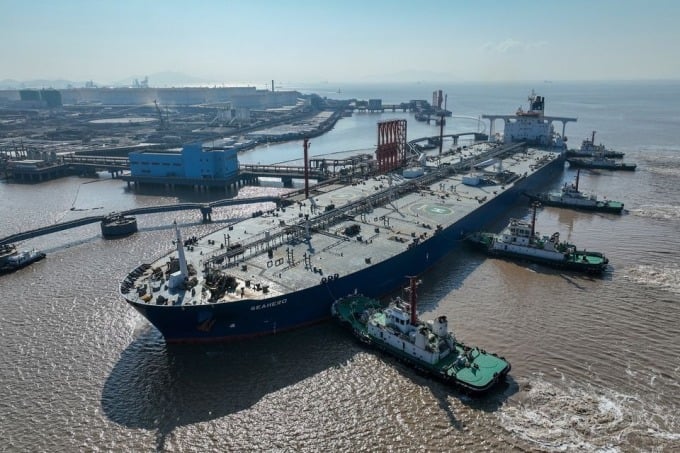
An oil tanker docked at a port in Zhejiang, China, in January. Photo: Reuters
The IEA's monthly report is closely watched by the market. This time, the report highlights the growing disparity between crude oil demand in developing countries and in Europe and North America – regions with less than optimistic economic prospects.
Demand is projected to surge in China and developing countries. Conversely, high interest rates and rampant inflation in developed economies could curb demand there.
Western countries' efforts to gradually move away from fossil fuels are widening this gap. Developing countries, on the other hand, still consider crude oil and coal to be reasonably priced fuels.
As demand is projected to rise, supply is struggling to keep pace. This year, global oil supply is forecast to average over 101 million barrels a day, an increase of 1.2 million barrels compared to last year.
The Organization of Petroleum Exporting Countries (OPEC) began cutting production by more than one million barrels per day this month. Oil companies in the US are also hesitant to invest in new production.
However, despite the IEA's forecast of a tense oil market, crude oil prices remain on a downward trend. Concerns about the health of the US banking system are the latest issue impacting the global economic outlook, putting pressure on crude oil prices.
Ha Thu (according to WSJ)
Source link



![[Photo] General Secretary and President To Lam meets with National Assembly delegates from ethnic minorities.](https://vphoto.vietnam.vn/thumb/1200x675/vietnam/resource/IMAGE/2026/04/20/1776696701056_a1-bnd-8331-3342-jpg.webp)
![[Image] National Assembly discusses the implementation of the socio-economic development plan.](https://vphoto.vietnam.vn/thumb/1200x675/vietnam/resource/IMAGE/2026/04/20/1776696707422_ndo_br_img-20260420-185419-jpg.webp)























































































Comment (0)