

A person who contributed to the preservation of the precious Van Pa pig breed.
Accompanying the delegation on the visit to Bu village was Mr. Le Thanh Tung, Deputy Head of the Technical Transfer Department, Quang Tri Provincial Agricultural Extension Center. According to Mr. Le Thanh Tung, the Van Pa pig breed (also known as the Quang Tri mini pig) has been raised by the Pa Ko and Bru-Van Kieu ethnic groups along the Truong Son mountain range since ancient times. This breed has been identified by the Ministry of Agriculture and Environment as a rare and valuable livestock genetic resource that needs to be preserved and propagated. Although Van Pa pigs have a small body weight and slow growth, they have good resistance to disease, are easy to raise, and have delicious, firm meat, making them very popular in the market. Due to the practice of free-range farming and a lack of investment, the number of purebred Van Pa pigs has rapidly declined and become crossbred, facing the risk of extinction.
Faced with this situation, the Provincial Agricultural Extension Center implemented the project "Building a model for raising indigenous pigs - Van Pa breed linked with product consumption" in the mountainous communes of the province, including Tan Lap, Lao Bao, and Truong Son, with an initial support of 550 purebred pigs. Mr. Ho Van Tung's family in Bu village was one of the households selected to pilot the model.
 |
| The food source for Van Pa pigs is sourced from nature - Photo: Provided |
For village headman Bu Ho Van Tung, during his years of struggling to find a sustainable economic development path for his family and fellow villagers, he always harbored the desire to restore and preserve the unique Van Pa pig breed of the Pa Ko and Bru-Van Kieu people. When he encountered the project "Building a model for raising indigenous pigs - Van Pa breed linked to product consumption" supported by the Provincial Agricultural Extension Center, he felt like he had struck gold and was determined to build a system of barns and launch the model.
“Previously, the villagers raised pigs in a fragmented manner, with each household having only a few pigs roaming freely, resulting in low economic efficiency, high disease risks, and environmental pollution. Since implementing the Van Pa pig farming model based on biosafety principles and strictly applying the technical procedures transferred by the provincial Agricultural Extension Center staff, my family's Van Pa pig herd has grown and developed well. Even when African swine fever broke out on a large scale, the Van Pa pig herd remained completely safe,” shared village head Ho Van Tung.
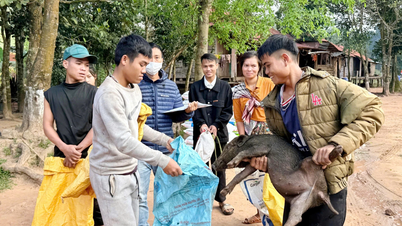
With an initial support of 40 piglets weighing 8-12kg, after nearly 8 months of care, the Van Pa pig herd of Mr. Ho Van Tung's family now weighs 27-30kg, ready for sale in time for the Lunar New Year. "Besides the pigs ready for sale, during the breeding process, I classify and select sows and boars for natural mating to create a local breeding stock to maintain and expand the Van Pa pig breed to other localities," Mr. Tung said.
Integration with digital technology
After many years of working and living in Laos, Mr. Ho Van Tung decided to return to invest in and develop his family's economy in Bu village, his hometown. To date, his family's diversified farming model is basically stable with 2.5 hectares of acacia trees; 1.4 hectares of cassava; 0.9 hectares of fruit trees and a fish pond. His most valuable asset is his closed-system livestock farm, strictly adhering to biosecurity regulations ("no entry, no exit"), and his Van Pa pig herd. Mr. Ho Van Tung's family earns an average income of approximately 200 million VND per year.
With a basic education, Mr. Tung quickly adapted to digital technology. Trusted by the villagers and elected as village head in 2021, in order to facilitate leadership, management, and mobilization of the people to effectively implement the Party's guidelines and the State's policies and laws, and to guide people in economic development and poverty reduction, Mr. Tung established a community Zalo group in Bu village to provide information coverage to all villagers.
 |
| The Van Pa pig breed thrives at Mr. Ho Van Tung's farm - Photo: Provided |
“After the Van Pa pig farming model stabilized, with the desire to expand it throughout the village, I selected three households – Ho Pa Moc, Ho Van Phoi, and Ho Thi Thai – to encourage them to raise Van Pa pigs together, with the piglets provided by my family. When African swine fever spread to the village, to ensure the safety of the pig herd, I completely isolated the entire pig farming system, so the households couldn't come to learn in person. I came up with the idea of guiding the villagers on all the care techniques through the community Zalo group in Bu village. Thanks to that, the transfer of knowledge was not interrupted, and the participating households developed their pig herds stably without being affected by the disease,” shared Village Head Ho Van Tung.
Village head Ho Van Tung shared before we left: “In the future, I hope to firmly establish the Van Pa pig brand in Quang Tri and become a reputable center for supplying Van Pa pig breeds nationwide. To realize this dream, I am replanning the semi-intensive farming area on 1.4 hectares; applying a completely biosecure farming process.”
Leveraging social media, Mr. Ho Van Tung promoted the Van Pa pig brand nationwide and sold breeding pigs through an online marketplace. Many customers from the northern part of the province and from Nghe An and Ha Tinh provinces contacted him to purchase breeding pigs.
Speaking about the village head, Ms. Ho Thi Thai, one of the households that received support from Mr. Ho Van Tung in the form of Van Pa pig breeds, sincerely said: “Tung is a great person. He’s hardworking… he says what he means and does what he says. Whatever the villagers need, they always turn to Tung for help. Thanks to Tung establishing the Zalo group and the Bu village community page, the villagers know everything that’s happening near and far. He also shares information about farming, what crops to plant, and what animals to raise so that the villagers can learn and follow his example.”
Ngo Thanh Long
Source: https://baoquangtri.vn/xa-hoi/202512/truong-ban-thoi-cong-nghe-so-1541423/


























































Comment (0)