

Nearly 50 years later, with the mission of "alleviating hunger" completed, this land faces a new challenge, no longer a battle against acidity and weeds, but a transformation in mindset: from purely agricultural production to a green, multi-value, and sustainable agricultural economy in the context of increasingly severe climate change.
MIRACLE OF RECLAMATION OF ALUM SOIL
Looking back on that journey, those who were directly involved in exploring the Mekong Delta still cannot hide their emotions.
In the continuous stream of memories stretching from the past to the present, the story is not just about growth figures or cultivated land area, but also a journey of faith, of bold decisions, and the unity of an entire generation.

Former Chairman of the People's Committee of Dong Thap (old) province, Nguyen Xuan Truong, when recalling the early years of pioneering, still maintains the calm but proud demeanor of someone who witnessed and contributed to creating a historical turning point.
According to Comrade Nguyen Xuan Truong, in the post-war context with countless difficulties and prolonged famine, Dong Thap was forced to find a way to survive from the very land that seemed unexploitable. "At that time, there weren't many options."
"To survive, we had to open up the land. But opening up the land in the Mekong Delta was unlike anywhere else; it was a battle against acidity, against water, and against the limitations of science at that time," Comrade Nguyen Xuan Truong recalled.
It was in this context that groundbreaking policies emerged.
From the policy of digging central irrigation canals to leach out acidity and bring in water, to the policy of leasing land to farmers to create incentives for production… all of these have formed a comprehensive system of solutions. But according to former Chairman of the People's Committee of Dong Thap province, Nguyen Xuan Truong, the decisive factor remains the will of the people.
"The government can only succeed when the people believe in it. When the people are united, even seemingly impossible things become possible," Mr. Truong affirmed.
From those strategic decisions, a new generation of residents in the Mekong Delta region has emerged – farmers who not only know how to cultivate the land but also know how to adapt, learn, and master their fields.
In that context, the memories of Comrade Phung Cong Thanh, Chairman of the People's Committee of Tam Nong commune, stand out as an authentic snapshot, continuing the historical thread from previous generations.
Born and raised in the very heart of the acidic soil region of the Mekong Delta, he is a direct witness to the daily changes taking place there.
Comrade Phung Cong Thanh still vividly remembers the rice crop failures due to soil acidity, the barren fields where the people's hard work was almost completely wasted.
But it was precisely from those failures that science and technology began to permeate every rice field. “There were scientists who ate and slept right in the fields, experimenting with different methods of reducing and controlling soil acidity alongside the farmers. From yields of only 3-4 tons/ha, they gradually increased to 6 and then 8 tons/ha. That was a huge turning point,” Comrade Phung Cong Thanh shared.
According to Comrade Phung Cong Thanh, the change comes not only from technology, but also from production thinking, as farmers begin to understand the land and water, and learn to "befriend" nature instead of just trying to control it.
However, Comrade Phung Cong Thanh himself frankly acknowledged the negative aspects of a period of rapid development. When food security was paramount, the model of intensive production with three rice crops per year was once considered the optimal solution.
But over time, the consequences began to become apparent. “The enclosed dikes helped to grow a third crop, but they also inadvertently prevented silt from reaching the fields. The soil gradually lost its looseness, fertilizer costs increased, and the economic efficiency was no longer the same as before,” said Comrade Phung Cong Thanh.
That's when farmers began to realize that if they continued to exploit the land in the old way, the land itself would "speak out."
These concerns were also shared by Comrade Nguyen Thanh Cong, Chairman of the Red Cross Society of Phu Hiep commune, former Tam Nong district (now Tam Nong commune), as a cautionary tale. Having experienced many ups and downs, Comrade Nguyen Thanh Cong believes that the greatest success of the EIA is not just the rice yield, but the people's trust in the government.
"To maintain that belief, we must dare to change; we cannot continue with the mindset of 'exploiting' the land. Climate change is no longer a distant issue; it is present in every rainy season and every drought and salinity intrusion," Comrade Nguyen Thanh Cong emphasized.
FROM "RICE GARDEN" TO MULTI-VALUE AGRICULTURE
In reality, the Mekong Delta is at a new crossroads. While previously the primary goal was to produce enough food, the challenge now is how to achieve sustainable development and increase value per unit area. And the solution no longer lies in increasing production, but in diversifying value.
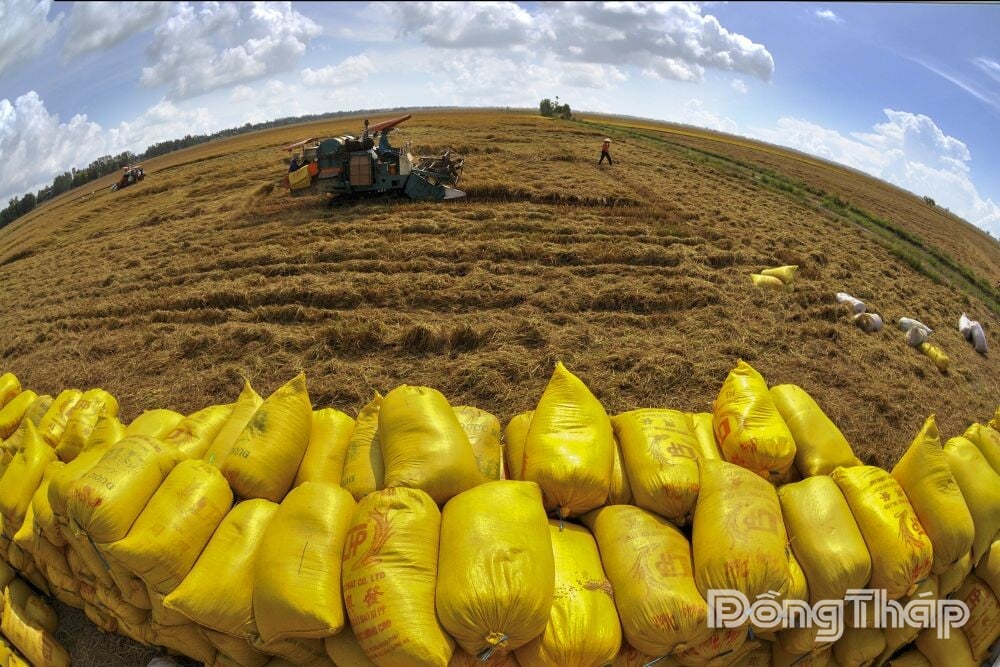
From practical experience in production, it can be seen that the Mekong Delta is not just about rice. The vast lotus fields, the unique wetland ecosystem, the abundant flood season… all are valuable assets.
However, for a long time, this region was almost entirely confined to its role as a rice granary, leaving many other potentials untapped.
A notable highlight in the current period is the emergence of a new generation of young farmers, a generation no longer struggling with the "survival" equation, but actively seeking new paths to development. They are not turning their backs on agriculture, but choosing to practice it in a different way.
Many new models have emerged, ranging from raising freshwater fish during the flood season combined with experiential tourism; cultivating rice and lotus plants linked with culinary services; and developing community-based tourism tours…
Instead of simply selling raw products, young entrepreneurs are learning how to tell the story of their products, increasing their value many times over. Notably, science and technology are becoming crucial levers.
From digital applications in production management to biological solutions and circular agriculture, all are contributing to shaping a modern agricultural economy that adapts to climate change.
Looking back over the past 50 years, Dong Thap Muoi has every right to be proud of a past full of hardship but also immense pride. From a "field of survival," where people struggled to find food, this land has risen to become an important part of the country's agricultural economic map.
However, many challenges remain: climate change, a competitive market, and increasingly high quality requirements necessitate continued innovation in environmental impact assessment (EIA).
And throughout this journey, lessons from the past remain invaluable: unity, a spirit of daring to think and act, and the ability to adapt flexibly. And today's young farmers of the Mekong Delta are expected to be a powerful driving force for this region to continue moving further forward.
MY LY
Source: https://baodongthap.vn/tu-canh-dong-sinh-ton-den-tu-duy-kinh-te-ben-vung-a240415.html







































































Comment (0)