



From village wrestling arenas to national figures.
At the traditional wrestling tournament of O Dien commune, held at the Hong Ha wrestling arena ( Hanoi ), the competitions were exciting. It was from this wrestling arena that many athletes matured and became prominent figures in Vietnamese wrestling, such as wrestler Pham Nhu Duy, who won a gold medal at the 33rd SEA Games on his first participation.
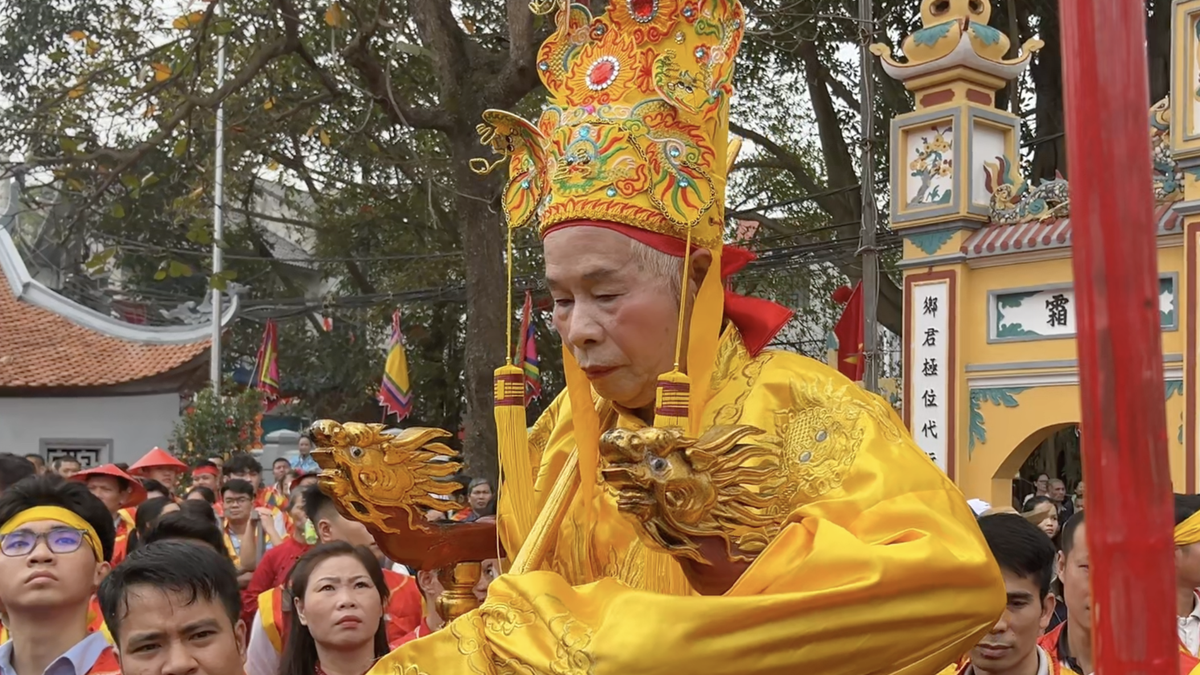
Similarly, at the wrestling festival in Mai Dong village (Hanoi), the festive atmosphere became vibrant with the appearance of national team wrestler Dao Hong Son and foreign wrestlers. Amidst the rhythmic drumming of the festival, the Asian Jujitsu champion made a strong impression with an exciting opening performance for the competition in the Year of the Horse.
Not only did Dao Hong Son impress with his technique and confident, professional demeanor, but he also demonstrated his competitive spirit by successively defeating seasoned village wrestlers and even MMA fighters to win 3 matches, finishing the tournament in third place overall. His presence alongside foreign wrestlers at wrestling arenas such as Cong Luan village communal house (Hung Yen), Mai Dong, Can Thuong (Hanoi)... shows the natural connection between traditional wrestling and high-performance sports .
Many other athletes who have won gold medals at the SEA Games, and even participated in the Olympics, also rose to prominence from village wrestling arenas, such as Nguyen Thi Lua, Can Tat Du, Nguyen Xuan Dinh, Phung Khac Huy... Starting from the village wrestling arenas, these young talents were discovered, honed, and gradually rose through the ranks of professional training systems.
Nguyen Thi Lua, a legend of Vietnamese women's wrestling, grew up in the wrestling arena of Yen Noi village (Hanoi). She was the first Southeast Asian wrestler to qualify for the Olympics twice and won a silver medal at the 2010 Asian Games. Before transitioning to coaching, even at the peak of her international career, Lua maintained the habit of returning to compete in village festivals every Tet (Lunar New Year), participating in 5 to 7 festivals each year. This was not only a way to connect with her hometown but also a way to continue the tradition.
Born into a family with a strong wrestling tradition in the renowned Phung Xa wrestling arena (Hanoi), Can Tat Du grew up in the village wrestling arena, fueled by the passion of his father, Can Tat Vinh, a famous wrestler and currently the coach of the Hanoi traditional wrestling team. His initial lessons in basic techniques and moves, learned right in the village square, laid a solid foundation for his later skills. At the recent SEA Games 33, he won his sixth gold medal, setting a record that will be difficult for any wrestler to surpass.
It can be said that most of the prominent names in the national team today rose from the wrestling movement in village arenas in their localities. Their journeys demonstrate the strong link between grassroots movements and elite sports.

A launching pad for success
Originating from traditional wrestling arenas, many localities have formed renowned "wrestling villages." Yen Noi (Hanoi), dubbed the "Number One Wrestling Village in the World," boasts thousands of wrestlers and has contributed hundreds of champions to the nation. Names like Phi Huu Tinh, Nguyen Dinh Chi, Nguyen Van Cong... all rose to prominence from this village.
Mai Dong is famous for the wrestling school of the renowned general Tam Trinh, long considered a harsh arena where wrestlers from many provinces and cities come to test their skills and make a name for themselves. Sinh Village ( Hue ) is a typical wrestling arena of Central Vietnam, not only a unique spring festival space but also a place where many talents for high-level local and national sports are discovered.
Therefore, the village wrestling matches in the spring are not simply traditional recreational activities. They are environments for training physical strength, willpower, and chivalrous spirit, and community spaces where folk cultural values are preserved and passed down through generations. From this movement, Vietnamese sports have developed extensively at the grassroots level, creating a solid foundation for high achievements.
At the recent SEA Games 33, wrestling was one of the sports that made a significant contribution to the Vietnamese sports delegation. With 12 medals, including 10 gold, 1 silver, and 1 bronze, Vietnamese wrestling continued to affirm its leading position in Southeast Asia. This achievement not only reflects the professional quality but also demonstrates the effectiveness of a strategy that leverages traditional identity to create a unique competitive advantage.
From a broader perspective, the presence of renowned wrestlers at village festivals not only enhances the festival's appeal and provides the people with high-quality matches, but also contributes to improving the community's spiritual life. From the cultural space of the countryside, the spirit of martial arts is nurtured, spread, and transformed into a driving force for the development of high-performance sports.
From the wrestling arenas at the beginning of spring, many generations of athletes have been forged with the will and courage to venture out into the wider world. This journey shows that Vietnamese sports are inseparable from their national cultural roots, and it is precisely from this traditional foundation that proud achievements on the international stage have been built.
Source: https://baovanhoa.vn/the-thao/tu-soi-vat-lang-den-ra-bien-lon-206663.html




















































Comment (0)