

Artificial intelligence (AI) has emerged as a disruptive technology with the potential to revolutionize various industries, and journalism is no exception.
 |
| While AI is revolutionizing journalism, it also raises several questions about ethics and law, accountability, and intellectual property. (Source: Vneconomy.vn) |
In recent years, AI has played an increasingly important role in shaping the journalistic landscape, from news gathering to content creation and audience engagement. AI-generated content refers to any type of content created by artificial intelligence rather than by humans.
This can include everything from articles and social media posts, news aggregation, text-to-speech, image creation and recognition, and even video creation….
With its ability to generate massive amounts of content in record time, AI-generated content has become a game-changer for many news organizations. But what does this trend mean for the future of journalism?
And while AI is revolutionizing journalism, enabling faster, more accurate reporting and more personalized content, it also raises ethical and legal questions surrounding issues such as accountability and intellectual property.
As AI technology continues to evolve, it is crucial for journalists and administrators to understand its potential as both a tool and a potential threat.
How can AI help news organizations achieve breakthroughs?
Save as much cost and time as possible.
Cost-effectiveness and time efficiency refer to the ability of AI to create content that can reduce the resources needed for content production while maintaining quality. AI can produce content at a much faster rate than humans, freeing up time and resources. AI can also create content around the clock without breaks or rest, accelerating content turnaround times.
Furthermore, AI also helps news organizations reduce their need for editors and reporters, allowing them to invest more in other areas of operation.
The New York Times, Associated Press, Reuters , and the Washington Post have all used AI to create content. The Press Association (UK) can now produce 30,000 news items per month using AI, in all formats: text, images, video, etc.
| RELATED NEWS | |
 | Artificial intelligence brings job loss fears, but employees are still eager to use it. |
Almost absolute accuracy
The accuracy of information is a major advantage of AI. Using algorithms, machines are designed to follow a set of rules that ensure consistent and accurate output. Machines can process large amounts of data more efficiently than humans, and they don't experience fatigue or make errors due to stress. This also ensures that the output is objective and not influenced by human emotions or biases.
The accuracy of AI-generated content depends on the quality of the data used to train the AI model and the algorithms used in the generation process. AI algorithms can process massive amounts of information quickly, which can improve the accuracy of data-driven content and statistical analysis, surpassing human performance.
In a research report by the Catalan Press Committee titled: "Algorithms in the Newsroom: Challenges and Recommendations for Artificial Intelligence with Ethical Values in Journalism," the results of an investigation into media organizations' application of AI in the publishing process are as follows:
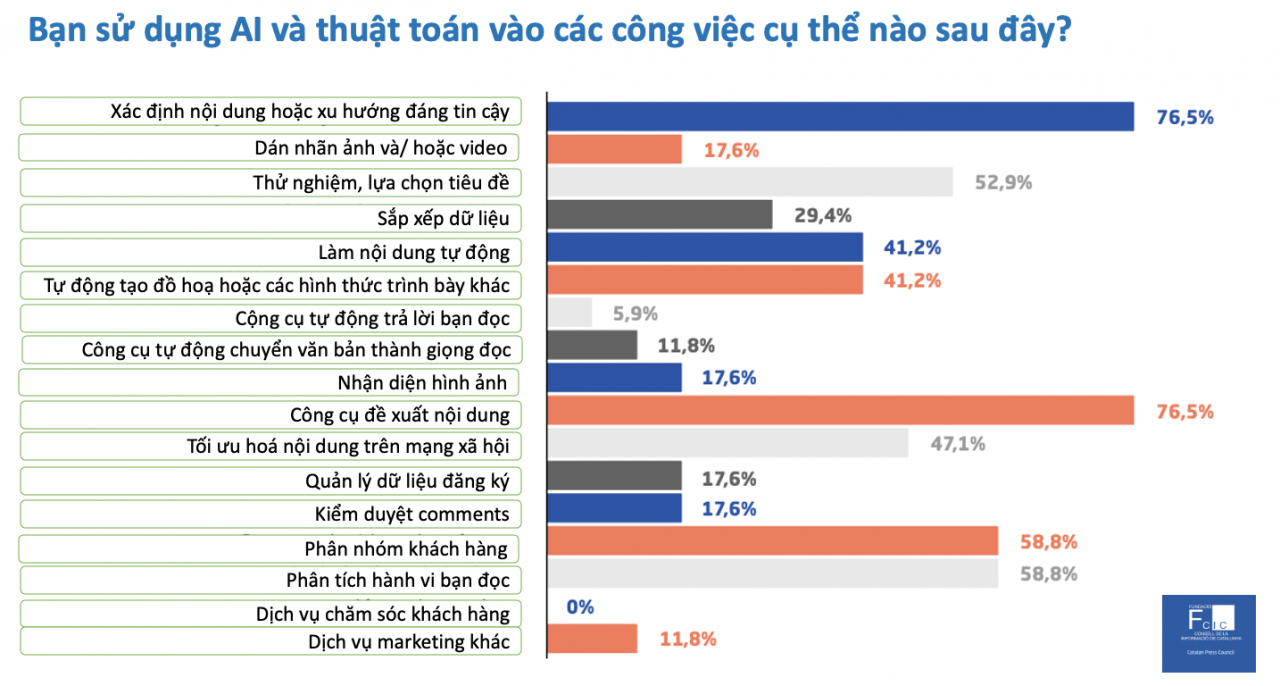 |
| A survey by the Catalan Press Council revealed the extent to which media organizations are applying AI in news publishing and other content production. (Source: Catalan Press Council) |
Enhanced personalization and audience engagement.
Artificial intelligence has the potential to transform how news is distributed and published, delivering personalized experiences tailored to each reader. By analyzing user preferences, habits, web browsing behavior, and social media interactions, AI algorithms can suggest relevant articles and topics of interest.
This enhances audience engagement and allows journalists to create content tailored to specific audiences, increasing readership and fostering closer connections between journalists and their readers.
The challenges posed by AI to news organizations.
Lack of creativity and insensitivity
One of the biggest challenges of AI-generated content is its lack of creativity and responsiveness. AI models are trained on existing data and patterns, which limits their ability to create truly original content. They excel at recognizing and replicating patterns and structures within their existing databases, but struggle to generate novel and innovative ideas.
Furthermore, AI lacks the sensitivity and nuance of a journalist, which is the ability to understand and respond to human emotions and behavior. This means that AI-generated content may fail to capture the nuances of a particular situation or understand the cultural context of a piece of content, leading to potentially insensitive or inappropriate output, and even misleading in some cases.
Therefore, many argue that, while AI-generated content may be useful for certain tasks, it should not replace human creativity and intuition in fields such as journalism. Journalists can draw on their unique perspectives and experiences to create content that is both accurate and engaging, while also adapting to the changing needs and expectations of their audience.
Therefore, although AI is now an extremely powerful tool, surpassing journalists in some aspects, this does not mean that the role of journalists in the production and distribution of news should be completely eliminated. It should be used in conjunction with human expertise to create truly engaging, relevant content that meets the needs of readers.
Accuracy and bias
AI-generated content can be biased or inaccurate if the algorithms are not properly designed. For example, if the training dataset is biased or the algorithm is programmed to prioritize certain factors, this can lead to inaccurate or misleading content.
The potential for algorithmic bias and discrimination is a significant concern. Journalists and developers must work together to ensure AI systems are transparent, accountable, and built on diverse and representative datasets.
 |
| Artificial intelligence has emerged as a powerful tool in the field of journalism. (Source: Digital.news) |
Ethical and legal issues
There are ethical and legal considerations when producing AI-generated content, as it differs from traditional journalism based on human judgment. AI models rely on large datasets for training, and ethical considerations regarding data collection and use are crucial.
Issues related to privacy, consent, and data ownership can arise when personal or sensitive information is used without consent or adequate safeguards. Protecting user privacy and ensuring ethical data practices are essential considerations in AI-generated content.
In some cases, AI can even be manipulated for malicious purposes, such as Deepfakes – a synthetic tool used to convincingly alter or fabricate content, such as videos or audio recordings. Deepfakes can be used to spread misinformation, manipulate public opinion, or damage the reputations of individuals. Ethical assessments and controls are needed, including measures to combat the misuse of AI technology and the development of mechanisms to verify and detect malicious acts in order to prevent them in a timely manner.
| RELATED NEWS | |
| Artificial intelligence and the threat of modern warfare. |
In summary, artificial intelligence has emerged as a powerful tool in journalism, transforming various aspects of the field, from news gathering to content creation and engaging with audiences.
While it offers unprecedented opportunities for efficiency, accuracy, and personalization, it also comes with ethical challenges that require careful consideration. The issue is that managers, as well as technologists and content creators, need to collaborate to leverage the opportunities offered by AI and responsibly address the challenges it poses.
Source


![[Photo] General Secretary and President To Lam meets with National Assembly delegates from ethnic minorities.](https://vphoto.vietnam.vn/thumb/1200x675/vietnam/resource/IMAGE/2026/04/20/1776696701056_a1-bnd-8331-3342-jpg.webp)

![[Image] National Assembly discusses the implementation of the socio-economic development plan.](https://vphoto.vietnam.vn/thumb/1200x675/vietnam/resource/IMAGE/2026/04/20/1776696707422_ndo_br_img-20260420-185419-jpg.webp)






































































































Comment (0)