

Ho Chi Minh City – Mr. Giang, 72 years old, developed a benign tumor under his left jaw 6 years ago. Now, the tumor is growing rapidly, causing difficulty swallowing. Doctors have diagnosed it as salivary gland cancer.
When first discovered, the tumor was only about the size of a fingertip, caused no unusual symptoms, and was diagnosed as benign by the doctor, so Mr. Giang did not go for a follow-up examination. For the past two months, he has had poor appetite and lost 3 kg, so he went to Tam Anh General Hospital in Ho Chi Minh City for examination.
Ultrasound results showed a tumor measuring 5x7x12 cm, with well-defined boundaries and no invasion of the left carotid artery. Fine-needle aspiration confirmed it to be a submandibular salivary gland tumor, a pleomorphic (mixed) type tumor.
On November 29th, Dr. Huynh Ba Tan, from the Department of Breast and Head and Neck Surgery, stated that although the tumor was benign, its rapid growth could indicate it had become malignant. The patient was advised to undergo surgery to remove the submandibular gland containing the tumor as soon as possible.
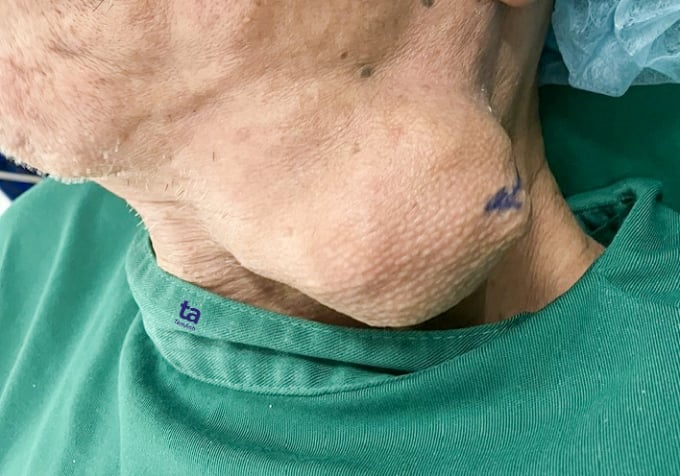
The tumor under the patient's jaw measured 12 cm. Photo: Nguyen Tram
The surgical team removed the entire left submandibular gland containing the tumor, preserving the mandibular nerve, lingual nerve, and hypoglossal nerve. Pathological examination revealed a stage three malignant tumor, and the patient underwent further radiotherapy.

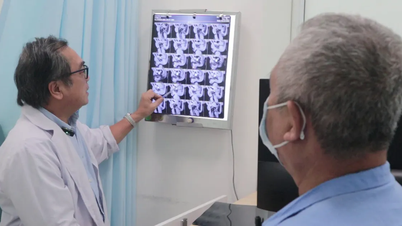
Doctor Bá Tấn advises a patient. Photo: Nguyễn Trăm
Salivary glands consist of major and minor glands distributed throughout the oral cavity, mainly in the palate and in the upper digestive tract (esophagus, stomach, duodenum).
Dr. Tan stated that most salivary gland tumors are benign, with only 5% being cancerous. Of these, 60% are malignant parotid gland tumors, 30% are malignant submandibular gland tumors, and 10% are malignant sublingual and accessory salivary gland tumors.
Some benign salivary gland tumors, such as pleomorphic adenomas and columnar adenomas, also have the potential to become malignant. With pleomorphic adenomas, the time it takes for the tumor to turn malignant is approximately 15-20 years from the time it appears as a benign tumor. Depending on cell development, the tumor may become malignant sooner.
Benign columnar tumors can gradually transform into glandular carcinoma. This is the second most common type of salivary gland cancer, which grows slowly and spreads along nerves. The prognosis for this type of cancer is less serious than for idiopathic glandular carcinoma.
Dr. Tan advises patients who discover any abnormal lumps to seek immediate medical attention for timely diagnosis and treatment. In the case of benign tumors, patients should undergo regular monitoring and not be complacent. Large tumors can affect aesthetics, compress the esophagus and larynx causing difficulty swallowing and breathing, and adhere tightly to surrounding tissues, making surgery difficult.
Nguyen Tram
| Readers can ask questions about cancer here for doctors to answer. |
Source link










































































































Comment (0)