


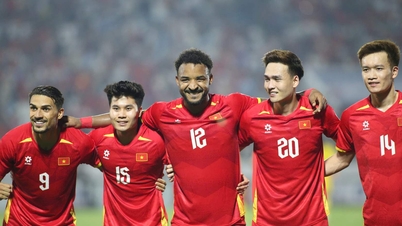
The Vietnam U23 team has been and continues to demonstrate its ability to reach the global stage.
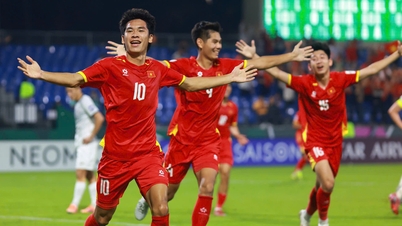
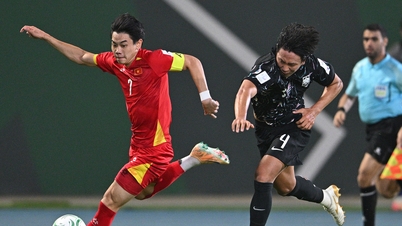
The 3-2 victory against UAE after extra time was the kind of win that big teams often achieve: not necessarily beautiful in every moment, but perfect in the most crucial moments. Twice taking the lead, twice being brought back to square one, and then remaining calm enough to finish it off in the 101st minute. It wasn't a lucky burst of luck. It wasn't an "earthquake" that left viewers baffled. This was the victory of a system that knew how to correct its mistakes during the match, knew how to withstand blows, and knew how to strike back.
A sign of maturity can be… heard.
If Changzhou (China) 2018 was a story of belief ignited in the snow, then Saudi Arabia 2026 is a story of belief measured by desert temperatures and intense competition. There is no room for romance here. Youth football in Asia demands a robust physique, strict discipline, and a cool head to survive periods of uncertainty.
The Vietnam U23 team possesses exactly those qualities. Their composure… can be heard in the way the team retreats to the correct distance, in the precise covering runs, in the way the players don't panic when the opponent equalizes, and don't become flustered when the opponent increases the pace. This is a sign of a team that has entered the "game management" phase, something that has been a major gap in Vietnamese youth football for many years.
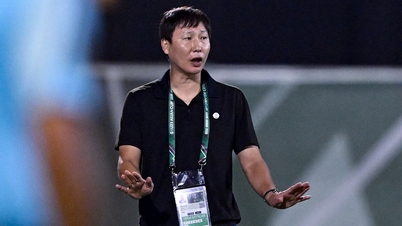
The statistics speak for themselves. In the 120-minute battle against the UAE U23 team, almost all the parameters were similar. Coach Kim Sang-sik's players held possession for 48%, made 562 passes, and had 14 shots, compared to their opponents' 52% possession, 609 passes, and 13 shots. However, the difference lay in the quality of the chances. Vietnam U23's 14 shots were expected to create 2.15 goals (2.15 xG), while UAE only had 0.99. This xG metric represents the quality of a scoring opportunity created and the likelihood of scoring from that opportunity. It is calculated based on various factors at the time the shot is taken, such as the shooter's position, distance from the goal, shooting angle, and other factors. Each shooting opportunity is rated individually and can have a value from 0 to 1. The final xG value is the sum of the values of all shooting opportunities. A penalty kick has a fixed value of 0.79.
While victory and defeat can be determined by luck, the xG (xonum of chance) metric more clearly reflects the quality of the players and the tactics of a team. Simply put, the better (or stronger) team always creates more clear-cut scoring opportunities. Therefore, the Vietnam U23 team overcame the UAE U23 team in a superior manner rather than relying on a miracle. This was also the 15th consecutive victory for the Vietnam U23 team in official tournaments, a remarkable number and certainly not due to luck.
Significantly, the way the Vietnam U23 team navigated that journey wasn't through a single playing style, but through various winning strategies. When control was needed, they controlled. When defense was needed, they defended. When acceleration was required, they accelerated. The high intensity of matches and the endurance of the system are the most reliable measures. A young team playing 8 official matches in less than 45 days, yet still able to accelerate in extra time and "break down" opponents in the final minutes – this is no longer just a matter of spirit. It's about physical science , organized recovery, disciplined living, and a foundation of physical training prepared to withstand a short-duration continental tournament.
And it is at this point that the Vietnam U23 team is "switching roles," transforming from a team that usually runs out of steam after the 70th minute into a team that becomes increasingly formidable towards the end. Not in a noisy way, but in the way of a machine that continues to run smoothly even when its opponent starts to lose momentum.
A match of patience
If the UAE presented a test of strength, physique, and West Asian tenacity, then the Chinese U23 team in the semi-final at 10:30 PM on January 20th will be a different challenge: discipline and tightness. Their quarter-final match against Uzbekistan was a "declaration" of their playing style: not being intimidated, not being afraid of being pressured, being willing to endure long enough to wear down their opponent, and then deciding the outcome through composure in the penalty shootout.
The Uzbekistan coach pointed out the most important thing: “China narrows their formation in the midfield, forcing opponents to play wide or use long balls. In other words, they build a ‘wall’ where opponents want to play the ball most and turn the game into a test of patience. Do you have enough composure to avoid rushing? Do you have enough quality passes to avoid wasting the ball? Do you have enough speed to take advantage of those rare moments?”
That's the kind of opponent that easily frustrates people. Therefore, this will be a match of "maturity"—maturity in choosing the right pace, maturity in avoiding emotional traps, maturity in winning without fanfare. People often talk about "the shift in power" as a rather grandiose phrase. But power in football doesn't lie in rhetoric. It lies in making your opponent change their way of thinking before the ball even starts rolling.
The Vietnam U23 team is achieving that. Previously, big teams facing Vietnam often thought simply playing to their full potential was enough. But now, they'll have to realize that playing to their full potential might not be enough, because Vietnam can withstand prolonged pressure, punish mistakes, and accelerate when you're out of breath. The semi-final against China U23 is the next test to turn that power into a habit, not just a fleeting moment. Changzhou 2018 was the opening chapter of a fairy tale. Saudi Arabia 2026 is the chapter where the fairy tale must grow, must be rewritten with discipline, science, and unwavering determination. At the threshold of the final, the Vietnam U23 team is no longer seeking recognition. Coach Kim Sang-sik and his players are seeking a place in the team, and more importantly, how to maintain that place through their own style of football.
Dinh Bac has a strong chance of winning the top scorer title.
Every major tournament usually needs a representative figure to embody the team's "spirit." For the Vietnam U23 team right now, Nguyen Dinh Bac is such a figure.
With 3 goals and his current form, Dinh Bac is a leading contender for the top scorer title at the U23 Asian Championship. In the scoring list, Ali Azaizeh (Jordan) and Leonardo Farah Shahin (Lebanon) are currently leading with 4 goals each; however, both players have no chance to improve their goalscoring record as their teams have been eliminated. Meanwhile, Dinh Bac and Ryunosuke and Shusuke Furuya (Japan) all have 3 goals and two matches remaining.
DANG XA
The U23 Asian Championship winners do not receive prize money.
The U23 Asian Championship currently taking place in Saudi Arabia does not have prize money, like many other youth tournaments under the Asian Football Confederation (AFC). The regulations for the 2026 U23 Asian Championship stipulate that the winning team receives the trophy and 43 medals. The second and third place teams also receive a similar number of medals. Additional medals can be produced upon request, with the cost borne by the requesting team.
According to the AFC, youth tournaments, including the U17, U20, and U23 Asian Championships, are platforms for developing talent, gaining international experience, and preparing a successor generation for national teams. Therefore, achievements in AFC youth tournaments are primarily judged by professional quality, player maturity, and future contributions to national football, rather than commercial value or direct prize money. K. Tuan
Source: https://baovanhoa.vn/the-thao/u23-viet-nam-vuon-ra-bien-lon-198425.html


![[Photo] National Assembly Chairman Tran Thanh Man successfully concludes his participation in IPU-152](https://vphoto.vietnam.vn/thumb/1200x675/vietnam/resource/IMAGE/2026/04/18/1776502638199_vna-potal-chu-tich-quoc-hoi-ket-thuc-tot-dep-chuong-trinh-tham-du-ipu-152-8709975-jpg.webp)











































































Comment (0)