

PROGRAM DISTRIBUTION IS NOT REASONABLE
Teacher Lam Vu Cong Chinh from Nguyen Du High School (District 10, Ho Chi Minh City) assessed: The real-life scenarios presented in textbooks are not truly realistic. For example, in the 12th grade math textbook, part of the "Connecting Knowledge" series, volume 2, exercise 5.18 (page 49) presents a scenario where a bullet is fired and moves in a straight trajectory. Experiential learning activities haven't truly achieved their objectives; the real-life scenarios remain "on paper," making it impossible to assess students' application skills. English exams and tests still only assess reading, writing, or listening skills, leaving students with weak speaking abilities.
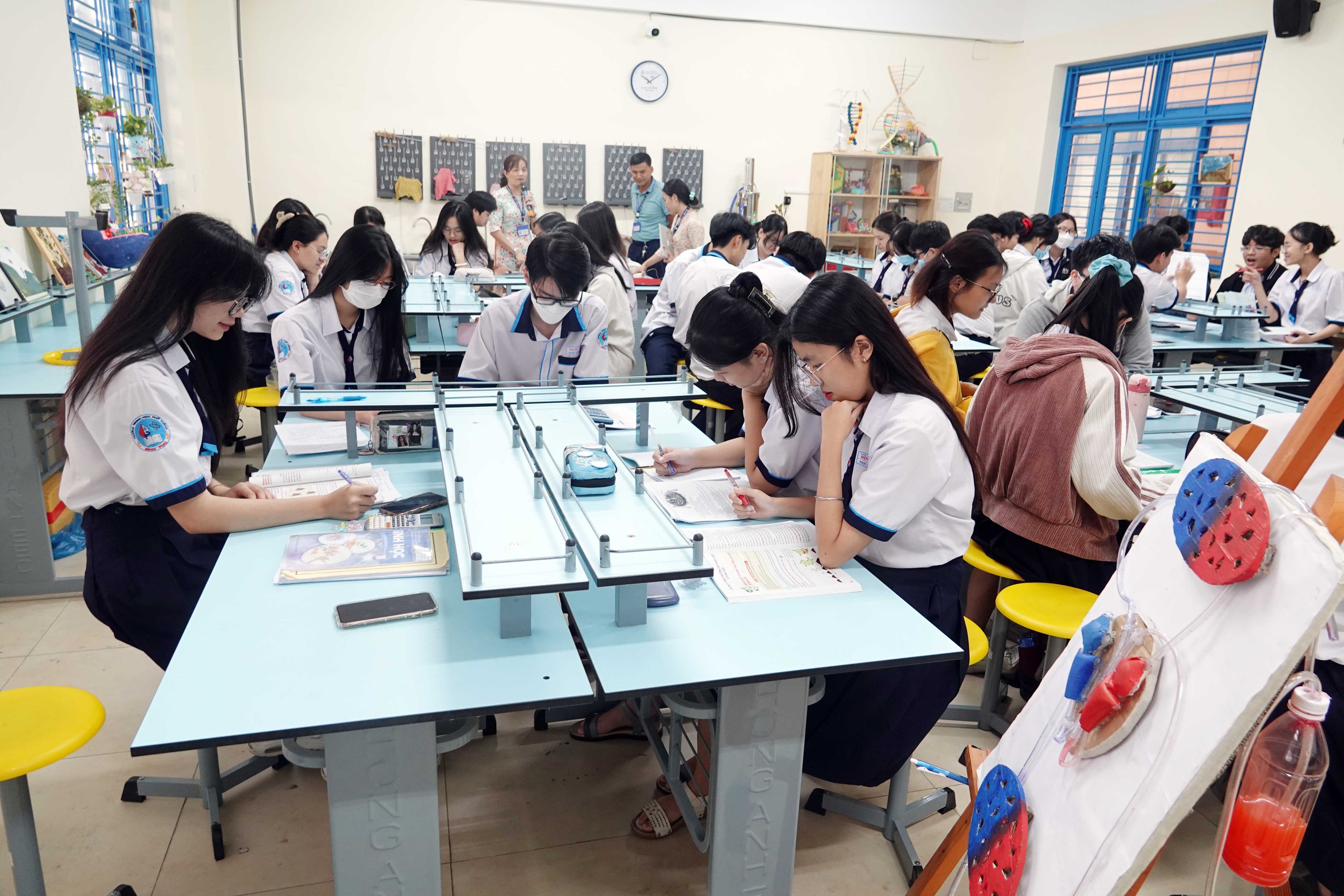
New curricula and teaching methods require time for teachers and students to adapt and implement them correctly.
PHOTO: DAO NGOC THACH
The allocation of time, structure, and knowledge units is not reasonable. Mathematics in grade 11 is quite "dense and heavy." The statistics chapter in grade 11 should be moved to grade 12 for better results. Knowledge of vector sums and differences, logarithms, etc., is used in physics, but the curriculum distribution is not synchronized, leading to students having to supplement their knowledge independently if they want to learn physics.
According to Mr. Chinh, mathematics is compulsory, while physics, chemistry, and biology are elective subjects. This leads to students who don't choose to study natural sciences having difficulty with some interdisciplinary problems in the textbooks. For example, in the 11th grade math textbook, part 1 of the "Connecting Knowledge" series, exercise 1.13 on page 21 introduces "In physics, the general equation of a harmonically oscillating object" and "use the sum-to-product formula to find the amplitude and initial phase of the resultant oscillation." This introduction isn't wrong, but it's a bit "hasty." If students don't choose a subject combination that includes physics, they won't know anything beyond applying the formula to find the answer.
Meanwhile, Mr. Tran Van Toan, former head of the mathematics department at Marie Curie High School (District 3, Ho Chi Minh City), believes that the new curriculum focuses on applying knowledge to practice, but students often struggle when transitioning from theory to practical application, due to a lack of experience or in-depth understanding of real-world situations. In addition, the new curriculum requires the use of various resources beyond textbooks, but the available reference materials are not diverse enough or up-to-date enough to support students.
TEACHERS AND STUDENTS HAVE NOT YET ADAPTED
According to Mr. Tran Van Toan, many teachers are still in the process of familiarizing themselves with the new curriculum, and therefore cannot yet effectively guide students. The transition to current teaching methods requires time to adapt and implement correctly. The 2018 curriculum requires students to independently explore and discover problems, instead of just listening to lectures and memorizing. This demands a change in thinking and learning methods, but many students have not yet adapted to active learning.
According to Mr. Toan, in the new program, assessment has undergone significant changes in both form and content with the application of three types of multiple-choice tests. This is a step forward in more comprehensively assessing students' abilities, thus requiring both teachers and students to adapt to many new challenges in teaching, learning, and assessment skills.
"The rapid transition from the old curriculum to the new one has left both students and teachers with insufficient time to adapt. This has created many difficulties in effectively changing teaching and learning methods. These difficulties require flexible adjustments in teaching and learning approaches, along with better support from teachers and resources, so that students can overcome challenges and develop comprehensively according to the new curriculum," Mr. Toan commented.
THE "PRACTICE EXAM - GETTING USED TO IT" METHOD WILL NO LONGER BE SUITABLE.
Many teachers say that educational reform is posing numerous challenges, especially as the 2025 high school graduation exam, which aims to assess competence rather than just testing pure knowledge, is fast approaching. To meet this goal, teachers need to change their teaching and assessment methods, helping students not only understand the lessons but also become familiar with new question types and exam structures.
Mr. Pham Le Thanh, a teacher at Nguyen Hien High School (District 11, Ho Chi Minh City), believes that teachers need to develop a clear review roadmap and focus on developing problem-solving skills. Instead of just requiring students to memorize theory, teachers should encourage critical thinking and the application of knowledge to real-world situations. This development of skills should be integrated throughout the learning process, through learning projects, practical exercises, and experiments. This not only helps students understand the essence of the knowledge but also familiarizes them with the exam structure, thus avoiding getting lost and being overwhelmed with unnecessary content.
Regarding assessment, Mr. Thanh said that it is necessary to continuously evaluate students' abilities throughout the learning process, thereby adjusting teaching and review methods accordingly. "This doesn't need to create pressure through heavy tests; instead, teachers can use gentler assessment methods such as case studies, discussions, or group projects. The important thing is to help students understand where they stand and what they need to improve to progress," Mr. Thanh stated.
According to Mr. Thanh, teachers need to have a comprehensive view, not just focusing on paper-based tests, but also encompassing the entire learning process, interactive teaching and learning activities, and assessment for the students' progress. The Ministry of Education and Training is currently implementing a policy that combines process assessment (50%) and exam results (50%), creating motivation for schools to truly implement the spirit of comprehensive competency development.
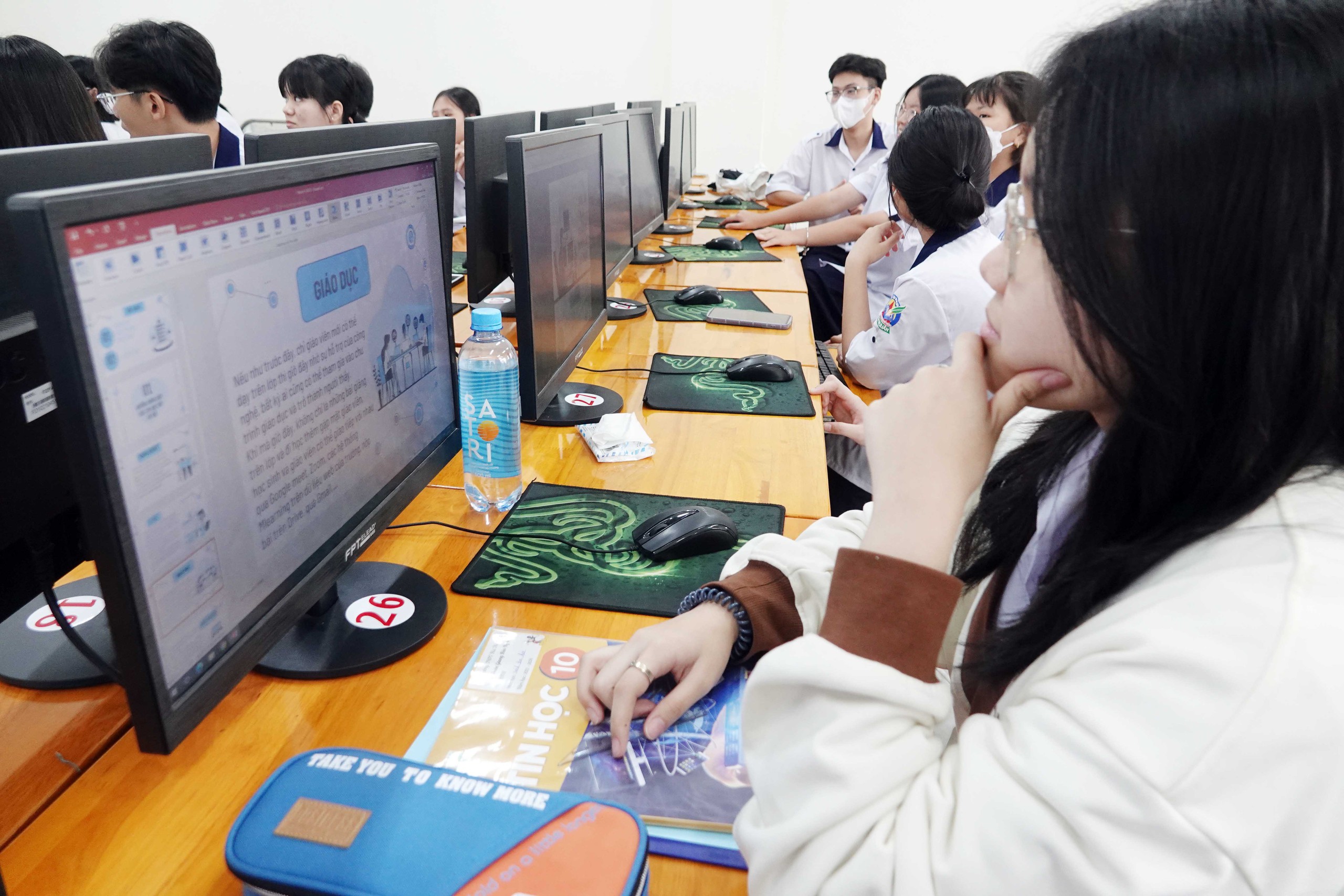
Assessment methods have undergone significant changes in the new education program.
PHOTO: DAO NGOC THACH
"To meet the requirements of the new education program, teachers need to innovate not only in their teaching methods but also in their approach to and support for students. The combination of teaching, process assessment, and preparation according to the exam structure will help students adapt well to the new exam, while developing the necessary competencies to succeed in their studies and life," teacher Pham Le Thanh expressed.
Teacher Thanh also emphasized that in the context of competency-based teaching, teachers need to abandon the "old ways" of doing difficult calculation exercises and complex problems that have no practical significance in assessing students' abilities.
With the subject matter covering a wide range of topics as stipulated in the learning objectives, the exam materials are very diverse in terms of exploration and approach, making the "practice exam - familiarize yourself with the material" teaching method no longer suitable. Teachers and students find it difficult to predict the types of questions in the exam, so in addition to providing knowledge, teachers need to help students master exam-taking skills such as how to read and understand the questions, analyze them, and allocate time effectively. This is especially important when the exam format changes, thus helping students avoid being surprised by new question types.
To meet the requirements of the new education program, teachers need to innovate not only in their teaching methods but also in their approach to and support of students.
Teacher Pham Le Thanh (Nguyen Hien High School, District 11, Ho Chi Minh City)
Many negative consequences result from "skipping steps and moving forward at the same time".
According to teacher Lam Vu Cong Chinh, for students who only study the 2018 General Education program at the high school level, the "skipping steps" approach leads to many negative consequences. For example, with the current 12th grade, having only applied the 2018 program for 3 years, they have to "struggle" to supplement their knowledge because some knowledge from the old 12th grade program has been transferred to the new 9th grade program (but these students haven't learned it yet). For instance, the chapter on cones, cylinders, and spheres is not in the new 12th grade textbook, but the questions in the textbook still contain related knowledge, forcing teachers and students to "add it themselves," leading to more lesson content and requiring extra tutoring sessions. The way lesson content is presented seems to "reduce the workload," but it is mentioned again in the exercises, making students feel that the flow of knowledge is fragmented.
Source: https://thanhnien.vn/chuong-trinh-giao-duc-pho-thong-2018-van-con-nhieu-bo-ngo-185241021225119818.htm
![[Photo] National Assembly Chairman Tran Thanh Man working with the Standing Committee of the National Assembly's Delegation Affairs Committee.](https://vphoto.vietnam.vn/thumb/1200x675/vietnam/resource/IMAGE/2026/05/20/1779294340023_ndo_br_1-1691-jpg.webp)
![[Image] "Journey of Hope" promotes the organ and tissue donation movement in Vietnam.](https://vphoto.vietnam.vn/thumb/1200x675/vietnam/resource/IMAGE/2026/05/20/1779294400833_1-8910-jpg.webp)
![[Photo] General Secretary and President To Lam works with the Party Committee of the Ministry of Health on the work of Vietnamese traditional medicine.](https://vphoto.vietnam.vn/thumb/1200x675/vietnam/resource/IMAGE/2026/05/20/1779294323718_a1-bnd-2978-3319-jpg.webp)

































































Comment (0)