

Social media platforms play a role in bringing talented but lesser-known songs or singers to the spotlight. However, they also have a downside, and the most prominent issue is the proliferation of trashy music, especially parodies of famous poems, stories, or comics that have resonated with generations of audiences. The most recent example is "Lượm" by poet Tố Hữu.
Valuable products are being distorted in an offensive way.
Parody songs have existed for a long time, even before TikTok was created. On Facebook and YouTube, audiences can find countless parody songs. There's every type of parody song imaginable, from humorous, down-to-earth yet wholesome lyrics to nonsensical and vulgar language and content.
However, the phenomenon of parody music is becoming increasingly worrying. It's not just pop songs; literary works, poems, and songs praising national spirit, the beauty of the homeland, or those associated with the childhood of countless generations are also being altered. The majority are parodied into meaningless content, with offensive language, and failing to retain the spirit of the original work.
The rap song "Lượm" from Tố Hữu's poem is currently trending on social media. It was created by 2see and remixed by DJ FWIN.
“A small, nimble boy, with a pretty little bag, quick feet, and a neatly cut hairstyle / The wind sways the bamboo branches like 'Prada' / What's the hot trend on the internet right now? / Painting a tiger's skin is difficult, painting its bones is even harder / The immortal knows the face of Nguyen Tri Phuong / He who laughs at others today will be laughed at tomorrow / Hearing is not as good as seeing clearly / To cross over here, you have to build a bridge / To have a well-educated child, you have to spend a lot of money,” is the content of a rap song that is spreading on TikTok.
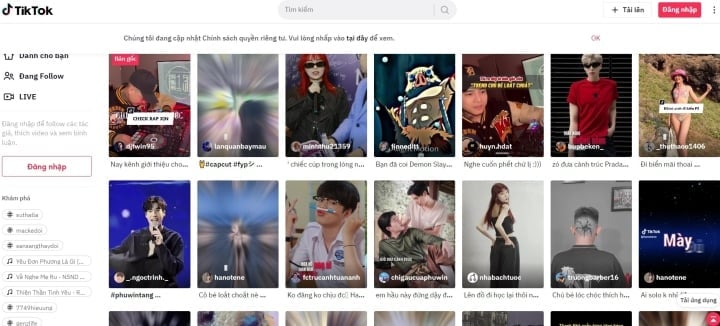
The parody song based on the poem "Lượm" has been used in many videos . Many accounts even combine it with videos of people posing suggestively or wearing bikinis.
Leaving aside the meaningless and nonsensical content, the music clip has also been criticized for not capturing the spirit of the poem "Lượm ." This is a very meaningful poem, depicting the innocent, cheerful yet courageous image of the young messenger boy Lượm during the resistance war.
This rap song is now used as background music for all sorts of videos on TikTok and Facebook. Most commonly, it's used in videos showing students standing on desks and chairs, even the teacher's desk, to pose. In many other videos, girls in traditional Vietnamese dresses strike rather suggestive poses. Others combine the song with videos of people wearing bikinis.
Previously, a parody song based on characters from the popular Doraemon comic series, performed by Le Duong Bao Lam on the "Lyric Battle" program, also went viral on social media, especially TikTok. Specifically, the parody song's lyrics read: "Sunset's mom is poor, Gian's mom is rich, and Nobita always bullies his friends. Nobita secretly loves Shizuka and picks roses for Gian. If Gian agrees to marry Nobita, then Nobito will be born."
For example, the song "I Love Vietnam So Much" was once parodied with offensive lyrics: " The bird in the cage flies out, the bird spreads its wings, tearing apart its tattered clothes. The bird flies to a faraway place " in Vanh Leg's "Singer's Dream" music video.
With the explosion of social media, numerous meaningful poems, literary works, and songs have been transformed into vulgar content. TikTok, in particular, has harmed music in general by encouraging the rise of trashy music.
TikTok is not good for the music industry because it doesn't focus on the quality of the songs. Instead, the effectiveness of a song on the app is what matters, according to Musician Wave .

Le Duong Bao Lam and his parody song based on Doraemon caused controversy for a long time.
The sadness of Vietnamese music
Experts have previously stated that parody music can be acceptable if the product aims for entertainment while still maintaining the original spirit with civilized and polite language. Meanwhile, parody music with harmful content and nonsensical lyrics not only lacks healthy entertainment value but also negatively impacts the minds and thoughts of the audience.
From the perspective of the original creators – those who spent a lot of time contemplating and refining the content and lyrics – it's certainly sad that their creations have been turned into nonsensical songs.
Composer Ngo Minh Tai believes there are many reasons why the phenomenon of parody music has become serious. First, there is a lack of censorship, and second, the explosion of social media leads producers and young audiences to often follow trends. They focus on the melody, especially in the first few seconds of the song, rather than the content and lyrics.
"I'm not judging, but from my perspective, audiences from the 80s and 90s generations might consider those poems and essays very valuable. But for younger audiences, many might not see that value. They think changing a few words in the work is nothing. Some even have quite sensitive dance moves, so when combined with the song, it becomes even more inappropriate," the musician told Zing .
"In the old days, artists wrote rich and heartfelt music, rarely encountering empty lyrics. Nowadays, people aim for easily understandable music, and melody is the most important element. It's not just the song 'Lượm,' many other songs have also been parodied. I believe parody music can be acceptable if it doesn't go too far to become ridiculous or vulgar, and still maintains aesthetic appeal."
"Looking at the situation of artists being targeted by fake news over the past period, it's clear that on social media now, people are doing everything they can to get views and likes. Many people don't understand the value of poems and essays, so they don't realize whether turning them into parody songs will cause offense," the musician emphasized.
The musician added that in the past, there might have been musicians and producers who created low-quality products. However, back then, social media wasn't as developed, so low-quality music was easily discarded. Now, the explosion of platforms makes it easier for products to spread, even if the content isn't highly rated. This is because current producers target young people and mainly focus on the first 7 seconds of a song.
"The 'magical 7 seconds' is a very popular phrase in current music, according to the musician. He explains that audiences now only listen to the first 7 seconds to decide whether or not to continue enjoying the product."
Science Times points out that TikTok is dangerously addictive. It's more addictive than any other social media platform. Therefore, the problem of parody music is becoming increasingly popular with young audiences and is becoming a serious issue instead of being resolved effectively.
Therefore, musician Anh Tú once told Zing that platforms need stricter censorship to prevent the spread of low-quality products and offensive content.
He said, "My child is also in elementary school and often sneaks onto YouTube and TikTok to listen when I'm not paying attention. Children don't have full awareness, so they easily learn inappropriate lyrics. Sometimes they imitate them and say things that are not allowed at that age. This is a problem, so I think censorship is very necessary."
(Source: Zing News)
Beneficial
Emotion
Creative
Unique
Wrath
Source


![[Photo] National Assembly Chairman Tran Thanh Man successfully concludes his participation in IPU-152](https://vphoto.vietnam.vn/thumb/1200x675/vietnam/resource/IMAGE/2026/04/18/1776502638199_vna-potal-chu-tich-quoc-hoi-ket-thuc-tot-dep-chuong-trinh-tham-du-ipu-152-8709975-jpg.webp)












































































Comment (0)