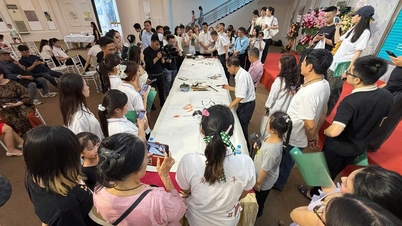
Consumers experience technology products at an event hosted by the rental platform Renrenzu in Guangzhou - Photo: China Daily
Such items are increasingly appearing in consumer leasing transactions in China , especially among Gen Z – a generation that prioritizes flexibility and cost-effectiveness over ownership.
Prefer renting to buying.
In China, owning assets, from houses and cars to technological gadgets, used to be not only about securing a livelihood but also about showcasing one's social status. However, this mindset is clearly changing among many young people today.
According to a survey published in February 2026 by China's Youth Daily , among 1,334 young people surveyed, 77.3% said they had chosen to rent instead of buy at least once, and 54.1% said they chose to rent because these items are used infrequently.
With a high-value product, many young consumers still maintain a wait-and-see attitude. Renting to experience it at a lower cost helps them answer the question: Is the product worth the money?
Among them, the group born after 2000 had the highest rental rate, accounting for 82.2%. Digital products such as cameras, computers, and drones (flycams) were the most popular.
Ms. Dieu, a regular user of rental platforms, shared that before each trip , she chooses to rent a camera to record her journey.
"Instead of spending 3,000-4,000 yuan buying a camera, using it a few times, then posting it on a secondhand platform and selling it at a loss, I'd rather rent one," she told the Yangcheng Evening News.
According to her calculations, a device costing 4,000 yuan (approximately $590) would cost over 1,300 yuan per use if used three times a year, while the daily rental price is only 35 yuan, meaning three similar uses would only cost a little over 100 yuan.
Another young man, Zhang Lin from Beijing, also chose to rent a drone when traveling.



According to Mr. Zhang, he would have to spend about 20,000 yuan (approximately $2,951) if he bought a similar device, but renting it only costs 300 yuan (approximately $44) per day, which is both economical and avoids leaving the device unused after his trip.
Zhou Di, a researcher at the Chinese Academy of Sociology, told the China Youth Daily that the consumption habits of young people in China have become "more mature and practical," which has also forced the market to change accordingly.
This model also helps alleviate financial pressure for some startups and small and medium-sized enterprises, enabling them to keep up with new technologies and avoid large initial purchase costs.
Positive and negative aspects
In early 2026, China's Ministry of Commerce, along with eight other ministries, included the model of renting used goods in the list of new consumer models to be encouraged, making it a target in the government 's plan to stimulate consumer demand.
The consumer leasing trend helps break the familiar buy-and-hold-waste cycle, thereby making better use of idle assets in society. This model also aligns with China's goals of reducing carbon emissions, promoting green consumption, and developing a circular economy.
Although the consumer rental market is encouraged to develop, in March 2026, China's State Administration for Market Regulation (SAMR) warned that the industry was still in a state of disorder and exhibited many serious shortcomings.
Many problems arise, such as disorganized management of various types of goods, lack of transparency in contract information, and frequent disputes over depreciation, damage, and compensation.
In principle, leasing is the temporary transfer of the right to use a product, with the total rent being less than the fair value of the product. However, some platforms or lessors have deliberately blurred the lines between regular leasing and installment leases.
When hidden fees are added, the total amount users have to pay can far exceed the initial purchase price, turning the rental operation into a disguised high-interest loan scheme. For example, in May 2026, the Longquan District Court (Chengdu City) heard a case that exposed the fraudulent nature of the "rent-a-money-exchange machine" model.
In this case, a customer named Zhang, in urgent need of money, signed a one-year rental contract for a phone worth 9,999 yuan, with a total rental fee of 12,351 yuan. Following the guidance of intermediaries, Mr. Zhang handed the phone over to a third-party company in exchange for 8,000 yuan in cash. For the next seven months, he diligently paid the rental fees without knowing that the third-party company was a front for the original rental company.
When Mr. Truong became financially exhausted and unable to continue making payments, the leasing company proactively sued him in court to recover the debt.



Such schemes often target people who are in urgent need of money or lack financial experience. In many cases, the total cost that consumers have to pay can be equivalent to 1.3 times, or even double, the actual value of the item.
To prevent this situation, observers suggest that Chinese authorities need to strengthen inspections of high-interest lending schemes disguised as rental services, and severely punish illegal lending organizations. In addition, e-commerce platforms should proactively review and promptly eliminate business practices showing signs of irregularities.
620 billion USD
According to statistics in the White Paper on the Healthy Development of the Consumer Leasing Industry, the scale of leasing economic transactions in China will exceed 4.2 trillion yuan (approximately 620 billion USD) in 2024, a 32% increase compared to 2023, serving more than 750 million users, with the market currently spanning over 200 product types.
Of these, transactions via digital platforms account for up to 65%. Consumers can now rent with low deposit fees, or even no deposit fees at all if they meet credit requirements. Goods are delivered to their doorstep and returned via courier services.
Source: https://tuoitre.vn/van-vat-deu-co-the-thue-o-trung-quoc-20260613080722692.htm