

Holding in my hands the book "Following the Golden Footsteps " by author Bui Ngoc Long, recently published by Thuan Hoa Publishing House, I feel that the stories of the ancient capital's scenic beauty, which are usually gentle, are now imbued with a certain "weight." What can I write about his passionate yet tranquil "way of loving" Hue , with its rich history, feng shui, culture, and geography? As Mr. Nguyen Phuoc Hai Trung, Deputy Director of the Hue Ancient Capital Relics Conservation Center, wrote in the preface "A 'Way of Loving' Heritage " at the beginning of the book: "Joining author Bui Ngoc Long in 'following the golden footsteps' to explore and experience Hue's heritage with its people, to see that each Hue resident has their own 'way of loving' heritage, and this book is one such way…".
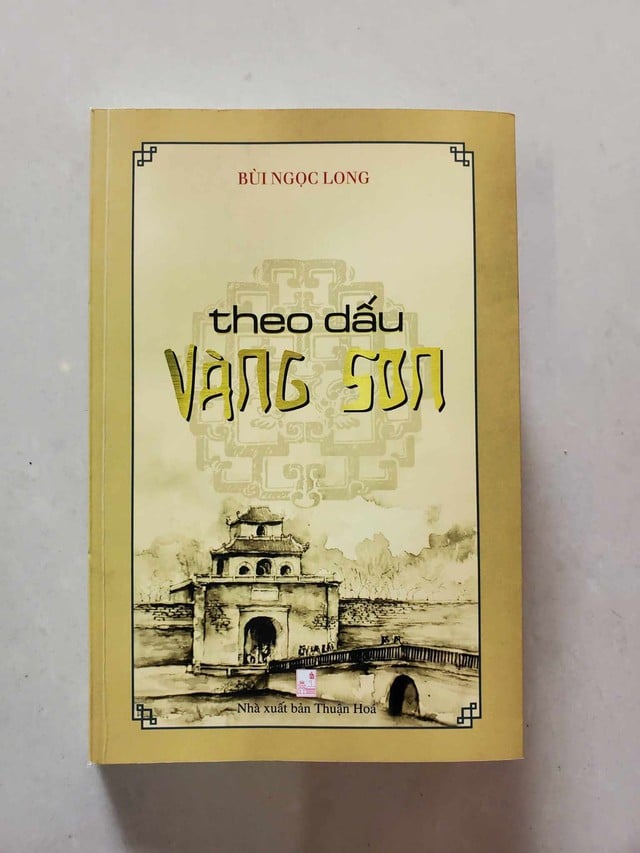
Book cover: Following in the Golden Footsteps
PHOTO: BNL
"Following the Golden Footsteps" is a collection of articles that Bui Ngoc Long wrote and published on the Culture and Arts page of Thanh Nien Newspaper over the years. He likely edited and supplemented them before printing the book. These articles attracted many readers of the newspaper he worked for for the past 20 years as a Thanh Nien correspondent based in Thua Thien-Hue.
The book has 7 parts with over 300 pages, including: The Feng Shui of Hue Imperial City, Searching for Traces of the Twenty Scenic Views of the Imperial Capital, Sacred Mountains, Stories of the Royal Physicians of the Nguyen Dynasty, The Miraculous Restoration of the Can Chanh Palace, Searching for Traces of the Tay Son Dynasty, and The Essence of Vietnamese Martial Arts. Each part has its own unique style and interesting insights, conveying and spreading a deeper message: to work together to preserve and promote the heritage value of the Hue Imperial City complex, including the Hue Imperial Citadel, which was recognized as a UNESCO World Heritage site in 1993.
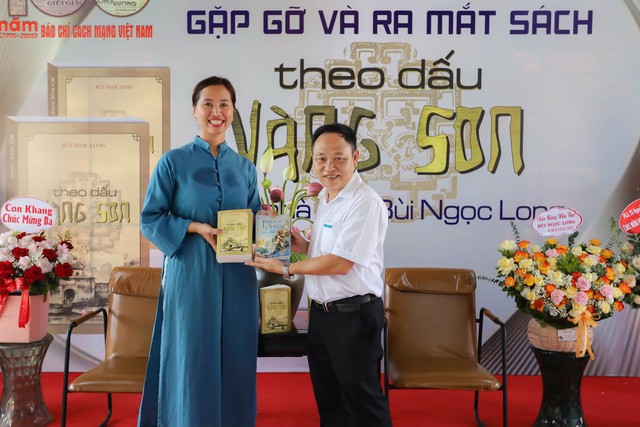
The author presented the book to a representative of the Hue Book and Culture Club.
PHOTO: LE HOAI NHAN
As a son of Hue, deeply attached to this land steeped in the spirit of a dynasty, journalist Bui Ngoc Long's heartfelt dedication to this subject matter is, in my opinion, quite challenging, as it "touches" the profound essence of this land known as the imperial capital. It would be difficult to fully express his intentions without careful consideration and reflection. Before writing, to gain the readers' agreement and satisfaction, he had to be extremely thoughtful and persuasive. With his own fortitude, the author delved deep, overcoming obstacles with confidence, using a method of research and approach, and employing appropriate materials and language—a journalist unafraid to immerse himself and pursue his cherished topic to the very end.
It's a story about the geomancy of Hue, the imperial city, the tombs and temples, the mountains and rivers, the place names of each region, and the people of Hue. Many articles, when read, seem as if the author is meticulously examining each layer of the city walls, observing in all directions to personally (along with many Hue researchers) pose questions, explain why, and recount, in journalistic language, the poetic and ancient natural landscape. A concise, clear, and refined language to convey very specific topics about Hue, which many readers are interested in and seek explanations for. It must be short yet complete, deep yet concise – that's the essence!
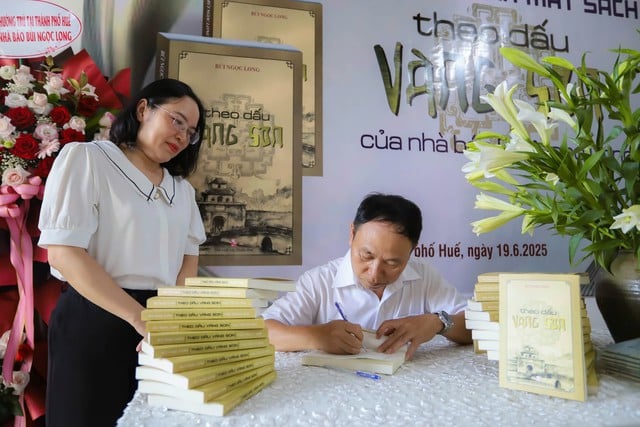
Author Bui Ngoc Long signs books for readers at the book launch event.
PHOTO: LE HOAI NHAN
That is why, when writing this article, I honestly cannot find enough words to explain the origins of each issue the author painstakingly presents in the book. Perhaps it's because for many years, every day when I held the Thanh Nien newspaper in my hands, I was captivated by each of his articles, imagining the author ascending each step. On those centuries-old, moss-covered stones, he has walked and arrived completely.
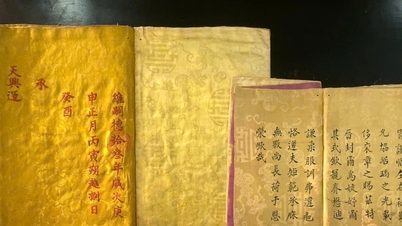
Reading Bui Ngoc Long's book, I suddenly recalled a story about a time when crowds of tourists were delighted to admire two of Empress Dowager Tu Cung's ao dai (traditional Vietnamese dresses) displayed in Hue. Suddenly, I began to imagine the wind blowing through the imperial palace of yesteryear, gently rustling the hems of the emperors' robes as they ascended the Four Directions Pavilion to gaze out over the vast expanse of sky and earth, after days and nights of worrying about their people and country.
The citadels, tombs, temples, jewelry, royal robes, secret imperial remedies, and the essence of martial arts... aren't these the remnants of 140 years of the Nguyen dynasty's existence in Hue, left for generations to discover?
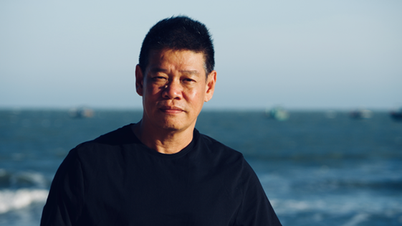
Sharing his reasons for publishing the book, journalist Bui Ngoc Long said: "Every journalist chooses their own path to delve into the field of words. I am fortunate to have been born and worked as a journalist in the sacred land of Hue, the ancient capital, a land of deep cultural heritage. Hue's cultural heritage, though serene and moss-covered, is always fascinating to me. The mission of a journalist is not to 'research' heritage, but to tell current events, to see how contemporary people treat heritage. And from those current events, the writer hopes to bring readers a view of heritage with love. This book marks the 20th anniversary of my work at Thanh Nien Newspaper, in celebration of the 100th anniversary of Vietnamese Revolutionary Journalism."

Source: https://thanhnien.vn/vang-son-tram-tich-muon-nien-185250620221850945.htm
![[Photo] General Secretary and President To Lam meets with National Assembly delegates from ethnic minorities.](https://vphoto.vietnam.vn/thumb/1200x675/vietnam/resource/IMAGE/2026/04/20/1776696701056_a1-bnd-8331-3342-jpg.webp)



![[Image] National Assembly discusses the implementation of the socio-economic development plan.](https://vphoto.vietnam.vn/thumb/1200x675/vietnam/resource/IMAGE/2026/04/20/1776696707422_ndo_br_img-20260420-185419-jpg.webp)











































































Comment (0)