

In Dong Thap, the 10-year conservation period, meticulous care and breeding, and restoration of a vast ecological area are the reasons why the total cost for developing the crane population exceeds 185 billion VND.
Recently, Dong Thap province approved a project to conserve the crane population imported from Thailand, to be implemented in Tram Chim National Park. The total cost includes approximately 56 billion VND for receiving, nurturing, breeding, and reintroducing the cranes; 24 billion VND for ecological restoration; 35 billion VND for building an ecological agricultural zone; and 51 billion VND for investment in infrastructure and equipment.
According to the plan, over the next 10 years, the province will receive 60 cranes from Thailand and agree to compensate Thailand for the costs of raising the cranes, training staff, and sending experts to inspect and provide support. The project aims to release 100 cranes into the wild, with a survival rate of 50%. In mid-December, Tram Chim received its first pair of cranes from Nakhon Ratchasima Zoo.
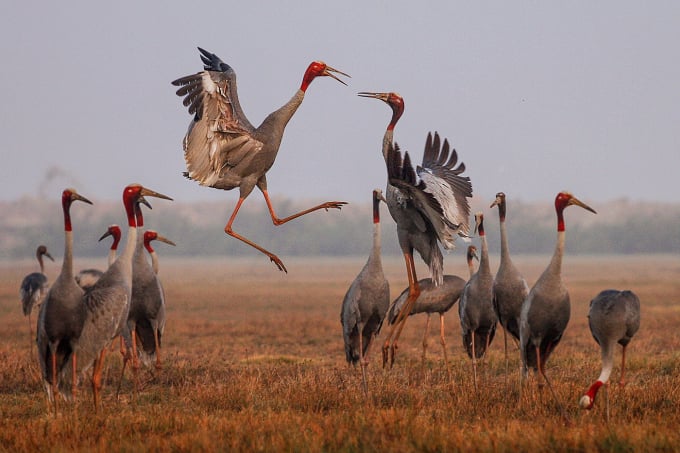
Red-crowned cranes migrated to Tram Chim National Park in previous years. Photo: Tran Van Hung
Dr. Tran Triet, Director of the Southeast Asian Crane Conservation Program and advisor to the project, said that Thailand transfers six six-month-old cranes to Vietnam each year. Upon arrival at Tram Chim National Park, they are cared for for four to six months to acclimate to the new environment before being released into the wild.
"The process of raising and training them is very elaborate. Caregivers dress up like mother cranes, preventing the cranes from seeing or hearing their faces, thus avoiding bonding and losing their wild instincts," the doctor said.
Furthermore, the process of breeding and reproducing cranes is very complex. Thailand spent 20 years researching, experimenting, and experiencing many failures. In the last 10 years, the Thais have successfully bred and reintroduced cranes, with direct costs of approximately 7 million USD and 3 million USD invested in an environmental education center. Currently, Thailand has a crane population of about 150 in the wild, producing 15-20 chicks each year.
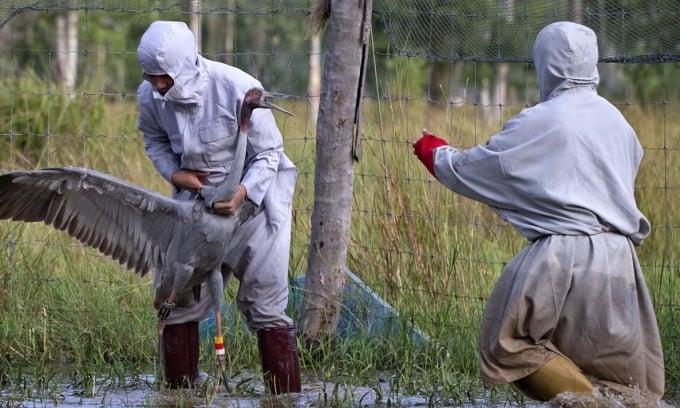
Raising and training cranes in Thailand before releasing them back into the wild. Photo: ICF
According to experts, the cranes in the transfer program do not have a seasonal migration instinct and only live around Tram Chim National Park. The fact that the cranes do not migrate is in line with the requirements of international nature conservation organizations, preventing population decline when they fly to areas where the environment is uncontrollable.
Therefore, according to Dr. Triet, the important issue is that the park must ensure a suitable environment for cranes to live in, not only in the core area of the national park but also in nearby rice fields where production must follow ecological principles. Farmers should limit the use of fertilizers and pesticides.
"Conserving the crested crane is not about whether the funding is high or low, but rather about focusing on the goals to be achieved, from conserving this critically endangered species, restoring the Tram Chim ecosystem, and supporting the green agricultural development process of Dong Thap province," Dr. Triet shared.
Mr. Doan Van Nhanh, Deputy Director of the Conservation and Development Center for Wildlife at Tram Chim National Park, said that the park will soon implement many solutions to restore the ecosystem. Areas A1, A4, and A5 – where cranes usually reside – will have their water levels lowered and thick layers of undergrowth burned to help the sedge grass (the cranes' main food source) grow.
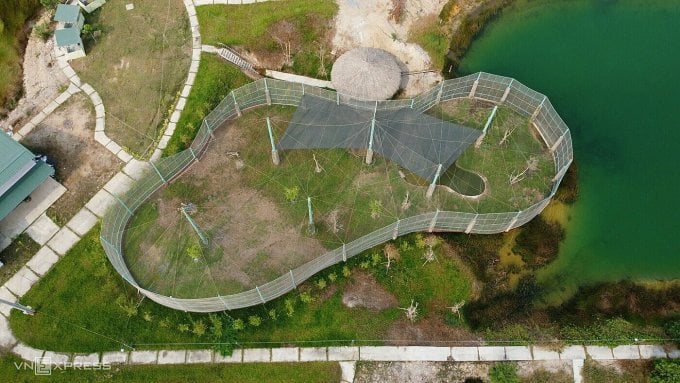
Crane enclosure in Tram Chim National Park. Photo: Tran Thanh
Tram Chim National Park, covering 7,500 hectares, is recognized as Vietnam's fourth Ramsar site. It is home to many rare bird species, especially the red-crowned crane, which migrates from Cambodia to feed and roost from December to April of the following year. In the 1990s, the park recorded very large flocks of cranes, sometimes numbering in the thousands, but they have become increasingly scarce, with some years seeing no return at all.
The red-crowned crane is distinguished by its featherless, red head and neck, and gray stripes on its wings and tail. Adults are 1.5-1.8 m tall, have a wingspan of 2.2-2.5 m, and weigh 8-10 kg. Cranes will mate at four years old and spend a year raising their young before laying the next clutch.
According to the International Crane Foundation, there are an estimated 15,000-20,000 red-crowned cranes worldwide, with 8,000-10,000 distributed in India, Nepal, and Pakistan. In Indochina (mainly Vietnam and Cambodia), approximately 850 red-crowned cranes were recorded in 2014, but this number had decreased to 234 by 2014, and currently stands at around 160.
Ngoc Tai
Source link
![[Photo] General Secretary and President To Lam meets with National Assembly delegates from ethnic minorities.](https://vphoto.vietnam.vn/thumb/1200x675/vietnam/resource/IMAGE/2026/04/20/1776696701056_a1-bnd-8331-3342-jpg.webp)


![[Image] National Assembly discusses the implementation of the socio-economic development plan.](https://vphoto.vietnam.vn/thumb/1200x675/vietnam/resource/IMAGE/2026/04/20/1776696707422_ndo_br_img-20260420-185419-jpg.webp)





























































































Comment (0)