

Due to order shortages, we are laying off workers.
From small to large businesses, all acknowledge that export orders for the textile and garment industry continue to decline. While there are no precise statistics, it is not uncommon for businesses to experience a 40-50% drop in sales. Large businesses are also seeing revenue decreases of 20-30%.
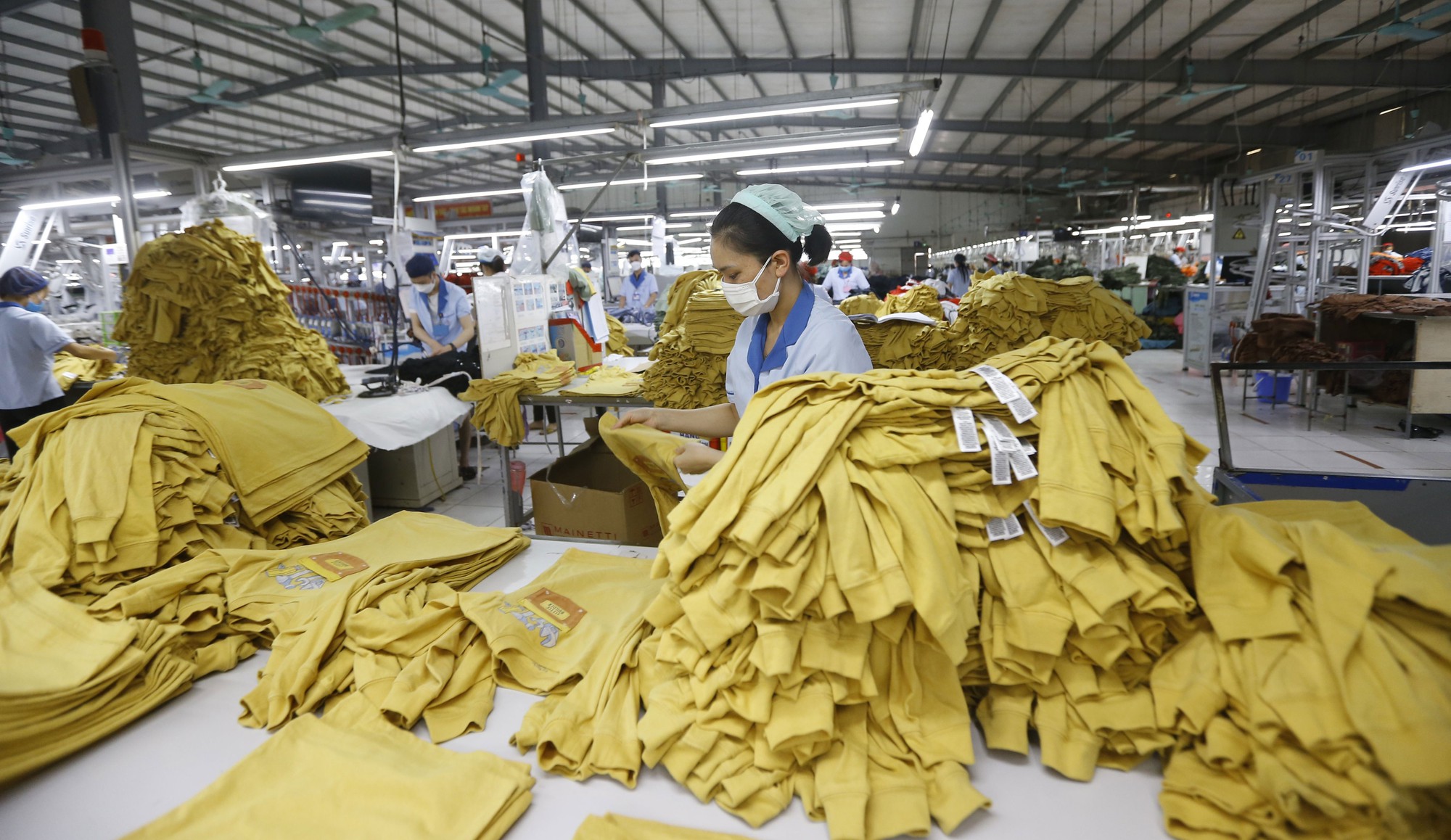
Vietnam's textile, garment, and footwear industries are experiencing a sharp decline as they lose their competitive edge.
According to the leaders of Thanh Cong Textile, Investment and Trading Company, revenue in the first five months of this year decreased by 20-25% compared to the same period last year. Recently, the company's Board of Directors announced an adjustment to the 2023 business plan targets, with revenue down to VND 3,927.4 billion, a 9% decrease compared to 2022, and net profit reaching VND 244.9 billion, a 13% decrease. Even more significantly, Binh Thanh Import-Export Production and Trading Joint Stock Company (Gilimex) reduced its 2023 revenue target by more than half compared to last year, down to VND 1,500 billion, and after-tax profit to nearly VND 104 billion, a decrease of 71%. At the end of the first quarter of 2023, Gilimex reported a revenue decrease of 89% compared to the same period last year, reaching nearly VND 157 billion. The company incurred a loss of VND 39 billion, while in the same period last year it made a profit of over VND 100 billion. Even the Vietnam Textile and Garment Group (Vinatex), the leading textile and garment company in the country, reported its first-quarter business results this year with revenue down nearly 15% compared to the same period last year and pre-tax profit down sharply by nearly 70%, to 118 billion VND. Vinatex has set modest business targets for the whole year with consolidated revenue reaching 17,500 billion VND, down more than 10%, and pre-tax profit reaching 610 billion VND, down nearly 50% compared to last year.
Similarly, in the footwear industry, many businesses have experienced reduced orders and layoffs. A representative from the PouSung Company's labor union (Dong Nai province) stated that the company laid off 1,000 workers in the first quarter of this year. Compared to many other companies in the same industry, this reduction rate is relatively low given the company's total workforce of approximately 21,000 employees. Production has stabilized since April. Explaining this, the union representative stated that each company's situation depends on the brand of its partner shoes. For example, PouSung specializes in producing for a major global shoe brand, so fortunately, the volume of athletic shoes hasn't decreased significantly. Meanwhile, the same brand, but with products like sandals and women's shoes, has seen a sharp decline. The previous layoffs were due to workers producing for a smaller brand, and when the client faced difficulties in sales, orders ceased.
Even more tragically, many footwear businesses have been forced to scale back operations, laying off thousands of workers. For example, at the end of 2022, Ty Hung Co., Ltd. (Ho Chi Minh City) laid off nearly 1,200 out of 1,822 employees due to a lack of orders. Similarly, PouYuen Vietnam, a major player in Vietnam's footwear industry, has continuously cut its workforce, losing over 8,000 people since the beginning of the year. The company stated that the reason was the difficult global economic situation, with people in many countries tightening their spending, leading to a decline in manufacturing and processing orders.
Is Vietnam struggling to compete with Bangladesh and Indonesia?
Mr. Nguyen Nhu Tung, Chairman of the Board of Directors of Thanh Cong Textile and Garment Investment and Trading Company, and Vice Chairman of the Vietnam Textile and Garment Association, assessed that both export turnover and orders in the textile and garment industry have decreased due to several reasons. Firstly, the overall global consumption has declined, especially in large markets like the US and Europe (EU), which have experienced a sharp drop. The market share has shrunk, and customers have cut back on less competitive segments.
Meanwhile, Bangladesh, which has historically competed with Vietnam in textile and garment exports, now has a greater advantage due to lower labor costs and a significantly depreciated local currency. At the same time, many Bangladeshi textile and garment businesses have achieved global "green" certifications such as ESG (Environmental, Social and Governance Index) and LEED (Leadership in Energy and Environmental Design). For example, out of approximately 100 green-certified projects worldwide , 40 are in Bangladesh. This has helped the country's textile and garment industry continue to attract orders, leading to a slight increase in Q1 2023; however, sales reversed in April due to the overall market difficulties.
According to Le Tien Truong, Chairman of the Board of Directors of Vietnam Textile and Garment Group (Vinatex), the decline in Vietnam's textile and garment industry is most severe due to the currency being 20% more expensive than that of competing countries, and interest rates in Vietnam remaining high at 9-11% per year during the first four months of this year, while other countries maintained rates at 3.5-7% per year.
Furthermore, the 3% increase in electricity prices has also put significant pressure on textile and garment businesses. Vietnam also faces a major challenge as China opens up. With its post-pandemic "boost" production, China has implemented numerous support policies for its domestic textile and garment industry. Chinese textile and garment businesses are among the world's largest producers; therefore, when demand declines and supply becomes more abundant, Vietnam will find it difficult to compete.
In addition to the above factors, the average monthly wage for garment workers in Vietnam is around $300 per person, higher than the global average of $200 per person. Vietnamese wages are higher than those in Bangladesh ($95 per person per month), Cambodia ($190 per person per month), and India ($145 per person per month). Mr. Le Tien Truong emphasized: Under these conditions, if businesses maintain low unit prices to compete with Bangladesh, they will incur losses of at least 15%. This presents many challenges, as domestic textile and garment businesses are losing many advantages over competitors in order to retain customers and orders.
Concurring, Mr. Diep Thanh Kiet, Vice President of the Vietnam Leather and Footwear Association (LEFASO), stated that overall, the market continues to decline sharply, with no positive outlook. The EU, in particular, is most severely affected due to the direct impact of the military conflict between Russia and Ukraine, alongside post-Covid-19 economic recession and issues related to environmental protection policies. A characteristic of the fashion industry in general is knowing orders six months in advance. Currently, June is over, and orders for the last six months of 2023 are essentially completed, with an estimated average decline of 10-12% across the industry. Orders for 2024 will become available after October. If the market unexpectedly improves, the fluctuation range will likely be between 3-5%. Therefore, even in the least-worst scenario, the footwear industry will experience a 7-8% decline this year, while a worse-case scenario would see a 13-16% decrease.
"Over the past 10 years, steady growth has left us without the pressure to transition to the world's green growth trend. Meanwhile, Bangladesh, due to the negative image of its fashion industry in the eyes of the global market, has forced its businesses and government to develop policies that positively shift towards environmental protection, labor practices, emission reduction, and communication. Therefore, when the world falls into crisis and orders decline, these 'low-lying' areas still attract investment. Vietnam, on the other hand, is currently on a high ground with high production costs and a failure to meet new environmental standards, resulting in declining orders. Bangladesh's preparations, carried out over the past 10 years, mean that their orders are always 'full'. We should see this as an opportunity to clearly identify market challenges in the new trend and proactively adapt to survive," said Mr. Diep Thanh Kiet.
According to the General Statistics Office, textile and garment exports in the first five months reached US$12.32 billion, down 17.8%, and fiber exports reached US$1.73 billion, down 27% compared to the same period last year. Similarly, footwear exports reached over US$8.18 billion, down nearly 14%, and exports of handbags, suitcases, umbrellas, etc. reached US$1.55 billion, down 5.5% compared to the same period in 2022.
Source link


![[Photo] General Secretary and President To Lam meets with National Assembly delegates from ethnic minorities.](https://vphoto.vietnam.vn/thumb/1200x675/vietnam/resource/IMAGE/2026/04/20/1776696701056_a1-bnd-8331-3342-jpg.webp)


![[Image] National Assembly discusses the implementation of the socio-economic development plan.](https://vphoto.vietnam.vn/thumb/1200x675/vietnam/resource/IMAGE/2026/04/20/1776696707422_ndo_br_img-20260420-185419-jpg.webp)




















































































Comment (0)