|
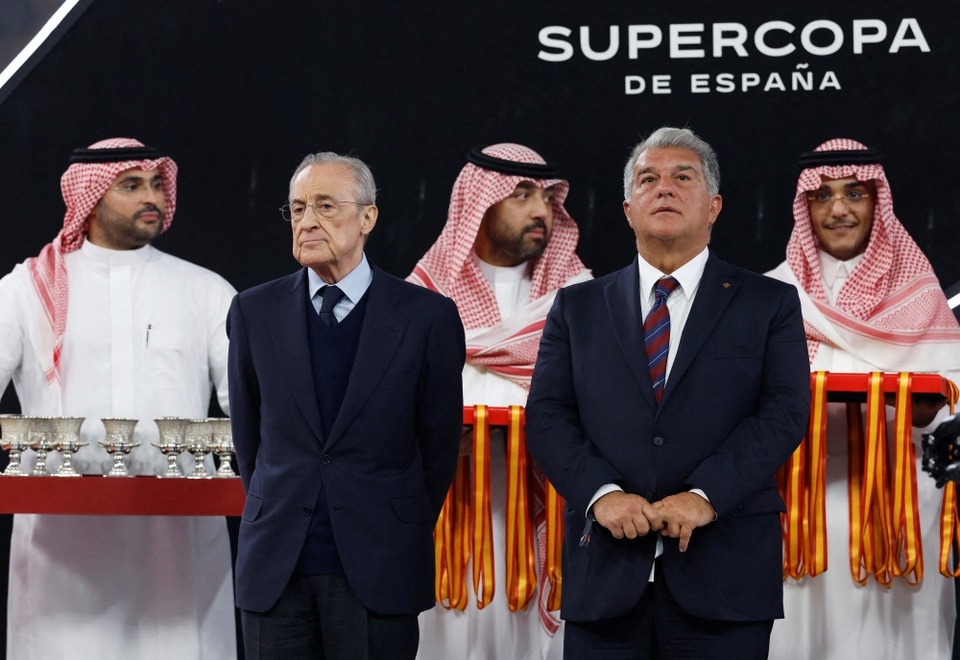
President Florentino Perez and Joan Laporta eventually withdrew from the Super League project. |
The Super League was once touted as the biggest revolution in club football history. Those behind it believed they had the financial resources, influence, and legal basis to challenge UEFA.
But in the end, the project ended in skepticism. It left one clear reality: football cannot be restructured solely by power and money.
The ruling was in favor of UEFA, but it lost the hearts of the people.
The legal turning point came from the ruling of the European Court of Justice in Luxembourg. The court sided with the Super League in its dispute with UEFA regarding its monopoly on organizing tournaments. According to the ruling, organizations have the right to establish their own leagues without needing UEFA's permission, and UEFA is not allowed to punish participating teams.
Legally, this is a significant victory. It shakes the foundations of power that UEFA has maintained for decades. However, the reality is that a favorable ruling does not automatically guarantee successful implementation.
The Super League lacks political and social consensus. Waves of opposition from fans, domestic leagues, and even the governments of some countries have created immense pressure. In a sport as deeply rooted in community as football, emotional and traditional factors carry just as much weight as any legal document.

|
The Super League project once shook European football. |
Immediately after the project was announced, the power structure in European football was shaken. Andrea Agnelli, then president of Juventus and also head of the European Club Association (ECA), resigned.
This position was given to Nasser Al Khelaïfi, representing the group of clubs that chose to remain with UEFA. As English clubs, and then Italian clubs, successively withdrew, the Super League narrowed down to a clash between Florentino Perez and Joan Laporta. Internal divisions made the project even more precarious.
Achilles' heel: A closed tournament
The most controversial aspect of the Super League is its closed model. Initially, the idea was to have a 20-team league, with 15 founding clubs guaranteed a fixed spot each season. This contradicted the principles of promotion and relegation and performance-based competition that are the heart of European football.
Under intense pressure, the Super League was forced to change. The project shifted to a three-tiered model: Star League, Gold League, and Blue League, each with 36 teams. Placement was based on domestic league performance, similar to the current Champions League, Europa League, and Conference League systems.
This adjustment shows that the organizers have recognized their initial mistake. However, with the new format almost identical to UEFA's system, the question arises: what makes the Super League different? If the model isn't truly groundbreaking, the only remaining competitive advantage will be financial.

|
The Super League project has faced opposition from fans. |
One of the Super League's most attention-grabbing commitments was to broadcast the entire league for free via a streaming platform called Unify. While this idea has been questioned in terms of its feasibility, it reflects a new trend in the rights market.
FIFA has been streaming the Club World Cup through DAZN. UEFA has also signed agreements with Amazon in several countries and is considering expanding the streaming model in key markets.
Financially, there were reports from the outset that investment bank JP Morgan was ready to provide $3.5 billion to kickstart the project. This shows that the Super League does not lack resources. Simultaneously, the wave of investment from funds and billionaires into football is growing stronger.
Most English clubs are owned by American investors. Atletico de Madrid is also in the hands of foreign capital groups. Top-level football has become a global industry where money flows have a profound influence.
However, this rapid commercialization has led to the Super League being perceived as a symbol of private ambition overshadowing community values. UEFA, while also operating according to market logic, has maintained its image as a representative of an open structure and the principle of achievement.
The Super League failed not because of a lack of money or a lack of legal basis. It failed because it strayed too far from the traditional foundations upon which European football is built. The project may have ended, but the issues it raised—regarding power, finances, and the future of the competition model—remain highly relevant.
Source: https://znews.vn/vi-sao-super-league-sup-do-post1627284.html




![[Photo] Opening Ceremony of the 13th National Congress of the Ho Chi Minh Communist Youth Union](https://vphoto.vietnam.vn/thumb/1200x675/vietnam/resource/IMAGE/2026/06/24/1782286753905_ndo_br_1-8510-jpg.webp)

![[Photo] Overview of the renovation and upgrading of the Ho Chi Minh Museum - Ho Chi Minh City Branch](https://vphoto.vietnam.vn/thumb/1200x675/vietnam/resource/IMAGE/2026/06/24/1782287051250_ndo_br_01-jpg.webp)
![[Image] Paris's oldest bridge goes viral after transforming into a giant cave.](https://vphoto.vietnam.vn/thumb/1200x675/vietnam/resource/IMAGE/2026/06/24/1782283441197_ndo_br_dsc05314-jpg.webp)