
The pagoda was built 200 years ago with simple bamboo and thatched roofs in a wild, swampy forest where lotuses grew. Later, it was destroyed by fire. In 1884, the villagers contributed money to rebuild it with wood. The pagoda features Khmer architectural style, with staggered roofs. In the center, three sloping roofs and one horizontal roof form a 2-meter-high tower with a five-tiered spire, surrounded by statues of the goddess Kayno supporting the tower. The pagoda has many fan-shaped serpent heads shielding the meditating Buddha. The main hall has two floors; the ground floor houses a statue of Shakyamuni Buddha. The pagoda has 11 statues of Shakyamuni Buddha in various meditative postures and three statues of the Buddha saving sentient beings. All the exterior pillars are carved with the mythical bird Mahaknot and the winged bat. The pagoda is the site of annual traditional festivals for the Khmer people in the area.
Vinh Long: Ky Son Pagoda
The pagoda is located in Soc Rung hamlet, Loan My commune, Tam Binh district, Vinh Long province, 42 km southeast of Vinh Long city. It is a characteristic architectural and artistic relic of the Southern Khmer people. The pagoda was recognized as a provincial-level historical and cultural relic by the People's Committee of Vinh Long province on November 23, 2007, according to Decision No. 2427/QD-UBND.
 Việt Nam•04/01/2025
Covering an area of 20,000 square meters, this provincial-level historical and cultural relic features a distinctive Khmer architectural style. The temple gate is a 7-meter-high, reinforced concrete triple-arched structure. The lower part of the gate is rectangular with eight square columns and a flat roof, topped with statues of the god Käyno. The name of the god is inscribed in gold Khmer letters on a blue background: Salavemothien, adorned with a two-headed dragon facing in two directions, and a relief of the god Reahu devouring the moon.
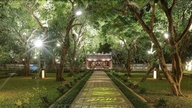


The main structure of the temple—the most sacred part—is the main hall, oriented east-west. The main hall is constructed of reinforced concrete and has two floors, each with a central chamber, a tiled roof, brick walls, and a tiled floor. The columns are circular, with lotus pedestals at the base and capital. Statues of Kâyno and Maha Kruốt support the roof at the top of each column. The eaves, column capitals, and other decorative elements are adorned with various motifs: coiled vines (Ang ko hiệl), lotus petals and leaves arranged in a straight line (bông pec), four-petaled flowers (bông dót chanh), lotus petals (trò bot chuk), and images of celestial beings.
This place preserves national cultural values, showcasing cultural exchange between ethnic groups, such as altars, wardrobes, semicircular tables, and scriptures and stories written on wooden panels. Every year, many traditional festivals of the Khmer people take place here, such as the Chôl Chnăm Thmây New Year (April 13-15), the Sen Dolta festival (August 29-30), and the Oóc- 0m- Bóc festival (held on the full moon day, October 15).
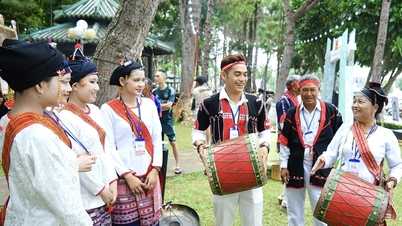
Sports and recreational activities are held close to major holidays, such as cultural exchanges, Lam-thol dances, and traditional five-tone music performances, making this place a cultural center for the Khmer people of Loan My commune.


![[Photo] General Secretary and President To Lam working with the Technical and Professional Center, Ministry of Public Security](https://vphoto.vietnam.vn/thumb/1200x675/vietnam/resource/IMAGE/2026/07/06/1783318005842_a1-bnd-1129-2263-jpg.webp)






















































Sunset Dance

Time Crossroads
