

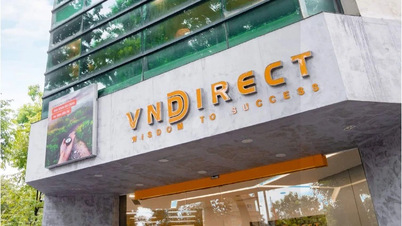
VNDirect suffers a setback - Information security is a matter of survival.
Compared to the attack that occurred at a securities company nearly three years ago, the attack at VNDirect was more serious, involving a complete system shutdown and a longer service recovery time.
VNDirect's defenses against attacks have "fallen apart".
As of this afternoon (March 25th), more than 30 hours after being "attacked by an international organization," the trading platform and website of VNDirect Joint Stock Company remain inaccessible. This means that the accounts of securities investors held at VNDirect – the third-largest brokerage firm in terms of market share, accounting for 7.01% of transactions on the Ho Chi Minh City Stock Exchange in 2023 – are completely "frozen" for the entire first trading session of the week.
VNDirect stated that its trading system was attacked starting at 10:00 AM on Sunday, March 24, 2024. “The entire VNDirect system was attacked by an international organization. VNDirect’s technology team has made every effort to restore it, but due to the very large data infrastructure, it will take more time to reconnect,” the official statement released on the morning of March 25 said.
Globally , attacks on financial institutions and stock exchanges are not uncommon. For example, in 2012, six major US banks simultaneously suffered a Distributed Denial of Service (DDoS) attack, preventing their customers from accessing websites or conducting online transactions. In 2013, the global stock market also witnessed the Nasdaq exchange being paralyzed for three hours due to a DDoS attack.
In Vietnam, new statistics from Kaspersky Security Network (KSN) show that the number of online attacks detected and blocked by Kaspersky in 2023 was 29,625,939, a 29% decrease compared to the previous year (41,989,163 attacks in 2022). The percentage of Vietnamese users infected with web threats during this period was recorded at 34%, placing Vietnam 67th globally in terms of the level of danger associated with web browsing.
Specifically in the securities sector, between July 23rd and July 29th, 2020, VPS's system (network/electronic trading) was repeatedly subjected to DDoS attacks, with the strongest attacks occurring from 9:00 AM to 11:00 AM on July 23rd and from 1:05 PM to 2:00 PM on July 29th. This caused congestion in VPS's electronic trading system, making it difficult for VPS customers to log in and even preventing them from trading at times.
Compared to the VPS attack nearly three years ago, the attack at VNDirect is more serious.
According to an analysis by a technology expert, the complete system shutdown and the lengthy service recovery time raise suspicions that hackers may have penetrated quite deeply into the system.
According to this expert, finding the full cause of a cyberattack typically takes one to two weeks. Administrators and experts will have to trace every clue to reconstruct the entire attack, thereby finding vulnerabilities and developing countermeasures for the future. Furthermore, there are usually three risks when a securities company is attacked: disrupted trading, causing economic losses to investors; leaked personal information; and compromised or changed account passwords.
Currently, VNDirect affirms that all customer information and assets are secure and unaffected. The incident only affected transactions.
A crucial factor requiring early defense.
Speaking to readers of Investment Newspaper at the Talkshow "Technology 'Transforming' Customer Experience" held earlier this year, Mr. Nguyen Phuc Nguyen, Director of Information Technology at Bao Viet Securities Company (BVSC), described the consequences of an attack on securities companies' systems as "terrible."
"In the securities industry, security is a 'vital' factor. Securities companies have the unique characteristic of real-time data and instantaneous transactions, so the consequences of an attack would be devastating. Therefore, from the moment they begin providing online services, service providers must build defenses against attacks and security barriers," Mr. Nguyen emphasized.
Not only in the securities sector, but also in the banking and finance sector, secure investment is a significant investment for organizations. Mr. Luong Tuan Thanh, Director of Technology and Digital Transformation atOCB Bank, stated that OCB's current defense system comprises three layers: protecting customer data, protecting the bank's systems, and protecting daily banking and financial operations.
"One highly regarded concept regarding public security is 'zero trust.' This means that even in banking systems and information security systems, no one should be trusted, not even bank employees or IT personnel, to ensure safety and security during operations."
According to Mr. Thanh, major cyberattacks and security breaches target specific sectors, so in the banking sector, banks share information about risks and interbank attacks to support each other in defense. Banking systems primarily utilize data-driven systems to monitor unusual behavior, transactions, or anomalies within the system, enabling early and automated defense. By the time an attack is detected, it's often too late. That's why automated defense and preparation are crucial to ensure security.
Regarding the incident at VNDirect, the securities company is currently working with partners, including leading technology corporations in Vietnam, and coordinating with the Cyber Security and High-Tech Crime Prevention Department (PA05) and the Cyber Security and High-Tech Crime Prevention Bureau (A05) to ensure the prevention of similar incidents to VNDirect and maintain market safety.
In addition to building defenses against attacks and sharing information to support each other in defense, in today's cyber environment, financial institutions also need to focus on supporting customers. As with the securities sector, Mr. Nguyen Phuc Nguyen emphasized the need to help customers better protect themselves through various means such as product design, trading methods, and customer communication…
Sometimes, simply clicking on a link can lead to a customer's password being stolen quickly. Even in the stock market, attacks can sometimes be as simple as someone buying a stock without actually transferring the money... These are all real risks for customers.
7% of VNDirect's outstanding shares changed hands on March 25th.
In today's trading session (March 25th), VND shares saw a surge in trading volume. The stock traded at a rapid pace, pushing the trading volume to over 86 million units, equivalent to 7% of the company's total outstanding shares.
This figure is three times the average daily volume over the past year and represents the second highest liquidity level in VND's listing history, second only to the session on July 6, 2023 (with 105 million units traded).
At the close of trading on March 25, VND shares fell 1.44% to 23,950 VND per share.
Source



























































![[Video] Sunset at Lap An Lagoon – Where the sun sets over the fishing nets](https://vphoto.vietnam.vn/thumb/1200x675/vietnam/resource/IMAGE/2026/05/31/1780192137701_beach-landscape-sea-water-nature-grass-745871-pxhere-com.jpeg)







































Comment (0)