.jpg)
June 5, 2026
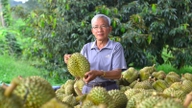
I'm standing in the middle of the Phan River, specifically on a barrier that acts like a pathway but also serves to block the flow of freshwater and prevent seawater from flooding during high tide. However, during the peak of the rainy season, when floodwaters rise and flow into the sea, this barrier is destroyed. It was built manually with whatever materials could be found, with all the efforts of the people whose dragon fruit orchards are within the irrigation area. Yet, it cost 57 million dong. This is the only barrier built on the river during the dry season of 2026 at the Go Ca location. The other 3-4 locations closer to the sea, where people contributed to build barriers in previous years to prevent saltwater intrusion, could not be built this year. "Because we no longer have money. The dragon fruit is affected by salinity, losing about 50% of its yield. The price isn't high either, so even though we're still mobilizing resources as in previous years, the people honestly say they don't have any money left," said Mr. Nguyen Thanh Gam from Hiep Phuoc village, Tan Thanh commune, sadly.
His family's 3-hectare dragon fruit plantation has been gradually affected by salinity during the dry season, despite building barriers and flushing out the salt during the rainy season year after year, like a bottomless pit, costing them money and numerous attempts to save the orchard. This year, he contributed 3 million VND to build barriers and also drilled a well in the corner of the orchard hoping to utilize freshwater for irrigation. Currently, his family's orchard has 5 wells, each 30-50 meters deep, costing 20-30 million VND, but every well is affected by salinity.
Not only Mr. Gam's family, but thousands of households in the former Tan Thuan commune are facing the same situation: the more they try to find fresh water to irrigate their dragon fruit, the more their drilled wells become contaminated with salt, lime, and alum. In this situation, they have to carefully manage the salinity before irrigating, preventing the dragon fruit from developing normally. Meanwhile, this year, the price of this fruit has been consistently low, without the high prices seen in previous years. Therefore, the feeling of "a futile effort" is evident in every word and expression of the people here.
.jpg)
June 7, 2026
Two years ago, I stood at the spot where, during the dry season, the first barrier, blocking seawater from entering the Phan River, was located. Locals began constructing this barrier during the dry season of 2007, but had to add more one or two years later when they realized the saltwater intrusion was too rapid. In 2010, the Tan Thuan commune recorded severe saltwater intrusion in the villages of Hiep Le, Hiep Phuoc, and Hiep Hoa, which were home to both Cham and Kinh communities. In total, for over 15 years, the people have been working together on this stretch of river, spending approximately 150 million VND annually on building barriers during the dry season, only for all of it to be washed away by the sea when the rainy season arrives.

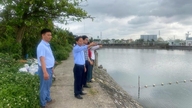

At that time, I wrote the report "Drive Out the Saltwater Invaders," documenting the shining spirit of solidarity and also seeking the root causes behind it.
“Looking from above, you can see that the dragon fruit growing area of the commune is formed along the Phan River, a river formed from many streams in Duc Thuan commune, Tanh Linh district, flowing through Ham Tan district to Ham Thuan Nam district, and into Tan Thuan commune before merging with the Ba Dang estuary (Tan Hai - La Gi) into the sea. With sandy soil and no reservoirs, the presence of a river downstream doesn't guarantee sufficient water. Therefore, every year during the dry season, the Phan River dries up. Along its banks, stretching for many kilometers with dragon fruit plantations, the amount of groundwater being exploited for irrigating the dragon fruit is increasing drastically. And that's when the groundwater level drops significantly, leaving the area vulnerable to seawater intrusion, especially in the evenings when the tide rushes from the sea into the Phan River, reaching as far as the suspension bridge near the commune's People's Committee office.” - This is an excerpt from the documentary “Push Back the Saltwater Invaders” in September 2024.
Now, the saltwater intrusion is no longer limited to the suspension bridge. It's said to have penetrated further inland, approximately 3 km, leaving the former Tan Thuan commune almost completely vulnerable to drought. Across from Thuan Quy, directly in front of the former Tan Thanh commune, the two communes that merged with Tan Thuan to form the current Tan Thanh commune are both coastal but not connected to the river, thus avoiding saltwater intrusion. Meanwhile, the land in Tan Hai commune along both sides of the Phan River has been abandoned for many years due to severe saltwater intrusion. This situation worries dragon fruit farmers in the Tan Thuan area, who fear that one day they will be unable to produce anything, even though many areas have already been left fallow. Furthermore, over time, if the government builds a saltwater barrier on the Phan River too late, the seawater will eventually reach the Ham Thuan Nam ward…
.jpg)
June 10, 2026
That is why, since the beginning of the year, voters in Tan Thanh have repeatedly petitioned for the early implementation of the Phan River Salinity Barrier Dam project. Notably, this latest petition seems to be a last resort, having waited a long time due to the obstacles in the project's implementation.
In 2021, the Phan River Salinity Barrier Dam project received investment approval from the People's Committee of the former Binh Thuan province, with a budget of 19 billion VND from the central government's contingency fund. Subsequently, the investment plan was adjusted, increasing the capital to 47 billion VND to ensure salinity control and flood prevention. This project was included in the priority investment list of the provincial planning for the period 2021-2030, with a vision to 2050, as per Decision No. 1701/QD-TTg dated December 27, 2023, of the Prime Minister . A further obstacle is that the central and local government budgets from the previous period were insufficient to cover this increased cost.
.jpg)

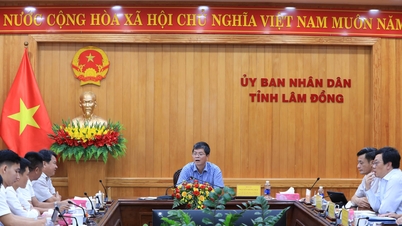
According to Report No. 171/BC-UBND dated April 20, 2026, from the People's Committee of Lam Dong province, the project needs to be reviewed to allocate funding according to the new budget management decentralization; at the same time, the project will be implemented immediately upon approval of the allocation of funds by the Provincial People's Committee in accordance with the Law on Public Investment and other relevant legal regulations.
“We know for sure the construction will go ahead, but if it starts too late, the land will be severely saline and nothing will be possible,” Mr. Gam and other residents looked at me pleadingly, as if begging the journalist to provide information. Suddenly, I felt a heavy weight on my shoulders…
Source: https://baolamdong.vn/vo-tran-nhiem-man-448043.html

![[Photo] General Secretary and President To Lam receives Palestinian Ambassador Saadi Salama](https://vphoto.vietnam.vn/thumb/1200x675/vietnam/resource/IMAGE/2026/06/25/1782365384740_a1-bnd-9423-8322-jpg.webp)
![[Image] Ho Chi Minh City: Ma Lang area, Chicken-Rice Market about to change its appearance](https://vphoto.vietnam.vn/thumb/1200x675/vietnam/resource/IMAGE/2026/06/25/1782377698627_ndo_br_m1-jpg.webp)
![[Image] Schools organize meetings and introduce teaching models to students admitted to grade 10.](https://vphoto.vietnam.vn/thumb/1200x675/vietnam/resource/IMAGE/2026/06/25/1782368077271_ndo_br_z7970052192242-1ec8daeb77a6eed1a4e9f58c564ddd3e-jpg.webp)









![[Video] Weather forecast for tonight and tomorrow, June 26, 2026: Northern Vietnam to end heatwave from tomorrow, Central Vietnam to continue experiencing a heatwave.](https://vphoto.vietnam.vn/thumb/402x226/vietnam/resource/IMAGE/2026/06/25/1782392692278_thumb-dem-png.webp)