

The necklace, made from the teeth of an ancient sea monster, was discovered during Magellan's scanning project of the Titanic shipwreck.
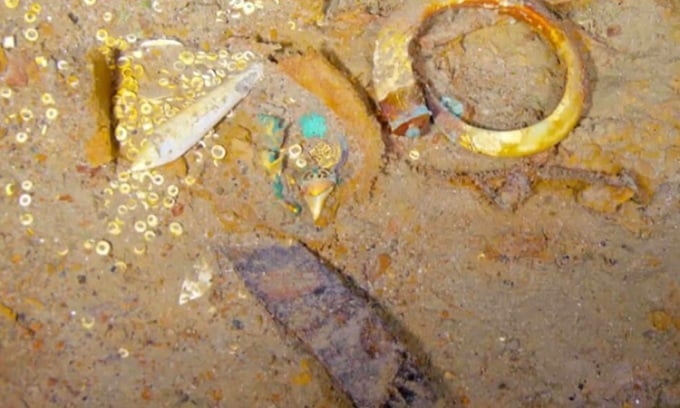
The exploration company will preserve the bracelet in its current state. Photo: Magellan
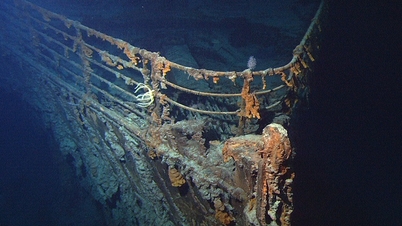
No one has ever seen the necklace from the Titanic, the luxury passenger ship considered the most advanced of its time, which sank 111 years ago. The Titanic sank after colliding with an iceberg in the North Atlantic, about 595 km southeast of Halifax, Nova Scotia, on April 15, 1912. The ship was on its fourth day of its maiden voyage from Southampton, England, to New York, USA. The disaster resulted in the deaths of more than 1,500 people, accounting for more than two-thirds of the crew and passengers on board at the time.
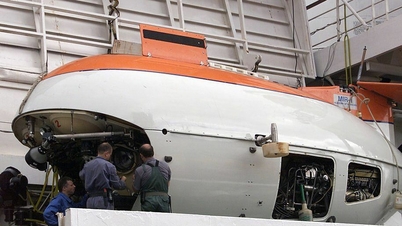
The remarkable necklace was discovered by Magellan, a company based in Guernsey, near the French coast. The company specializes in underwater exploration and seabed mapping. As part of an underwater scanning project, Magellan took 700,000 photos of the Titanic wreck using two submarines. Using these images, the company created the first full-size digital scan of the Titanic, providing a new perspective on the wreck. Among the images captured, Magellan's research team discovered the necklace containing gold and megalodon shark teeth, according to CEO Richard Parkinson.
Megalodon was a giant shark that became extinct approximately 3.6 million years ago. As the largest shark to ever live, the oldest megalodon skeleton dates back over 20 million years. The largest megalodons could have measured 15–18 meters in length, according to the Natural History Museum in London. In comparison, the largest great white shark was about 6 meters long. Megalodon teeth could have been nearly 18 cm long, although fossils are typically between 8–13 cm.
Magellan did not remove the necklace containing the megalodon shark tooth from the shipwreck due to an agreement between the US and the UK. Now, Magellan is trying to identify the owner of the necklace with the help of artificial intelligence (AI). The company is using AI to analyze footage of passengers boarding the ship in 1912, examining their clothing and implementing identification techniques.
Magellan's scan of the Titanic could help create a realistic 3D model or digital twin of the wreck with unprecedented resolution. Due to the wreck's remote location at a depth of approximately 3,810 meters, a full view of the area has been difficult. The new model will allow people to zoom in and examine the entire wreck for the first time.
An Khang (According to Newsweek )
Source link





































![[VIMC's 40-day rapid rollout] VOSA accelerates the deployment of a comprehensive logistics solution for HODA.](https://vphoto.vietnam.vn/thumb/402x226/vietnam/resource/IMAGE/2025/12/23/1766473634002_vosa-23-12-25-2_upscayl_2x_remacri.jpeg)













![[Photo] Closing Ceremony of the 15th Conference of the Central Committee of the 13th Party Congress](https://vphoto.vietnam.vn/thumb/402x226/vietnam/resource/IMAGE/2025/12/23/1766462841764_a1-bnd-3731-1647-jpg.webp)
































Comment (0)