

Ninh Binh has thousands of hectares of low-lying rice paddies where farmers practice a model of one rice crop followed by one fish crop. In 2023, these areas were severely affected by drought, resulting in low yields. This year, with favorable weather conditions, early and evenly distributed rain, many farmers believe that this rice-fish crop will be highly effective.
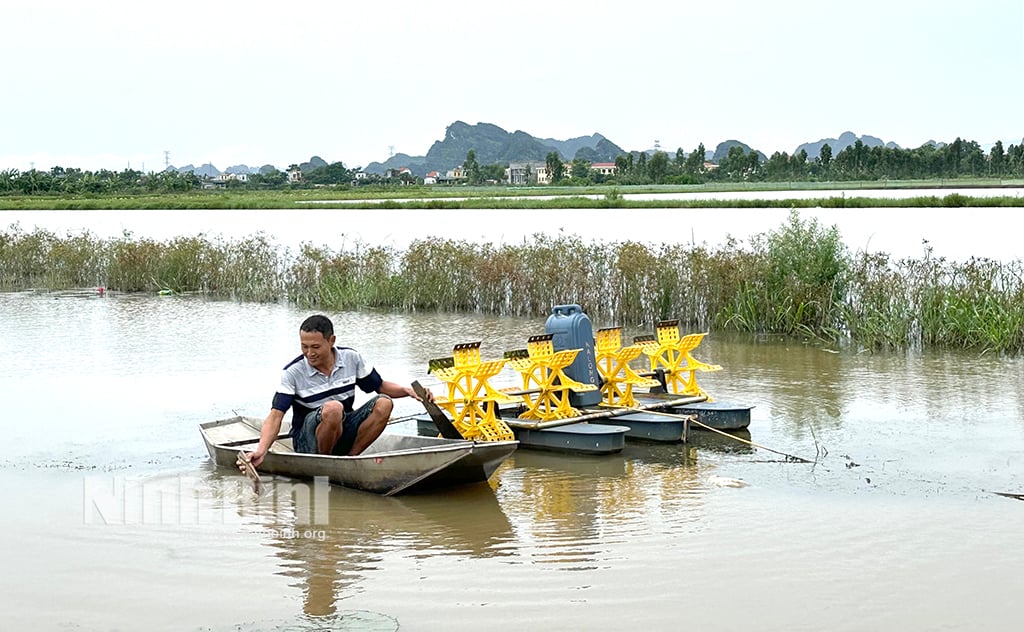
Mr. Nguyen Van Khai (Trung Son village, Son Thanh commune, Nho Quan district) inspects and takes care of the rice paddy area where fish have been planted.
Early in the morning of August, Mr. Nguyen Van Khai (Trung Son village, Son Thanh commune, Nho Quan district) paddled his boat around to check on his fish pond. He surrounded the pond with nets, and dug a deep trench in the middle to provide shelter for the shrimp and fish. He also installed a water fan to create a current and increase the oxygen level in the water.
Mr. Khai said: Last year, many households couldn't release their fish into the fields in July because of the intense heat and water shortage. In some places, the water level was only about 20-30 cm, causing the shrimp and fish to grow slowly, and some even suffered from heat shock and died. But this year is different. With continuous rain and abundant water, he released 3 tons of fish fry and 100,000 freshwater prawns into these 20 hectares of rice fields from the end of May to the beginning of June. Before that, the shrimp and fish had been raised in ditches for about two months to acclimatize them and help them develop good health to withstand the unusual environmental conditions.
"Last year, because we stocked late and harvested late, some of the farmed shrimp died due to the cold weather. This year, I stocked early, so I'll harvest early, which is more reassuring, and I'm sure the yield will be much higher than last year... There's no question about this; we farmers have decades of experience in shrimp farming," Mr. Khai affirmed.
Like Mr. Khai, Mr. Pham Van Hien also rented 30 acres of rice fields from villagers to raise aquatic animals. Mr. Hien shared: "The most important thing in this model is the water source. In years with favorable water conditions, raising fish is very easy and highly effective. Rice field fish mainly feed on rice sprouts and plankton in the water, so when the weather is cool, the water source is abundant, and there is plenty of natural food, they will grow quickly."
According to Mr. Hien, this year, in addition to raising traditional fish species, his family is also raising giant freshwater prawns. This is a new species, but trials conducted in the previous season showed that the prawns adapt well, are suitable for the water and soil conditions of this region, are easy to raise, and can utilize many readily available natural food sources such as protozoa, polychaete worms, crustaceans, insects, mollusks, algae, and organic detritus. In particular, giant freshwater prawns have high nutritional value, are delicious, and are very popular with consumers, so the market is very open. Mr. Hien expects this year's aquaculture crop in his rice paddies to bring high income to his family.
As a low-lying area, rice cultivation during the rainy season is often flooded by storms, rendering it unharvestable. Therefore, with the goal of respecting natural laws, promoting sustainable development, and adapting to climate change, Son Thanh commune has proactively converted 200 hectares to a rice paddy fish farming model. Mr. Nguyen Van Luan, Chairman of the Son Thanh Commune People's Committee, stated: "The area dedicated to rice paddy fish farming in Son Thanh has developed strongly in recent years because this model reduces farming risks while improving people's income. On average, farmers earn a profit of about 25-30 million VND per hectare. This year, thanks to favorable weather conditions, farmers have already planted rice on 100% of the area since May."
To create the most favorable conditions for farmers' production, the commune acted as an arbitrator, mobilizing households to agree to lease their land to fish farmers; providing support in irrigation work and ensuring security and order; creating conditions for people to access preferential capital sources to invest in breeding stock and feed; and regularly coordinating with specialized agencies to open training courses on techniques for caring for and managing fish ponds.
Not only in Son Thanh commune, but also in Nho Quan, Gia Vien, Hoa Lu districts and Tam Diep city – key rice-fish farming areas in the province – farmers are currently hoping for a successful harvest, given favorable water conditions from the beginning of the season. However, according to the Fisheries Sub-Department (Department of Agriculture and Rural Development), in recent years, along with the impact of climate change, natural disasters have become increasingly complex, extreme, and unpredictable; therefore, farmers must absolutely not be complacent.
To ensure high efficiency in rice paddy fish farming, minimize negative environmental impacts on the health of farmed shrimp and fish, and reduce the risk of losses, farmers should note the following: Stocking should be done according to the seasonal schedule, and larger fingerlings should be selected to shorten the rearing time. Regularly monitor the ponds, checking environmental factors such as pH, temperature, and water clarity to make appropriate adjustments. Ensure a clean and safe farming environment through simple measures such as periodically applying lime to the ponds. Supplemental feed (rice bran, corn) can be given to the fish in amounts equal to 3-5% of their weight. When the rice stubble in the pond is insufficient for grass carp, additional green feed should be added.
During hot weather, farmers should limit thinning, transporting, and stocking of fish. It's necessary to proactively manage water supply so that water levels can be raised when needed. Digging ditches and creating depressions can provide shelter for fish during prolonged periods of hot weather, and using shade nets over ditches and ponds can help reduce the heat for aquatic animals.
In addition, farmers must also prepare flood prevention plans such as reinforcing embankments to be sturdy, leak-proof, and 0.5m higher than the highest water level to withstand floods; installing numerous drainage pipes and ditches around the ponds; placing nets around the farming area; regularly inspecting the drainage system and embankments; cleaning ditches and canals to ensure quick water drainage; and preparing pumps for drainage when necessary. Flood prevention plans must be calculated for the entire farming area. During the farming process, farmers must constantly monitor the ponds; if any unusual signs are detected, suspected disease, or if there is any mortality in the ponds, they must report it to the authorities for guidance and timely action.
Text and photos: Nguyen Luu
Source: https://baoninhbinh.org.vn/vu-ca-ruong-khoi-dau-thuan-loi/d2024081015366268.htm


























































































Comment (0)