

Living with the villagers
When tourists are no longer satisfied with simply "seeing for the sake of seeing," community-based tourism villages in Dak Lak are becoming destinations that "captivate" visitors with vibrant experiences. There, culture is present in every aspect of daily life of the Ede, M'nong, and other ethnic groups.
With 7 community-based tourism villages already announced, the locality is gradually forming a unique and distinctive experiential tourism ecosystem.
 |
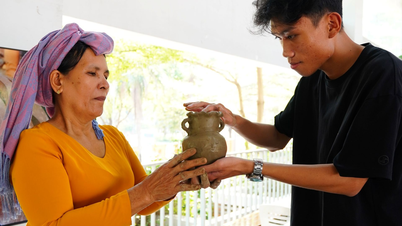
| Dak Lak is gradually asserting its position on the tourism map with its unique cultural values. ( In the photo: Tourists are interested in learning about the brocade weaving process of the Ede people). Photo: Huu Hung |
A prime example is the Tơng Ju community tourism village (Ea Kao ward), which, despite being a familiar destination, still attracts tourists thanks to its in-depth approach to tourism, creating unique tourism products.
According to Ms. H'Yam Bkrong, head of the Tơng Ju village community tourism group, since the beginning of 2026, the locality has welcomed many domestic and international tourist groups. Unlike typical tours, visitors come here to "live with the culture." They spend a lot of time admiring the architecture of the longhouses, learning about the matriarchal system, or deciphering the symbols of the staircases shaped like breasts, stars, etc.
Beyond simply learning about the culture, tourists also get to directly participate in the production process of the local people. Tours of coffee plantations, learning how to roast and grind coffee manually, and joining in the kitchen to prepare local dishes have transformed the trip from a simple "sightseeing" experience into a truly enriching journey. As a result, the number of visitors to Tơng Ju village has increased by approximately 15% compared to the same period last year; the length of stay has also increased.
In the heart of Buon Ma Thuot city, Akô Dhông village still retains a rare, tranquil beauty. More than 30 longhouses, connected to each other, create a unique architectural space that is both familiar and deeply rooted in tradition.
A highlight of Akô Dhông village is its ability to preserve the Êđê people's cultural life almost intact amidst urbanization. The villagers have developed professional tourism services while simultaneously preserving the landscape and traditional way of life. Akô Dhông's appeal also stems from ancient artifacts still present in daily life, such as wine jars, Kpan chairs, gong sets, and H'gor drums. These are not mere exhibits; they are all still "alive" within the community, creating an authentic experience for visitors.
Mr. Nguyen Minh Dat, a tourist from Ho Chi Minh City, shared: “Previously, I thought that going to the Central Highlands was mainly for sightseeing, but when I came to Dak Lak, I found that experiencing the culture was the most memorable thing. The way the Ede people live, eat, and preserve their traditions is very special. Staying for just one night felt very different from a typical tourist trip.”
Unlocking the potential of cultural identity.
The reality from community-based tourism models in villages like Tơng Ju and Akô Dhông shows a strong shift in preferences. While previously tourists prioritized visiting scenic spots, they now often seek experiences deeply rooted in local culture. This is a competitive advantage for Dak Lak, a land that brings together the cultural essence of 45 ethnic groups. The appeal lies not only in intangible cultural heritage such as the Central Highlands Gong Culture Space and Bài Chòi art, but also in the simple, authentic lifestyles and customs. This authenticity creates a unique and unmistakable "brand." If properly exploited, each cultural value can become a unique tourism product, bearing the distinct mark of the region.
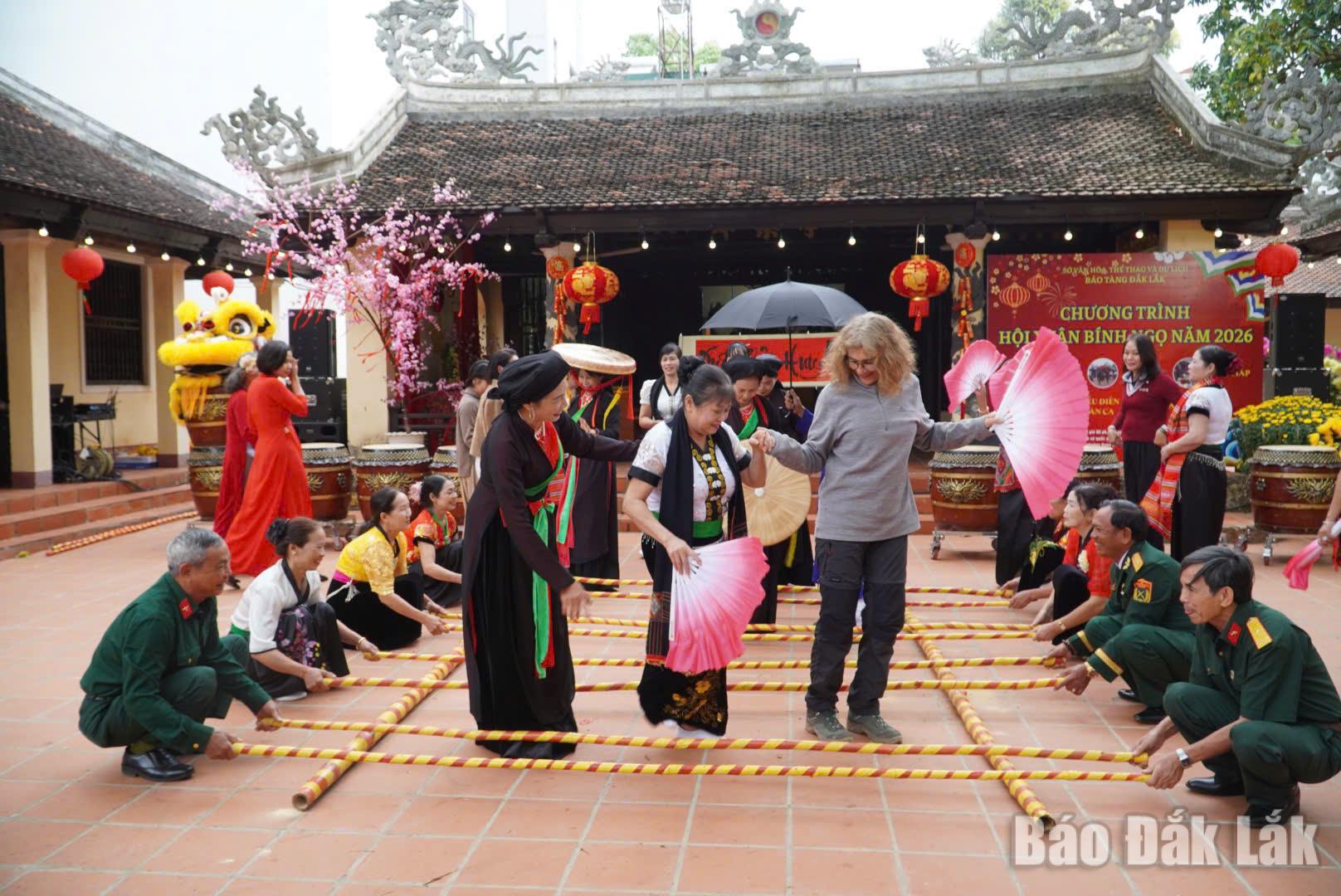 |
| International tourists experience bamboo pole dancing as part of their journey to explore local culture in Dak Lak. |
In the first quarter of 2026, Dak Lak's tourism industry recorded positive signs, welcoming 2.3 million visitors and generating revenue of over 4,100 billion VND. |
However, according to Mr. Nguyen Duc Phuc, Director of Bazan Xanh Travel Service Trading Company Limited (Buon Ma Thuot ward), the exploitation of this potential is still not truly commensurate. The issue is not about whether there is a new model or not, but about how to tell the story of the culture in a way that is attractive enough to keep tourists staying longer. Tourists coming to Dak Lak love the climate, cuisine, and local culture, but to keep them staying longer, unique, in-depth products that are properly invested in are needed.
Therefore, to enhance competitiveness, a coordinated effort is needed between businesses, the people, and the government in developing unique and distinctive product lines. Businesses play the role of organizing tours, connecting markets, and promoting destinations; the people are the custodians of cultural values, directly providing services and creating authentic experiences for tourists; and local authorities need to enact mechanisms and policies, invest in infrastructure, support training, and provide long-term development guidance.
When these "links" play their roles correctly and connect effectively, they will create tourism products with depth, harmoniously combining nature, culture, and cuisine, thereby enhancing attractiveness and competitiveness with other localities.
Nhu Quynh
Source: https://baodaklak.vn/tin-noi-bat/202604/van-hoa-ban-dia-nam-cham-hut-khach-du-lich-3493de9/
![[Photo] Prime Minister Pham Minh Chinh receives the Chinese Ambassador to Vietnam](https://vphoto.vietnam.vn/thumb/1200x675/vietnam/resource/IMAGE/2026/04/05/1775397481797_ndo_br_dsc-5512-jpg.webp)













































































Comment (0)