


Golden season by the Pearl River
I arrived in the Du Long pomelo growing region, and a sudden, cold rain poured down due to the monsoon winds. However, the rain couldn't dampen the mood, as the entire riverside area seemed illuminated by the vibrant golden hues of ripening pomelos. The atmosphere of harvest was bustling, and the joy of a bountiful crop was evident on the faces of the farmers.
The current sense of peace and prosperity makes it hard to believe that just in 2024, this place was devastated by Typhoon No. 3. At that time, strong winds and heavy rains damaged 70% of the pomelo orchards, uprooting trees, flooding the area, and causing fruit to fall everywhere. Yet, in the 2025 pomelo season, the farmers of Du Long have achieved a miracle with a completely successful harvest.
As one of the first people to bring pomelo trees to this land, Mr. Nguyen Van Lam (Du Long residential area) couldn't hide his emotion as he stood amidst his 2-hectare orchard laden with fruit. He recounted that after the storm, many orchards were almost completely destroyed, and seeing the withered trees was heartbreaking. But undeterred, thanks to the technical support of the cooperative and experts, the farmers actively revived their orchards. "Looking at the results today, every tree is laden with ripe, golden fruit, and traders have already bought the entire orchard. We farmers are very happy," Mr. Lam shared.

Sharing in that joy, Ms. Nguyen Thi Thu, a farmer with years of experience growing pomelos since 2007, was also busy welcoming traders. With 1.5 acres of carefully tended orchard, Ms. Thu said that most of the pomelos in her garden had already been "ordered" by traders. "This year the pomelo harvest is good, and the price is also stable at 10-15 thousand dong per fruit. I only dare to keep a few of the most beautiful ones for ancestral worship and retail sales during the Tet holiday," Ms. Thu happily said.
The story of Mr. Lam and Mrs. Thu is a vivid testament to the enthusiastic work ethic and happiness of hundreds of households in Du Long when nature rewards their hard work.
From trade secrets to sustainable production thinking
To achieve the miraculous recovery and "premium" quality of pomelos, in addition to efforts to restore the trees after the storm, the people of Du Long also possess cultivation secrets accumulated over decades.
Sharing his annual care techniques to maintain quality year after year, Mr. Nguyen Van Lam revealed a rigorous process: "After harvesting (around December), we start the new season. The first thing is to loosen the soil around the tree's canopy to sever old roots, stimulate new root growth, and simultaneously apply organic fertilizer and phosphorus to revitalize the tree." He emphasized that the most important secret lies in "counting the fruit." "For Dien pomelos specifically, if a tree has too few fruits, the fruit will be too big and not tasty, but if it has too many, the fruit will be too small. For old trees with wide canopies, I only leave about 150 fruits, and for young trees under 10 years old, I only keep 80 fruits. You have to observe the tree and the leaves to keep the fruit so that the pomelo segments are juicy and not dry," Mr. Lam enthusiastically explained.

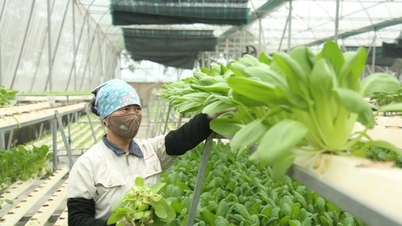
No longer relying on traditional farming methods or word-of-mouth experience, farmers in Du Long today have made a significant shift in mindset: moving towards systematic, scientific production processes and minimizing the overuse of chemical fertilizers and pesticides. Mr. Luu Van Trung, Director of Chau Giang Agricultural Service Cooperative, stated that from spontaneous planting, the entire region now has 90 hectares of concentrated fruit orchards, including 19 hectares of pomelo trees in Du Long that have achieved VietGAP certification. Clean farming practices, prioritizing the use of organic fertilizers and well-rotted chicken manure, not only help trees thrive and soil health but also enhance product value.
The economic benefits are evident in the numbers. One hectare, planted with approximately 450 trees, each yielding 100 fruits, and selling at an average price of 10,000 VND per fruit, generates revenue of 400-600 million VND per hectare. After deducting costs for fertilizer, pesticides, and labor, farmers earn a net profit of around 300 million VND per hectare, 7-8 times higher than their previous rice cultivation.
With the cooperative's support in connecting consumers with supermarkets and stores selling clean agricultural products, Du Long pomelo is increasingly asserting its position, bringing prosperity and a vibrant new rural landscape to the land along the Chau Giang River.
Source: https://baoninhbinh.org.vn/vung-buoi-du-long-thap-lua-don-tet-260128130607826.html































































Comment (0)