


Streams and lakes have dried up completely, and many crops have withered and died.
For the past few months, the Cha stream in Phong Van commune (Luc Ngan district) has dried up completely, revealing scattered pebbles. Amidst the scorching heat of early summer, Mr. Vi Van Gioi and his neighbors are still diligently drilling a well right in the middle of the Cha stream, clinging to the faint hope of finding water for daily use. He recounts that since Typhoon No. 3 struck at the end of September 2023, there has been no rain in the area, all the wells have dried up, and the stream has also completely dried up, so he had to dig a new well right in the middle of the stream. After drilling about 7 meters down the fourth hole, they found water, and everyone quickly installed pipes to bring it home. However, after only a few buckets, the flow gradually weakened and then stopped.
Many lychee trees belonging to residents of Phong Van commune (Luc Ngan district) have died. |
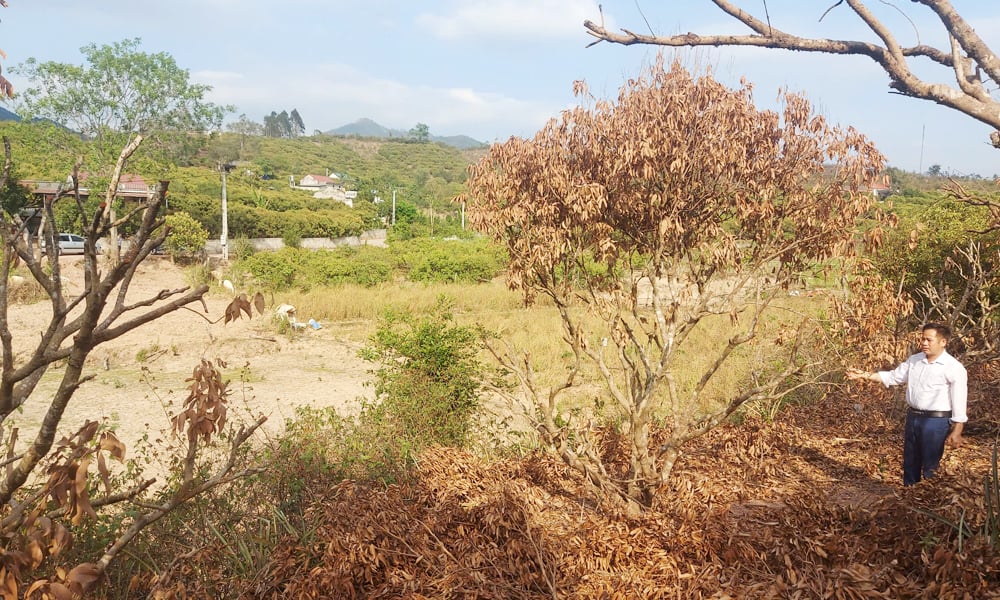
Pointing to the three water containers, Mr. Gioi said, "Throughout the day, my family of three has to share and use this water sparingly for eating, drinking, bathing, and washing." The Cha stream is located right at the edge of the protected forest. For many years, this stream has provided water for nearly 100 households in the village and for irrigating dozens of hectares of crops. The villagers are worried that if there is no rain in this highland area for another two weeks, and the water from the drilled wells runs out, they don't know how they will manage.
Not only in Phong Van, but also along the high hillsides of the road from Bien Son commune to the highland communes of Ho Dap, Cam Son, Tan Son... scattered dead lychee trees with yellowing leaves can be seen, and many rice and corn fields belonging to the people are wilting due to dry, cracked soil.
Ms. Hoang Thi Loc from Tan Son commune expressed her concern: “This year, the lychee trees bloomed profusely, with a high fruit setting rate, and my family hoped for a good harvest. However, the harsh drought has caused 50 lychee trees, planted nearly 30 years ago, to wither and die. Trees on the high hills without reliable irrigation are also showing signs of wilting, and the young fruit is not developing.” According to a quick summary by the Department of Agriculture and Environment of Luc Ngan district, as of April 22nd, the entire district has more than 5,600 hectares of crops without reliable irrigation, including 4,100 hectares of lychee trees and about 1,500 hectares of other crops, significantly affecting the lives of people in the highlands and hindering the growth of the crops.
The prolonged drought has also caused hardship for residents in the communes of Son Dong district due to a shortage of water for daily life and production. Hundreds of hectares of lychee, rice, corn, beans, and potatoes have been affected by the lack of supplemental irrigation water. For many years, Khe Dang reservoir has supplied water for daily use to more than 4,000 people in An Chau town and some neighboring communes, and ensured irrigation for more than 100 hectares of crops in Vinh An commune. With the water level dropping significantly, the pumps do not have enough water to operate continuously, and their capacity is low, so the managers of the water pumping stations have to implement a rotational water supply system between residential areas and production zones.
This situation has lasted for months, causing an unstable water supply in residential areas; people here have to buy bottled water, dig wells, or find water sources in natural forests tens of kilometers away to bring to their homes. Currently, all reservoirs in the district are at near-dead water levels. Some residents said it has been a long time since they have seen such a drought as this year. Many households have spent tens of millions of dong digging wells and buying additional water pipes, but they are still worried, not knowing how long they will be able to maintain the supply.
Prioritize water supply for domestic use and make efforts to combat drought for crops.
Bac Giang province currently has 274 large and small reservoirs and 203 diversion dams. As of early April, the average water capacity of these reservoirs reached 47% of their design capacity (lower than the same period in 2024). Although there has been some rain recently in the province, it was mainly concentrated in Bac Giang city, with negligible rainfall in the districts and towns. According to the forecast of the Bac Giang Provincial Meteorological and Hydrological Station, from mid-May onwards, the province is likely to experience 4-6 periods of intense and extremely intense heat with temperatures commonly ranging from 39-41 degrees Celsius. Therefore, if there is no rain, the drought will become even more severe, making it very difficult for the lives and production activities of people in the highland communes.
The water level at Khe Hang Lake (Son Dong District) is gradually receding. |
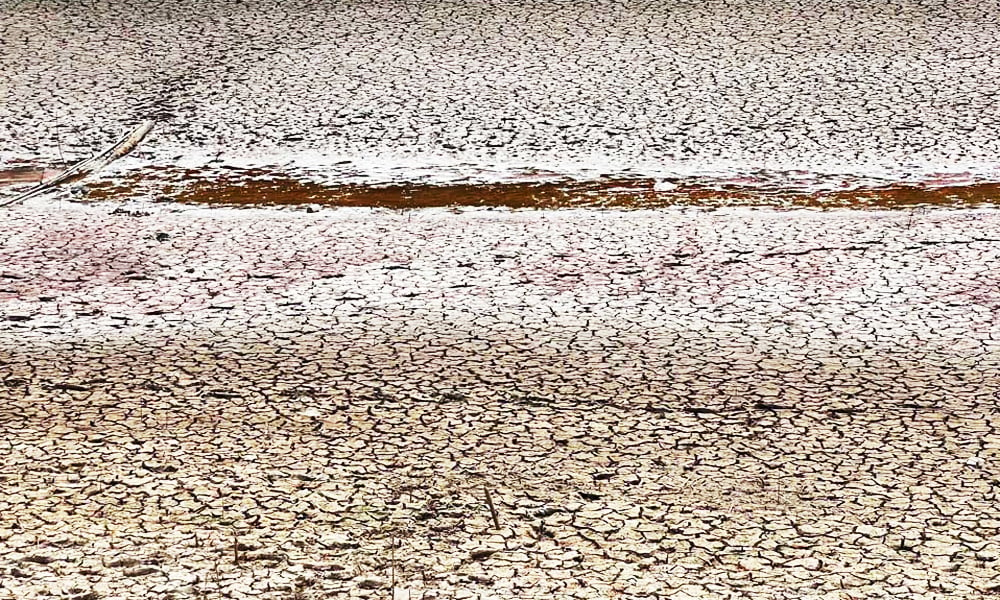
In an effort to mitigate the damage caused by drought, the Department of Agriculture and Environment, local authorities, and the people are exploring all possible solutions to combat it. In response to this situation, the leaders of Son Dong district have inspected reservoirs and production areas, assessing the living conditions and water needs of the local population. Recognizing the likelihood of continued drought, the district leaders have directed specialized agencies to disseminate information and advise the public, officials, and employees of agencies and units to raise awareness of water conservation and efficient water use.
Initially, the district will regulate water use by reducing irrigation water to prioritize water for domestic use until the rains arrive. In the long term, the district is proposing that the province allow the construction of a clean water supply system from the Khe Ro area to supplement domestic water for residents in the central communes of the district; the estimated cost is approximately 13 billion VND.
For fruit orchards, especially lychee trees in severely water-scarce areas, farmers should focus on pruning to minimize water loss and prioritize care to maintain growth. Remember to use water-saving irrigation methods such as: alternating wet and dry irrigation for rice; drip irrigation and sprinkler irrigation for fruit trees and vegetables… combined with foliar fertilizers to supplement nutrients and increase drought tolerance. |
Currently, the province has 29,700 hectares of lychee orchards; nearly 65,000 hectares of spring-summer crops, of which rice accounts for more than 45,000 hectares. Authorities have not yet fully compiled statistics on the area of crops without reliable irrigation, but it is expected that a significant number will be affected by the drought. To ensure stable production, the People's Committees of districts such as Son Dong, Yen The, Luc Nam, Luc Ngan, and Chu town are currently directing specialized agencies and communes/townships to continue reviewing and identifying areas where crops are affected by drought and water shortages.
According to Mr. Le Ba Thanh, Deputy Director of the Department of Agriculture and Environment, for fruit tree areas, especially lychee trees in areas severely lacking water, farmers need to focus on pruning to limit water loss from the trees and prioritize care to maintain growth. The Department is also coordinating inspections of areas with difficult irrigation conditions and high risk of affecting crop yields to continue directing the implementation of timely drought mitigation solutions.
Text and photos: Hai Van
Source: https://baobacgiang.vn/vung-cao-xoay-xo-tim-nuoc-postid416759.bbg











































































Comment (0)