

Founded in 2010 with the ambition to create a new work culture, WeWork boomed but then plummeted in just 9 years and has been unable to recover after the pandemic.
Ten days before the end of 2018, WeWork's $60 million Gulfstream plane took off from New York bound for Hawaii. On board were co-founder Adam Neumann and a $20 billion secret: Project Fortitude, in which SoftBank CEO Masayoshi Son increased investment to $10 billion and bought out most of the shares of every investor – except Neumann – for another $10 billion.
This plan ensured WeWork would remain under the Neumann family's control for generations, backed by a strong investor and fueled by an increasingly ambitious vision. However, within a year, the Gulfstream aircraft were put up for sale, Neumann lost his position, and WeWork's value plummeted sevenfold.
After enduring another wave of Covid-19 and subsequent unsuccessful attempts to save its business, WeWork accumulated billions of dollars in debt and defaulted on bond payments. From a darling valued at tens of billions of dollars in the venture capital world, the WSJ reported in early November that the startup was preparing to file for bankruptcy. What happened to WeWork?
The dream of 'changing the world '
In 2010, Adam Neumann and Miguel McKelvey used the proceeds from the sale of their startup Green Desk to co-found WeWork. Their vision was to create a "physical social network" that could attract freelancers or those working from home.
WeWork's business model involves leasing office buildings (or individual floors) long-term and then renovating them for rent. It's not simply about providing flexible, short-term workspace; they strategically attract clients with luxurious, modern spaces and amenities for community interaction, entertainment, and dining.
For young people wondering if there's anything more interesting in life than sitting in front of a computer screen all day, WeWork offers beer, pinball tables, and meditation rooms. Neumann went around promoting the creation of a new work culture and more, everywhere. "We're here to change the world. Nothing more than that interests me," he once said.
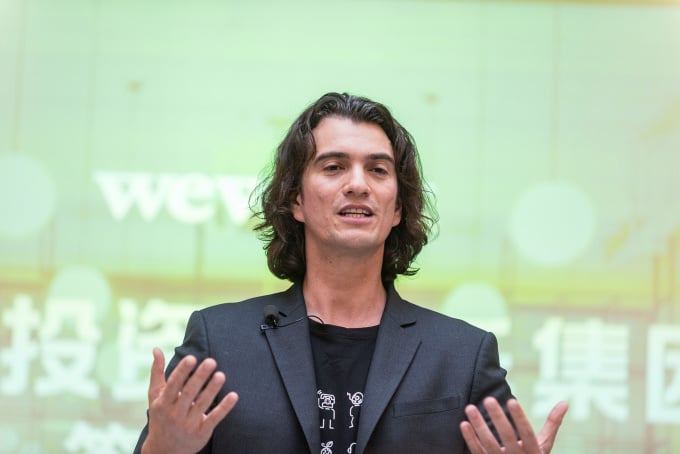
Adam Neumann in Shanghai, China, on April 12, 2018. Photo: Reuters
In theory, the costs incurred, including rent and operating services, were expected to be lower than the price charged to tenants, allowing WeWork to generate profits. Like most startups need to "burn money" in the early years, Neumann analyzed the advantages of the new model and the prospect of a $2 trillion co-working space market – which The Guardian later deemed inflated – to attract funding.
He always recounts that SoftBank CEO Masayoshi Son only took 28 minutes to decide to invest in WeWork. In 2017, SoftBank and Vision Fund invested $4.4 billion in the startup at a valuation of $20 billion. By 2018, SoftBank committed an additional $4.25 billion, making WeWork one of the world's leading unicorns (startups valued at over one billion dollars).
The valuation bubble burst.
Doubts had already begun to emerge. In 2017, the Wall Street Journal expressed skepticism about the $20 billion startup that was essentially an office rental business. This is without even mentioning the $47 billion valuation achieved in a private funding round, or the staggering $100 billion estimate Morgan Stanley projected the company would reach.
The glitz and glamour didn't last long. In 2018, when WeWork approached the bond market to borrow hundreds of millions of dollars, they had to disclose more about their financial situation. Documents revealed that in 2017, WeWork lost $883 million, despite having revenue of approximately $886 million. A leak by the Financial Times revealed that the following year, the company lost $1.9 billion on approximately $1.8 billion in revenue.
By 2019, WeWork had surpassed JPMorgan Chase to become New York's largest commercial leasing company and controlled more square meters in London than anyone except the British government . But investors questioned its unstable financial foundation. That October, the company had to withdraw its IPO plans after investors were unwilling to buy its shares. Banks were also more reluctant to lend to WeWork.
Throughout these hardships, Neumann remained Neumann. His private jet trips were allegedly linked to cross-border marijuana trafficking. His wife could fire employees if she felt uncomfortable, and the company ended a layoff meeting with a musical performance.
Ultimately, WeWork's valuation plummeted from its peak of $47 billion in January 2019 to $7 billion by the end of that year, when it was acquired by SoftBank (Japan). They laid off thousands of employees. Neumann resigned and received over $700 million from the sale of shares to SoftBank and cash payments.
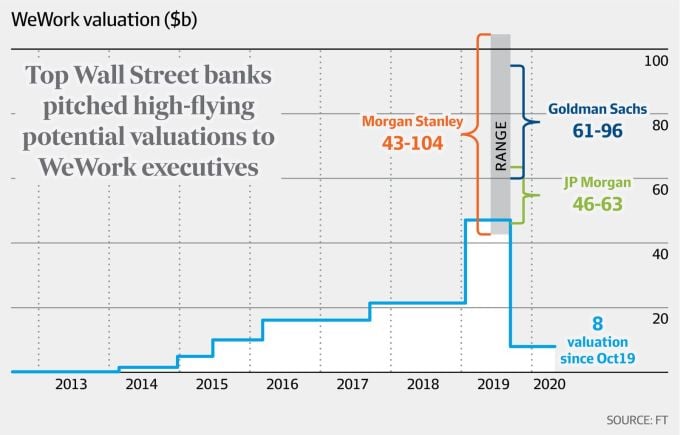
WeWork's valuation fluctuated between 2013 and 2020, peaking at estimates ranging from $8 billion to $104 billion in 2019 by financial institutions. Graphic: FT
According to a 2019 Bloomberg analysis, what transformed WeWork from a venture capital darling to a scorned company is precedent-setting in any growth and decline pattern, and not one of the usual investor concerns, such as future cash flow.
The analysis suggests that WeWork's decline can only be explained by abstract concepts, much like how founder Neumann convinced investors to pour in tens of billions of dollars. It must be acknowledged that Neumann was capable of selling a vision of a startup that could dominate the world, rather than just a shared office rental company.
Struggling in the post-Covid-19 era
When the Neumann era ended, in February 2020, Sandeep Mathrani took over the reins. Under Mathrani's leadership, WeWork went public in October 2021 through a merger with a special purpose acquisition company (SPAC).
The Covid-19 pandemic swept through, creating fears of economic recession and leading to job cuts in the tech industry, weighing heavily on the demand for co-working spaces. More broadly, the office rental market suffered post-pandemic as employees were reluctant to return to the office.
Susannah Streeter, head of currency and markets at Hargreaves Lansdown, said WeWork already showed signs of weakness with large losses and mounting debt before the pandemic. "But the Covid crisis made them pay the price for an already fragile business model," she said.
Facing these headwinds, earlier this year WeWork made efforts to strengthen its finances to weather the downturn. In March, it agreed to a debt restructuring deal with SoftBank as well as several major Wall Street creditors, including King Street Capital Management and Brigade Capital Management.
SoftBank agreed to swap approximately $1.6 billion in debt for a new mix of debt and equity in WeWork. This transaction reduced the company's debt by more than $1.5 billion.
As part of that agreement, WeWork also received investment from SoftBank's Rajeev Misra fund, One Investment Management, providing nearly $500 million in high-interest debt. "The new funding raised and committed in the transaction is expected to fully finance WeWork's business plan and provide ample liquidity," the company stated at the time.
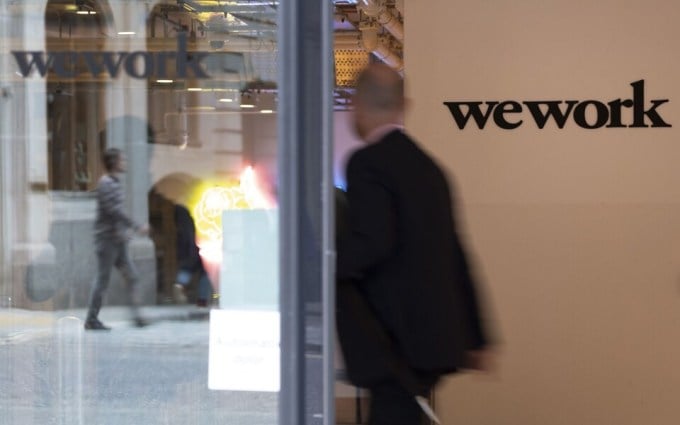
A WeWork branch in London, England, October 2019. Photo: Bloomberg
But in May of this year, after overseeing the financial restructuring, Mathrani abruptly announced his departure. By August, WeWork raised doubts about its ability to sustain operations as it continued to incur losses and its cash reserves dwindled.
According to securities filings, the company burned through $530 million in the first six months of the year and has approximately $205 million in cash remaining. Meanwhile, they have $2.9 billion in long-term debt and over $13 billion in rent, amid rising borrowing costs and difficulties in leasing office space.
The management stated at the time that "the losses have led to a growing number of members leaving... and there is considerable doubt about the company's ability to continue operating."
Therefore, WeWork outlined steps to improve liquidity and profitability, including cutting costs through restructuring and renegotiating lease terms, increasing revenue by reducing member churn, and generating new sales. The company said it would seek additional capital through bond issuance, stock offerings, or asset sales.
Also this month, three board members resigned due to major disagreements over governance and strategic direction. Four new directors with expertise in financial restructuring were appointed to negotiate with creditors.
The situation is not looking good. Year-to-date, WeWork's stock has fallen 96%. As of June, the company maintained 777 locations in 39 countries, 30% of which are in the US. The company faces an estimated $10 billion in rent payments starting from the second half of this year through the end of 2027 and an additional $15 billion from 2028.
By early November, WSJ sources indicated that WeWork could file for Chapter 11 bankruptcy as early as the following week, paving the way for the company to restructure its operations and debt. Under the regulations, such a restructuring plan must be approved by the bankruptcy court and creditors.
But how WeWork will transform itself is a question. Previously, the startup always presented itself as "asset light," meaning it didn't own many physical assets. This was WeWork's truly groundbreaking characteristic, in two ways.
First, by renting instead of buying or building, they can rapidly expand their network, as long as they have sufficient capital to cover the rent. Second, more than just marketing, they effectively leverage the advantages of the space design and work environment to persuade clients, whether freelancers or fast-growing companies that can't afford to expand their offices in the traditional way.
But "asset light" also has a downside. Aswath Damodaran, a finance professor at New York University, was skeptical of WeWork's business model from the start. "In good times, you fill your building. In bad times, they leave, and you're left with an empty building and a debt to pay," he said.
Phiên An ( compiled )
Source link

![[Photo] National Assembly Chairman Tran Thanh Man attends the opening session of IPU-152](https://vphoto.vietnam.vn/thumb/1200x675/vietnam/resource/IMAGE/2026/04/16/1776277863731_ctqh5-jpg.webp)
![[Photo] Mrs. Ngo Phuong Ly meets and exchanges views with Mrs. Peng Li Yuan](https://vphoto.vietnam.vn/thumb/1200x675/vietnam/resource/IMAGE/2026/04/16/1776277858080_phu-nhan-1-jpg.webp)
![[Photo] My Son at night: A thousand-year-old heritage site amidst the Milky Way](https://vphoto.vietnam.vn/thumb/1200x675/vietnam/resource/IMAGE/2026/04/15/1776261039184_ndo_br_chon6-jpg.webp)

![[Photo] The General Secretary, President and his wife meet with Vietnamese-Chinese friendship leaders.](https://vphoto.vietnam.vn/thumb/1200x675/vietnam/resource/IMAGE/2026/04/15/1776264829725_vna-potal-tong-bi-thu-chu-tich-nuoc-to-lam-gap-mat-nhan-sy-huu-nghi-viet-nam-trung-quoc-8703641-3130-jpg.webp)





















































































Comment (0)