

Shift from external to internal
Recently, at Tan Phu Trung Industrial Park (Cu Chi District, Ho Chi Minh City), Viettel Group commenced construction of a data center (DC) with a designed capacity of 140MW, ranking among the top 10 in Southeast Asia. The project, spanning nearly 4 hectares, allows for the installation of approximately 10,000 racks (server cabinets). Phase 1 is expected to be operational from Q1 2026, with the entire project scheduled for completion before 2030. Upon completion, this will be Vietnam's first data center with a capacity exceeding 100MW, also known as a super-large scale center, comparable to major data centers worldwide.

A shift at the monitoring area of CMC Group's data center in District 7, Ho Chi Minh City.
Previously, in April 2024, Viettel also built a 30MW data center with over 2,400 racks at the Hoa Lac High-Tech Park (Hanoi), making it the largest data center in Vietnam today. “The super-large data center in Tan Phu Trung Industrial Park is not a standalone project but a strategically important piece in the overall picture of digital infrastructure that Viettel is continuing to build,” said Major General Tao Duc Thang, Chairman and CEO of Viettel. Currently, the group has 15 operational data centers in Hanoi, Da Nang, Ho Chi Minh City, and Binh Duong .
The Vietnamese data center market is currently dominated by domestic telecommunications companies such as VNPT, Viettel IDC, FPT Telecom, CMC Telecom, and VNG, with significant growth in demand for cloud services and big data analytics. The annual growth rate of the data center market in Vietnam is over 15%, and Vietnam is currently one of the top 10 emerging data center markets globally.
In recent years, many domestic businesses have invested thousands, even tens of thousands of billions of dong, to build data centers that meet international standards, creating self-reliance for the domestic internet infrastructure and preparing them to compete internationally. This contributes to changing the data ownership environment, allowing domestic businesses to store their data domestically instead of having to store it with foreign companies.
For example, VNG's data center (VNG Data Center), with a usable floor area of up to 12,400 m² in Tan Thuan Export Processing Zone (District 7, Ho Chi Minh City), is ready with digital service platforms, secure data storage, and specialized cloud computing solutions for customers in Vietnam. Initially, VNG Data Center will provide 410 racks, and depending on demand, this will expand to 1,600 racks to promptly meet the expected strong growth in Vietnam's digital transformation process.
Implementing a digital resource strategy
Currently, Vietnam has 33 data centers and 49 service providers, mainly concentrated in major cities such as Hanoi and Ho Chi Minh City. The Vietnamese data center market is expected to flourish from 2024, as major telecommunications companies have successively launched "Make in Vietnam" data centers. According to statistics from W&S Market Research, the data center market in Vietnam is projected to reach US$1.03 billion in 2028 and over US$1.26 billion in 2030, with an average annual compound growth rate of 10.8%.
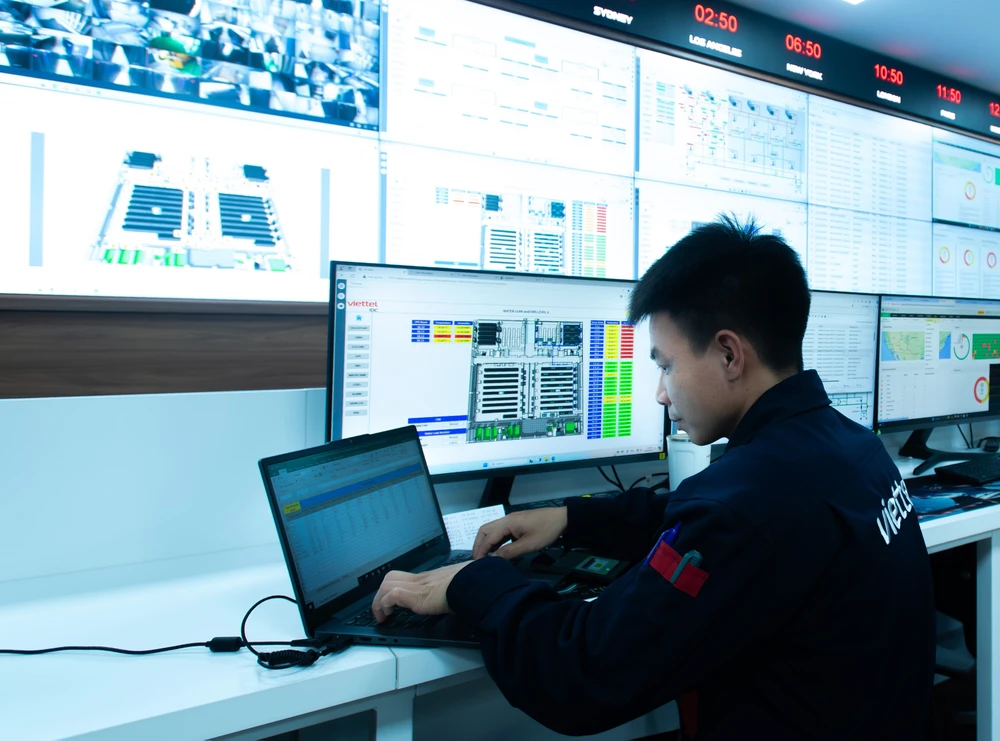
Viettel engineers on duty at the Data Center Monitoring System.
According to Mr. Vu The Binh, Secretary General of the Vietnam Internet Association, the commissioning of large-scale domestic data centers has accelerated the transformation process of Vietnamese agencies, organizations, and businesses, especially promoting digital transformation. These data centers are also anticipating the demand from abroad shifting to Vietnam, driven by the wave of foreign investment and the trend of global content providers moving content closer to Vietnamese internet users.
Mr. Nguyen Trung Chinh, Chairman of the Board and Executive Chairman of CMC Technology Group, shared: “The CMC Data Center (District 7, Ho Chi Minh City), with an investment of VND 1,500 billion, is the most modern and secure data center in Vietnam and Southeast Asia. The center also serves Ho Chi Minh City's development goal of becoming a high-quality, technologically advanced service city by 2030, leading in the development of the digital economy and digital society.”
A representative from Viettel stated that the data center project in Tan Phu Trung Industrial Park will serve as a data hub attracting foreign businesses to Vietnam, such as Microsoft, Google, and Amazon, and will provide broadband connectivity from Ho Chi Minh City to destinations worldwide. Vice Chairman of the Ho Chi Minh City People's Committee, Vo Van Hoan, assessed that Viettel's data center in Cu Chi District has the potential to become a crucial data hub, attracting global technology corporations and businesses to invest and operate in Vietnam. He expects it to be a driving force in Ho Chi Minh City's development of digital infrastructure, smart city construction, and digital government.
Decision No. 142/QD-TTg dated February 2, 2024, approving the National Data Strategy to 2030, signed by Deputy Prime Minister Tran Luu Quang, contains quite specific provisions on data infrastructure development. The strategy aims to ensure that by 2030, 100% of national data centers, regional data centers, and national-level centers for big data storage and high-performance computing across the country are successfully connected, forming a network for sharing computing and big data processing capabilities to serve the socio-economic and cultural development of the country.
BA TAN
Source: https://www.sggp.org.vn/xay-dung-cac-trung-tam-du-lieu-thuc-day-nhanh-qua-trinh-chuyen-doi-so-quoc-gia-post794205.html


![[Photo] Prime Minister Pham Minh Chinh presides over the conference announcing the establishment of the International Finance Centre in Vietnam.](/_next/image?url=https%3A%2F%2Fvphoto.vietnam.vn%2Fthumb%2F1200x675%2Fvietnam%2Fresource%2FIMAGE%2F2025%2F12%2F21%2F1766309817714_ndo_br_dsc-3400-jpg.webp&w=3840&q=75)

![[Photo] Prime Minister Pham Minh Chinh presides over a meeting on private sector economic development.](/_next/image?url=https%3A%2F%2Fvphoto.vietnam.vn%2Fthumb%2F1200x675%2Fvietnam%2Fresource%2FIMAGE%2F2025%2F12%2F20%2F1766237501876_thiet-ke-chua-co-ten-40-png.webp&w=3840&q=75)
















































































Comment (0)