|
| The ném tree provides income and stable employment for many people in Dan Dien commune. |
In the early days of 2026, we visited the Dan Dien area where the neem trees were being grown, more than a month after planting, and the neem trees had begun to turn green. Despite experiencing successive floods in October and early November 2025, according to the locals, the unfavorable weather did not significantly affect the neem cultivation.
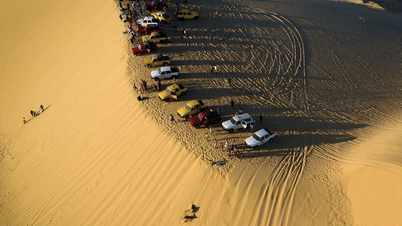
According to Mr. Doan Viet Loc, Director of Thanh Loi Agricultural Cooperative in Dan Dien commune, there are currently two main areas for growing ném (a type of plant) in the area: ném in sandy hills (commonly called ném rú) and ném in rice fields (ném đồng). This plant is easy to grow, has a short growth period, and its leaves can be harvested and sold on the market after only about 2.5 months.
Not only is it easy to grow, but the ném plant also yields superior economic returns compared to many other crops. Local calculations show that, on average, each sao (approximately 1000 square meters) of ném plants produces 6-8 quintals of ném leaves, bringing in an income of about 10-15 million VND per sao, 4-5 times higher than rice cultivation. Therefore, many households have boldly converted their cultivated land to ném cultivation.
Ms. Ho Thi Mong Diep, a long-time ginger farmer in Dan Dien, shared: “My family grows a few acres of ginger, and seeing the effectiveness, we recently rented another acre from the cooperative to expand the area. Although the initial cost of ginger seeds is a bit high, if we work diligently and combine it with intercropping other crops, it still ensures a stable income for the family.”


In many of the rice paddies currently used for growing ném (a type of vegetable), the people of Dan Dien also utilize vacant land to intercrop other crops such as chili peppers, beans, cabbage, and corn, helping to improve land use efficiency and generate year-round income. Mr. Nguyen Hoa, a ném farmer, said that this year, due to the prolonged heavy rains and floods, the planting season was later than usual, but the ném plants still grew well. Besides applying manure and organic fertilizers, the farmers mainly focused on weeding, incurring minimal maintenance costs. Intercropping not only increases income but also creates regular employment for rural workers.
Many locals affirm that ném (a type of leafy vegetable) is not only a staple crop but also a traditional crop deeply rooted in the lives of the people in the Dan Dien sandy region. Almost every family grows ném, some with at least one sao (approximately 1000 square meters), while others may have up to 3-4 sao. The price of ném leaves fluctuates depending on the time of year, sometimes ranging from 12,000 to 17,000 VND/kg, but can reach 30,000 VND/kg, and even 40,000 VND/kg at the beginning of the season.
The biggest concern for taro growers in Dan Dien today is the unstable market for their product. While the taro tubers have been registered under the brand "Tam Giang Taro," the taro leaves, the main product, still lack a brand and a sustainable distribution channel. Prices depend heavily on traders, causing anxiety for the farmers every harvest season.
"We hope for a more stable market. If there is a sustainable outlet and reasonable prices, people will be willing to expand the area planted with ném (a type of herb) to meet consumer demand," Mr. Doan Viet Loc emphasized.
According to statistics from the Dan Dien Commune People's Committee, the commune currently has approximately 31 hectares of land planted with ném (a type of medicinal herb), with nearly 600 households participating in production. Mr. Nguyen Ngoc Tien, Chairman of the Dan Dien Commune People's Committee, affirmed that ném cultivation has helped many households stabilize their lives and escape poverty. In the future, the locality will continue to promote and introduce Dan Dien ném products to more markets; at the same time, it will research expanding the planting area in a concentrated, large-scale manner.


To establish a foothold for Dan Dien's neem tree in the market, the locality needs to quickly develop and register a brand for the neem leaf product, linking it with traceability and enhancing its value. Along with this, it is necessary to strengthen the links between farmers, cooperatives, and businesses in the consumption of neem tree products, gradually forming a sustainable production and consumption chain. Applying technological advancements and mechanizing some stages of neem production is also an important solution to overcome the current shortage of rural labor.
Source: https://huengaynay.vn/kinh-te/xay-dung-thuong-hieu-cho-cay-nem-dan-dien-162032.html