

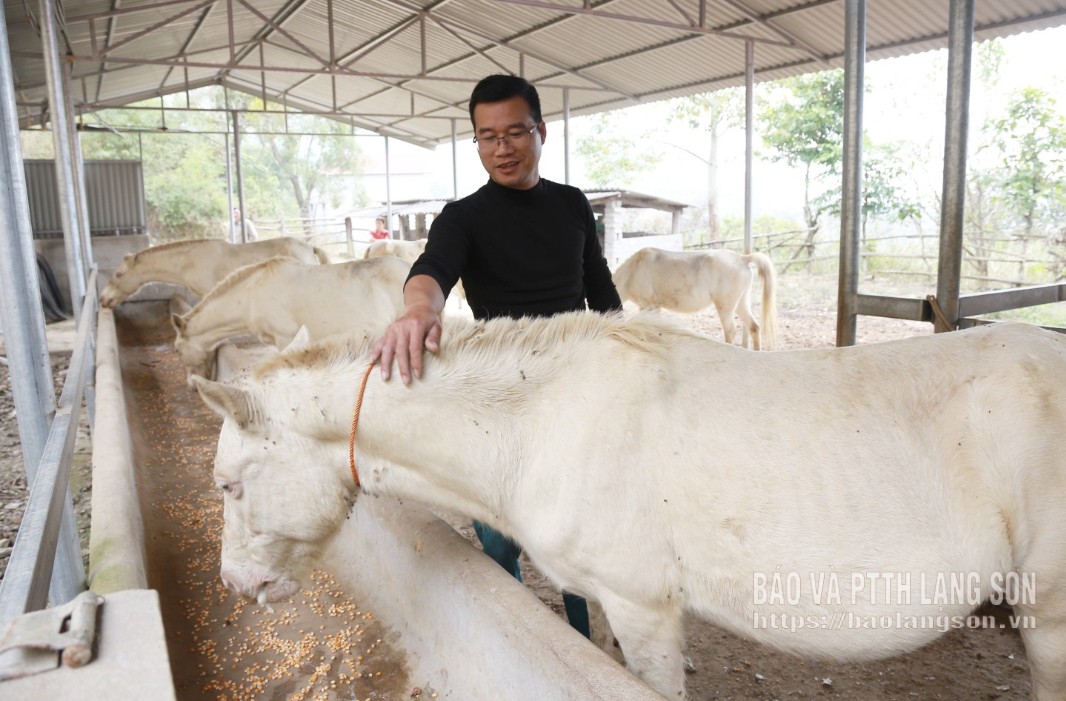
For a long time, the former Huu Kien commune, now Quan Son district, has been known as the land of white horses. Raising white horses has become the main economic model, helping the people here change their lives, with many families rising out of poverty and achieving a comfortable life. Thanks to the horses, the people have been able to build houses, buy household items, motorbikes, cars, and more.
Rising to the top thanks to a white horse.
Along the road from the Quan Son Commune People's Committee headquarters to Suoi Ma village, it's not difficult to spot herds of horses leisurely grazing by the roadside and on the hillsides. The white-haired horses with their characteristic brassy eyes (a hallmark of white horses) lift their heads to look at strangers before lowering them to eat grass and corn cobs, giving the impression that they are very tame!
Suoi Ma currently has 173 households and 768 inhabitants, divided into 6 small hamlets with rather impressive names: Ba Ngan, Keo Nang, Co Cam, Phai Linh, Dong Mo, and Na Thong. Here, almost every household raises white horses; some maintain 1-2 horses, while others have more than a dozen. About 5 years ago, white horses were valuable, with many mature horses fetching prices up to hundreds of millions of dong. In recent years, although prices have decreased, they still bring a considerable income (ranging from 50-60 million dong per horse) to the villagers.
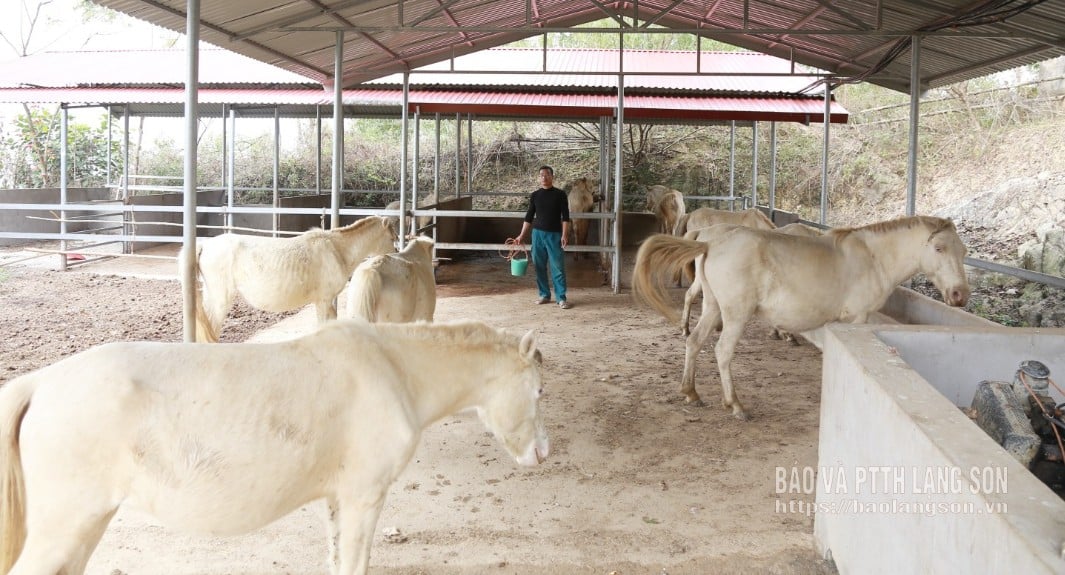
Raising white horses has helped many households escape poverty. Nguyen Van Hai, a resident of Ba Ngan hamlet, Suoi Ma village, said: "My family has been raising white horses for many years, maintaining a herd of over 10 horses annually, including one male for breeding. Female horses usually give birth once every 11 months, and foals can be sold at around 14 million VND per foal at 4 months old. Just selling foals brings my family over 100 million VND annually. Adult horses (about 2.5 years old) can fetch nearly 100 million VND per horse in some years. For many years, my family has built stables and implemented a semi-intensive farming system, combining scientific and technical methods with vaccinations and accumulated experience. As a result, our herd of horses remains healthy and thriving, providing us with a stable and steadily increasing income."
The raising of white horses in Suoi Ma has been maintained for generations. Ms. Nguyen Thi Thuyen, Party Secretary and Head of Suoi Ma village, said: "Previously, the scale of white horse breeding in the village was not large; in 1998, only about 20 households raised them. Gradually, recognizing the high economic efficiency, the scale of breeding has expanded. To date, 100% of households in the village raise white horses. Income from raising white horses has contributed to reducing the poverty rate and increasing the number of well-off and wealthy households in the village. By the end of 2025, the village will have 29 poor households and 8 near-poor households, a reduction of 9 poor households and 3 near-poor households compared to 2024."
Not only in Suoi Ma, but now the white horse herd is also developing in many other hamlets of Quan Son commune. Mr. Hoang Van Binh, from Cu Na hamlet, Quan Son commune, shared: "Previously, my family struggled to find a way to develop our economy, and our lives faced many difficulties. Recognizing the economic benefits of raising white horses from households in our hamlet and other hamlets in the commune, in 2018 my family invested in raising white horses. Starting with two breeding horses, the herd gradually developed, bringing in significant income and helping my family stabilize our lives."
The land of white horses has long been renowned, so the market for white horse breeding models is quite stable. Besides selling breeding stock and horse meat, white horse bone extract also brings significant income to the people of Quan Son commune. Customers are traders from many places and provinces.
Replicating the model
According to the experience of many white horse breeders in Quan Son, compared to traditional livestock such as pigs, chickens, buffaloes, and cows, white horses have many outstanding advantages. This breed is easy to raise, adapts well to local climatic conditions, especially grows quickly, has low care costs, and is less susceptible to disease.
Mr. Nguyen Hung Manh, Chairman of the People's Committee of Quan Son commune, said: "Along with the above advantages, the commune has a large area of hills and grasslands, making it very favorable for horse grazing. To raise white horses effectively, the commune has propagated and encouraged people to increase the herd size and apply scientific and technical methods to production; coordinated with specialized agencies to organize training and guide people on how to care for and prevent diseases in the horse herd. At the same time, we create conditions for the sustainable development of white horse breeding, encouraging people to diversify horse products and link them with product consumption."
Notably, over the years, the Quan Son commune government has implemented specific and practical policies to support people in replicating this model. Beyond organizing training courses on transferring scientific and technical knowledge, the commune has also coordinated with local households to access preferential loans for horse breeding; and implemented projects to support poor and near-poor households in livestock farming…
Specifically, starting in 2023, as part of the national target program for socio-economic development in ethnic minority and mountainous areas, the People's Committee of the commune has implemented a horse breeding project to support poor and near-poor households in the area. To date, the commune has implemented 6 projects (4 projects scheduled for 2025), with a total of 51 poor and near-poor households receiving support. The projects provide capital support to people ranging from 76% to 95% from the state budget, with people contributing in terms of barns, feed, and veterinary medicine.
Ms. Nong Lan Huong, residing in Cu Na village, Quan Son commune, one of the households supported by the project, said: "My family is a poor household, facing difficult living conditions and lacking capital for economic development, which has left us in a desperate situation. I am very happy that in mid-December 2025, thanks to the attention of the commune's People's Committee, I received capital support to buy a white horse to raise. I will take good care of it so that it can thrive and generate income, helping me gradually escape poverty."
According to statistics from the Quan Son Commune People's Committee, there are currently about 2,750 white horses in the commune. The advantage of generations of experience in horse breeding, coupled with the vast grassland terrain suitable for grazing, has created favorable conditions for the livestock population in general, and the white horse population in particular, to increase. In addition, for many years, the local people have applied scientific and technical advancements in horse care, resulting in healthier horses with fewer diseases, thus reducing risks and allowing for higher selling prices.
Furthermore, in recent years, many families have changed their practices, investing in building barns and adopting a semi-grazing system. On rainy or cold days, people usually keep their horses in barns to prevent them from getting sick. They also prepare and stockpile feed for the horses by growing corn, bananas, and elephant grass.
The development of horse farming, which generates high income, has helped stabilize the lives of local people and contributed to reducing the poverty rate in the area. According to the 2025 review data of the Quan Son Commune People's Committee, the multidimensional poverty and near-poverty rate in the commune is 17.29%, a decrease of nearly 3.1% compared to 2024; the households that escaped poverty mainly did so thanks to raising white horses.
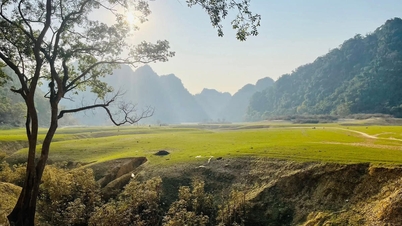
Leaving the land of white horses along the vast grasslands, the sight of pure white horses grazing peacefully on the green meadows stands out, while foals playfully trot around their mothers. Along the way, many mares belonging to local families are kept in enclosures, preparing for their birthing season. This picturesque and vibrant scene seems to herald a prosperous, peaceful, and abundant New Year of the Horse 2026 for all families here.
Source: https://baolangson.vn/xuan-ve-xu-so-bach-ma-5068790.html
![[Image] Close-up view of the 10-lane road connecting to Long Thanh Airport](https://vphoto.vietnam.vn/thumb/1200x675/vietnam/resource/IMAGE/2026/04/04/1775291871988_ndo_br_1-resize-5690-jpg.webp)

































































Comment (0)